A lot of parents land here after the same uneasy moment. A paystub comes in higher than usual because of overtime. A year-end bonus posts. A commission check hits. Then the question follows immediately: Will this change child support?
In North Carolina, that question matters because child support isn't based only on base salary. If your income rises and falls, or the other parent's does, the fight usually isn't about whether variable pay matters. It's about how the court should treat it, what proof the judge will trust, and whether a bonus or overtime pattern is likely to continue.
That uncertainty creates real stress. The parent receiving support may worry that income is being understated. The parent paying support may worry the court will lock in a number based on an unusually good year that won't repeat. Both concerns are legitimate.
Child support for overtime and bonuses nc cases often turn on evidence, not assumptions. The strongest position usually comes from organized records, a realistic explanation of the job, and a clear argument for either averaging the income or treating future bonuses separately. When that groundwork is done well, the court has something reliable to work with. When it isn't, judges are left sorting through incomplete pay records, competing narratives, and avoidable disputes.
How North Carolina Defines Income for Child Support
A parent may walk into court focused on base pay, only to learn that the judge is looking at the whole compensation picture. In North Carolina child support cases, that often includes overtime, bonuses, commissions, and other earnings that do not arrive in the same amount every pay period.
Under the North Carolina Child Support Guidelines, the court starts with gross income, not just salary or hourly wages. That broader definition catches many parents by surprise. They assume only guaranteed wages count because bonuses may be discretionary and overtime may rise and fall with staffing, season, or demand. Courts usually take a wider view and ask a practical question: what money has been coming in?
Gross income means more than salary
For child support purposes, gross income includes the parent’s real earnings pattern. The distinction is important because support is supposed to reflect each parent’s actual ability to contribute to the child’s needs.
That does not mean every extra dollar will be treated the same way in every case. It does mean a parent who regularly earns beyond base pay should expect the court to examine those amounts closely. Judges want a number grounded in reality, and payroll records usually matter more than either parent’s assumptions about what should count.
Practical rule: If overtime, commissions, or bonuses appear again and again in the pay history, expect them to become part of the child support analysis.
From a strategy standpoint, many cases are won or lost. If you want variable income included, show the pattern clearly with year-to-date paystubs, prior W-2s, and employer records that make the payments look routine rather than exceptional. If you want it excluded or limited, the evidence needs to show why the higher earnings were temporary, unusual, or already ending.
The guidelines use worksheets, but the income number drives the result
North Carolina child support is usually calculated under Worksheet A, Worksheet B, or Worksheet C, depending on the custody arrangement. The worksheet changes the math. The income figure often drives the fight.
A few common examples:
- Primary custody cases: The calculation relies heavily on each parent’s gross income.
- Joint custody cases: If the parents meet the overnight threshold for joint custody, parenting time affects the support amount more directly.
- Split custody cases: A different worksheet applies when each parent has primary custody of at least one child.
The worksheet can be chosen correctly and still produce a distorted result if the income proof is weak. I see that problem often in cases involving rotating overtime, performance bonuses, and commission-heavy jobs. One side submits a few recent stubs. The other side points to a better year or a worse year. The real work is tying the documents to a persuasive argument about what income is likely to continue.
Broad income definitions create practical court issues
North Carolina’s broad approach is not meant to punish a parent for working extra shifts or earning incentive pay. It reflects the income-shares model. Child support is meant to track the financial resources that would have supported the child if the parents were still running one household.
That is why a narrow presentation of income usually creates trouble. A nurse with consistent overtime, a utility worker with storm pay, or a salesperson with recurring commissions may have earning capacity that base wages alone do not show. On the other hand, a one-time retention bonus, a short-term surge in hours, or an unusual commission spike may call for a different argument.
The legal definition is only the starting point. The stronger position comes from proving how the income works in practice, on paper, and over time.
Distinguishing Between Recurring and Non-Recurring Income
The hardest fights usually aren't over the definition of income. They're over predictability. A judge may agree that bonuses or overtime count in principle, yet still need to decide whether a particular stream of income is recurring or non-recurring.
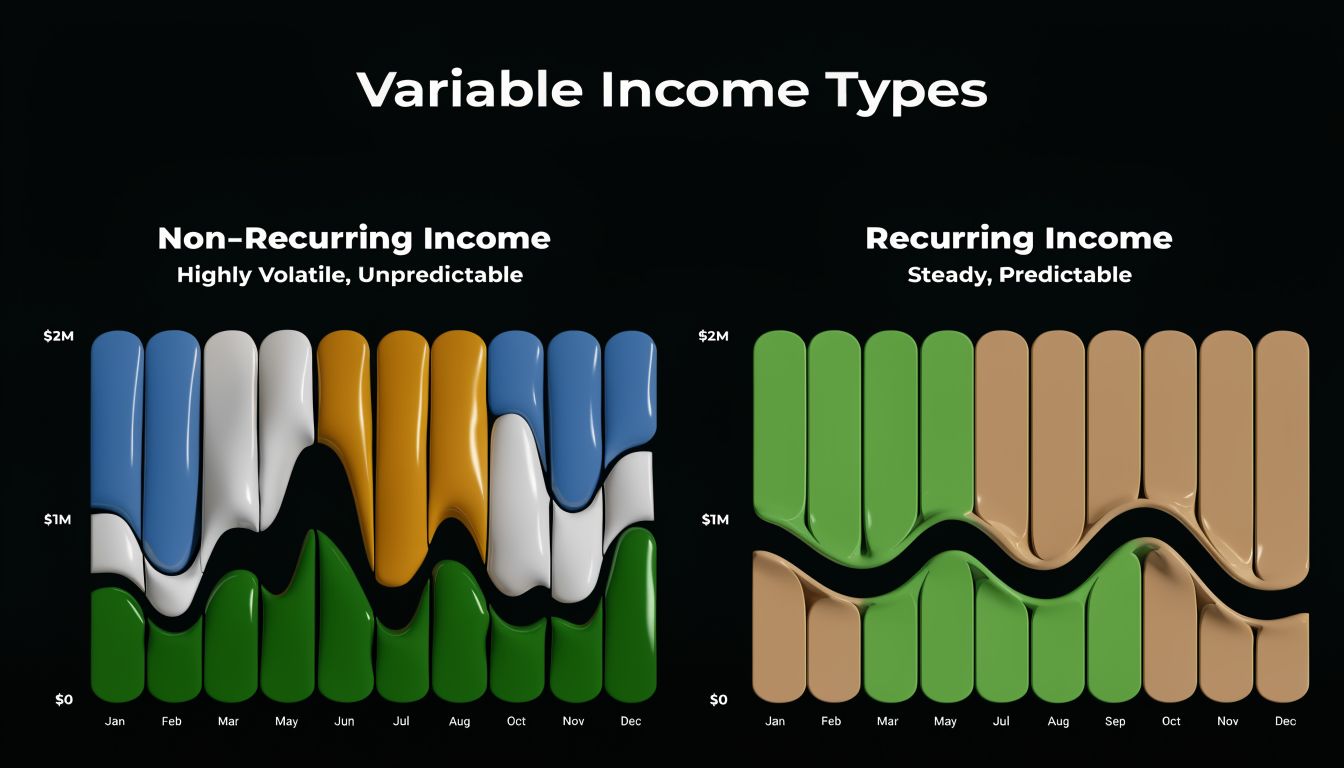
That distinction drives many child support for overtime and bonuses nc disputes. North Carolina courts must include bonuses that are likely to continue, and they have discretion with irregular income. Cases discussed by Your NC Attorney on recurring versus non-recurring bonuses, including Hinshaw v. Kuntz and Ludlam v. Miller highlight that the parent usually needs to prove the historical pattern, often with 12-36 months of paystubs or employer affidavits.
What recurring income usually looks like
Recurring income doesn't have to be guaranteed in writing. That's a common misunderstanding. Plenty of income is technically discretionary but still arrives often enough that a court may treat it as part of the parent's ordinary earning pattern.
Recurring income often includes:
- Regular overtime: The employer routinely offers it, and the employee has a history of taking it.
- Expected bonuses: The company pays them year after year, even if the amount changes.
- Consistent commissions: The employee works in a role where variable pay is a standard part of compensation.
What helps most here is pattern evidence. Judges tend to trust records more than labels. Calling a bonus "discretionary" doesn't end the analysis if the employee receives it repeatedly.
What non-recurring income usually looks like
Non-recurring income is harder to fold into a fixed monthly support amount because it may not happen again. That can include a one-time retention payment, an unusual sign-on bonus, a rare production incentive, or overtime tied to a temporary staffing shortage that has already ended.
The argument for exclusion is strongest when the parent can show that the payment was unusual in amount, timing, or purpose. A short explanation isn't enough by itself. The court usually wants documents that connect the payment to a one-time event.
Useful proof can include:
- Employer letters explaining that the payment wasn't expected to repeat
- Pay records across multiple years showing no similar payment history
- Job changes or policy changes ending the bonus or overtime opportunity
- Industry-specific context showing the payment arose from unusual conditions
Judges don't just ask whether income was received. They ask whether it's part of a dependable pattern the child can reasonably benefit from going forward.
What clients often get wrong
One frequent mistake is assuming that "not guaranteed" means "not countable." It doesn't. Another is assuming that one unusually high year automatically controls the future. It shouldn't, if the full evidence shows that year was abnormal.
How legal arguments are framed is important. The same pay history can support different arguments depending on the surrounding facts. A parent seeking inclusion may emphasize consistency over time. A parent seeking limitation may focus on employer policy, market changes, or a temporary spike that no longer exists.
A short video can help if you're trying to understand how these disputes are argued in real cases.
The evidence burden is real
In court, broad claims usually fail. Saying "my overtime dried up" or "her bonus always comes every year" won't carry much weight without records.
The strongest presentations usually answer three questions:
| Question | Why it matters |
|---|---|
| How often was the income paid? | Frequency helps the court decide whether it is recurring. |
| How stable were the amounts? | Large swings may support a different method of calculation. |
| Why did the income change? | A documented business reason is more persuasive than a guess. |
When the proof is thin, the result becomes less predictable. That's why the distinction between recurring and non-recurring income isn't just a legal label. It's a factual case that has to be built.
Two Methods for Calculating Support with Variable Pay
A common courtroom problem looks like this. One parent says, "My overtime is never the same, so it should not be counted that way." The other says, "It shows up year after year, so the child should benefit from it." Both may be partly right. The core question is which calculation method fits the pay history the judge is looking at.
In North Carolina, courts usually handle variable pay in one of two ways. They may average the income over a reasonable period, or they may set support based on regular income and require an added percentage from future bonuses, commissions, or other variable compensation as it is paid.
The averaging method
Averaging usually makes sense when the extra income rises and falls, but still shows a dependable pattern. The court looks at a defined period, totals the overtime, bonuses, or commissions received during that period, and converts that amount into a monthly figure for the worksheet.
The math itself is simple. If a parent earned $750 in overtime over three months, the court can treat that as $250 per month and add it to base gross income for support purposes. The harder part is choosing the right time period. A parent seeking inclusion will usually push for a longer history that shows consistency. A parent seeking exclusion or a lower figure will often argue for a shorter and more current period if recent records show the extra pay has dropped off.
That is where case strategy matters. Averaging can produce a fair result, but only if the period being averaged matches present reality.
When averaging usually works well
Averaging is often the stronger argument when:
- The income shows up regularly: Overtime or bonuses are not guaranteed, but they appear often enough to be part of the parent's actual earning pattern.
- The court wants a stable monthly number: A fixed figure is easier to collect, easier to budget around, and easier to enforce.
- The records cover enough time: Year to date paystubs, prior W-2s, and payroll summaries usually make the average more persuasive.
The downside is practical. A backward-looking average can overstate income after staffing cuts, reduced hours, or a compensation change. It can also understate income if the parent recently moved into a much higher-paying role.
The percentage method
The second approach is often better when the variable income is real, but too irregular to fold into a steady monthly number with confidence. In those cases, the court can calculate support on regular income first, then order the paying parent to pay a set percentage of future bonus or similar income if and when it is received.
For example, if the worksheet shows that 20% of income is effectively going to support, a $5,000 bonus could lead to an added $1,000 payment under the same ratio, as described in Rice Family Law's discussion of percentage-based treatment of bonus income. In practice, this approach can also reduce conflict in bonus-heavy compensation cases because it ties support to money received instead of fighting over projections.
Key takeaway: The percentage method often works best when the parent has real upside, but the timing and amount are too unpredictable for a fair monthly average.
Why parents sometimes prefer this method
This method addresses two competing concerns at the same time.
For the parent paying support, it avoids locking in a monthly obligation based on compensation that may never repeat. For the parent receiving support, it prevents variable pay from being treated as off-limits because it is not guaranteed on a fixed schedule.
It also creates specific proof issues. If you want a percentage provision, ask the court for clear reporting terms. The order should say what counts as bonus income, when notice must be given, what documents must be produced, and when the added support is due. Without that language, enforcement becomes harder than it should be.
Choosing the stronger argument
The better method depends on the evidence and the compensation structure, not on which side prefers the simpler result.
| Method | Stronger fit | Main risk |
|---|---|---|
| Averaging | Income has a stable pattern over time | It may lag behind current reality |
| Percentage of future income | Income is real but highly unpredictable | It requires clear reporting and follow-through |
If you want the court to average income, prove repetition and reliability. If you want a percentage-of-future-income provision, prove unpredictability and give the judge a clean way to enforce it. For parents who want more background on the worksheet itself, this guide on how child support is calculated in NC provides helpful context.
What tends not to work
Extreme positions usually weaken a case. Courts are less persuaded by blanket arguments that all overtime must always count, or that none of it should count because it was not guaranteed.
A better presentation is narrower and fact-driven. Show the pay pattern. Show what changed, if anything, and when it changed. Then ask for the method that fits the actual compensation history and gives the court an order it can administer without constant return trips to court.
Gathering Evidence to Prove Your Income in Court
Most child support disputes involving overtime and bonuses are won or lost on documentation. If the records are organized, the argument becomes clearer. If the records are incomplete, even a reasonable position can look weak.
North Carolina uses Worksheets A, B, or C, and accurate gross income data is central to all of them. Documentation is especially important in joint custody cases using Worksheet B, where 123+ nights per parent affect the support calculation, as explained in Smith Debnam's overview of the North Carolina child support worksheets and income proof requirements. The same verified guidance emphasizes that overtime and bonus figures directly affect the support burden.

The documents that usually matter most
Start with payroll records. In variable-income cases, recent paystubs can be more revealing than a single salary figure because they show year-to-date earnings, overtime codes, bonus line items, and deductions tied to compensation.
A strong evidence file often includes:
- Paystubs with year-to-date totals: These help the court see whether overtime or bonus income is isolated or part of a pattern.
- W-2s and 1099s from prior years: They provide a broader earnings history and can confirm whether variable income repeats.
- Bonus and commission statements: These can show formula-based pay versus discretionary awards.
- Employment contracts or compensation plans: Helpful when the issue is whether future bonuses are likely.
- Employer correspondence: A letter or affidavit can clarify whether overtime is mandatory, optional, seasonal, or no longer available.
Why employer explanation can change a case
An employer's letter can be far more useful than people expect. If the company confirms that a bonus program ended, that staffing cuts reduced overtime, or that a payment was tied to a one-time event, the court has something concrete to evaluate.
On the other hand, if the employer confirms the parent remains eligible for incentive compensation under the same structure as prior years, that tends to support inclusion.
Bring records that explain the story, not just records that show a number.
Organizing proof the way a judge can use it
The court doesn't want a pile of unsorted payroll papers. It wants a clean picture. The more complicated the compensation, the more important presentation becomes.
A practical approach is to organize evidence in this order:
Current income snapshot
Recent paystubs and the latest compensation information.Historical pattern
Prior tax documents and payroll history showing whether the income repeats.Reason for fluctuation
Employer proof, job change documents, or policy changes that explain increases or decreases.Proposed treatment
A clear argument for averaging or percentage treatment based on the evidence.
That last step is where many people fall short. They bring records but no framework. Judges still need someone to connect the documents to a workable support calculation.
Common Disputes Over Overtime and Bonuses
Variable-income cases rarely come to court in a neat package. They come with accusations, half-complete financial records, and strong emotions. The legal issue may sound technical, but the dispute is usually personal. One parent thinks the other is overstating instability. The other thinks a temporary high-income period is being treated like a permanent reality.
Mandatory overtime versus voluntary overtime
This dispute comes up often. A parent paying support may argue that overtime shouldn't count because it isn't part of normal wages. The other parent may respond that the overtime appears on paystub after paystub and has become part of the family's actual financial life.
Courts often look closely at whether the overtime is built into the job or depends on a parent's personal choice. That doesn't create a simple yes-or-no rule, but it does shape the argument.
If you're trying to include overtime, stronger proof may include:
- A long payroll history showing regular overtime hours
- Employer scheduling records showing overtime demand is common
- Past support records showing the parent has historically relied on that extra income
If you're trying to limit overtime, the focus changes. You may need proof that the overtime came from an unusual staffing shortage, emergency coverage, or a temporary push that has ended.
Performance bonuses that aren't guaranteed
A bonus can be discretionary on paper and still look recurring in practice. That's why these cases turn on pattern evidence and context, not just labels from HR documents.
The conflict usually sounds like this:
| Position | Common argument |
|---|---|
| Seeking inclusion | The bonus comes often enough that it should count. |
| Seeking limitation | The bonus depends on uncertain results and may not recur. |
The stronger side is usually the one with records across enough time to show whether the payment is part of a pattern or an outlier.
Claims that a parent reduced income on purpose
Another recurring problem is strategic income reduction. A parent may cut back on overtime, turn down commission opportunities, or move into lower-paying work right before or during litigation. Sometimes that change is legitimate. Sometimes it isn't.
When the issue becomes earning capacity rather than actual earnings, courts may consider imputed income arguments. If that concern is part of your case, this article on imputed income and child support in North Carolina explains how the issue can develop.
What helps in these disputes is evidence of timing and motive. Did the income drop because the employer changed schedules, or because the parent chose to stop taking work? Did the bonus program end, or did the employee merely miss a target after years of receiving incentive pay?
Modification fights in high-variability jobs
Recent disputes have become sharper in high-income and commission-heavy sectors. According to Sodoma Law's discussion of the 2023 North Carolina child support guideline update, the income cap increased to $40,000 per month, and courts have been requiring at least 12 months of income proof to establish a pattern for modification in many variable-pay disputes.
That matters in finance, tech, sales, and similar work where compensation can swing materially from one year to the next. It also matters for parents whose work changed after remote-work shifts and changes in overtime availability.
The more variable the job, the more important it is to prove the reason for the variability.
Hidden commissions and incomplete disclosure
Some cases aren't really about classification. They're about missing income. A commission-based employee may report a modest salary while leaving out incentive compensation, deferred payouts, or irregular draws.
When that happens, the strategy becomes document-driven. Bank deposits, payroll summaries, compensation plans, and year-end tax forms often tell a more complete story than a single monthly stub.
The court can't calculate support fairly if one side is working from partial information. That's why broad discovery, careful review, and skepticism about unexplained gaps often matter more than dramatic courtroom arguments.
Modifying and Enforcing Child Support with Variable Income
A child support order isn't frozen forever. If income changes in a meaningful way, either parent may be able to seek modification. In variable-income cases, that issue comes up often because bonuses disappear, overtime dries up, commissions spike, or compensation structures change.
When modification may be appropriate
In North Carolina, modification generally requires a substantial change in circumstances. In the overtime and bonus context, that may mean the income pattern used to set support no longer reflects reality.
Examples include:
- A job change that eliminates bonus eligibility
- A promotion that creates a new incentive structure
- A sustained reduction in overtime supported by payroll records
- A new compensation plan that shifts income from salary to commissions, or the reverse
The key is proof. Courts usually want more than a few isolated pay periods. They want enough documentation to show the change is real and not just temporary noise.
How to approach a modification request
A practical modification file usually includes current paystubs, prior income records used in the existing order, and documents explaining what changed. If the issue involves recurring versus non-recurring income, employer confirmation can be especially helpful.
Parents considering this step can learn more about the process in this guide to child support modification in NC.
It also helps to compare the existing order's assumptions against current compensation. If support was based on averaged overtime from a period that no longer reflects the job, the court needs clear evidence of that mismatch.
Enforcing bonus-based support terms
Enforcement becomes harder when an order requires payment tied to future bonus or commission income. The problem usually isn't legal authority. It's tracking and compliance.
A parent may receive a bonus and fail to report it. Or the order may be too vague about timing, documentation, and payment procedure. That's why careful drafting matters on the front end.
Strong orders often address:
- When bonus income must be disclosed
- What documents must be provided
- How quickly the additional support must be paid
- Whether wage withholding is available
If a parent doesn't comply, enforcement tools may include a motion for contempt or other court remedies. But enforcement is easier when the order is specific enough to leave little room for dispute.
Frequently Asked Questions About NC Child Support and Variable Pay
| Question | Answer |
|---|---|
| Does overtime always count in North Carolina child support? | Not automatically in the sense that every extra hour creates the same result, but overtime is part of gross income under the guidelines. The real dispute is usually whether it reflects a recurring earning pattern and how the court should treat it. |
| What if my bonus is discretionary and not guaranteed? | A discretionary label doesn't end the issue. Courts often look at whether the bonus is likely to continue based on your history, employer records, and the structure of your compensation. |
| Can the court use a percentage of future bonuses instead of averaging them? | Yes. In some cases, that is the cleaner approach, especially when future bonus income is real but unpredictable. It can prevent a monthly support amount from being distorted by a one-time payment or an unusually strong year. |
| How much proof do I need if I'm asking to change support because overtime dropped? | You need enough documentation to show a reliable change, not just a temporary dip. In practice, organized pay records over time tend to carry more weight than broad statements about fewer hours being available. |
| What if the other parent isn't reporting commissions or bonus income? | That usually requires a closer review of payroll records, tax documents, compensation plans, and other financial evidence. If disclosure is incomplete, formal discovery may be needed to build an accurate income picture for the court. |
A few practical points are worth adding.
Does shared custody eliminate support if both parents work?
No. Shared custody affects the worksheet and may change the amount, but it doesn't mean support disappears. If one parent earns substantially more, support may still be owed.
Should I wait to file until I have every document?
Usually, no. But you should gather as much reliable information as possible before the hearing. A good strategy often starts with the core records and then fills gaps through formal requests, employer documentation, or updated payroll evidence.
If your income is variable, the most persuasive case is usually the one that shows the full pattern instead of cherry-picking the best or worst month.
Protect Your Financial Future and Your Child’s Well-Being
A parent works steady overtime for six months, then the shifts disappear. Another receives a year-end bonus that may never come again. Those facts can change support in a real way, but only if they are presented clearly and backed by the right records.
Variable income cases are usually won or lost on preparation. The court needs a reliable income pattern, not a rough estimate or a single paycheck pulled out of context. If you want overtime, commissions, or bonuses included, the goal is to show they are consistent enough to count. If you want them excluded or limited, the goal is to prove they were unusual, temporary, or too uncertain to support a fixed monthly number.
That usually means acting early. Gather pay stubs, tax records, year-end compensation documents, employer policies, and any evidence showing whether extra pay is expected or fading. Then build the legal argument around the facts instead of hoping the judge will fill in the gaps.
If you're dealing with child support for overtime and bonuses nc issues, legal advice early in the process can help you avoid preventable mistakes and present a stronger case.
If you're a North Carolina parent dealing with overtime, bonuses, commissions, or a support order that no longer fits your real income, Law Office of Bryan Fagan can help you assess the facts, organize the financial proof, and pursue a practical strategy suited to your case. Schedule a consultation to discuss your child support concerns and your options under North Carolina law.