
If you're searching for child support for high income earners nc, you're probably already realizing something unsettling. The online calculators that seem useful in most cases stop giving clear answers once family income reaches a certain level. What should be a numbers exercise turns into a dispute about lifestyle, proof, credibility, and judgment.
That shift catches many parents off guard. A physician, business owner, executive, or other high earner may assume child support will track income upward. The other parent may assume the court will automatically preserve every part of the child's prior lifestyle. Under North Carolina law, neither assumption is safe.
In higher-income cases, outcomes often turn less on broad arguments and more on whether a parent can prove the child's actual needs, the family's prior standard of living, and each parent's real financial picture. That's where strategy matters.
The Two Worlds of North Carolina Child Support
A parent walks into my office expecting a calculator problem. The family earns well into six figures, the child has always lived comfortably, and the question sounds simple. What should support be? In North Carolina, the answer depends first on which system your case falls into.
North Carolina child support operates in two different worlds. In one, the guidelines and worksheets drive the result. In the other, once income is high enough, the case turns into a proof-based dispute about the child's needs, the standard of living the child experienced, and the reliability of each parent's financial evidence.

For families still within the guideline system, the process is more predictable. Courts use worksheets tied to income, custody, and certain child-related costs. If you want a basic reference point for how that system works, North Carolina's child support guidelines overview is a useful starting place.
Above the cap, the strategic posture changes. The worksheet stops controlling the outcome, and the quality of your evidence starts carrying more weight than your assumptions. High-income cases are not merely larger versions of ordinary child support disputes. They are discretionary cases, and discretion favors the parent who arrives prepared.
What that means in practice
Below the cap, counsel often spends time checking inputs and correcting numbers.
Above the cap, the better question is, "What can you prove with records a judge can trust?"
That shift affects everything. A parent seeking higher support needs more than a broad statement that the child is used to a certain lifestyle. A parent resisting an inflated request needs more than saying the other side is overspending. The court will want specifics. School costs. Activities. Travel tied to the child's actual history. Housing details. Recurring expenses. Bank records. Payment histories. Credible testimony that connects the numbers to the child, not the parents' conflict.
Practical rule: Once you're above the guideline cap, organized evidence usually carries the case.
A parent who shows up with clean account statements, tuition records, extracurricular invoices, and a realistic child-focused budget stands in a much stronger position than a parent who relies on rough estimates or indignation. In these cases, documentation is strategy.
Understanding the NC Child Support Guideline Cap
A parent can walk into my office with the same question in two very different cases: "What will child support look like?" If the family's income falls within the guideline range, I can usually frame the answer around worksheets, inputs, and likely outcomes. Once income rises above the cap, that conversation changes fast. The case stops being mainly about math and becomes a proof problem.
North Carolina's child support system uses guidelines for many cases because a formula can produce a presumptive amount from the parents' incomes, childcare costs, health insurance, and custody arrangement. If you need a grounding in how that formula works in ordinary cases, this overview of North Carolina child support guidelines is a useful reference.
Where the guidelines stop
The guideline cap marks the point where the worksheet no longer controls the result. Under the current guidelines, that threshold is a combined gross income of $40,000 per month. Above that level, the court does not merely plug numbers into a chart and issue an order. The judge must decide support based on the facts of that family and the evidence the parties present under N.C. Gen. Stat. § 50-13.4(c).
That change matters more than many parents expect.
Below the cap, lawyers spend a great deal of time checking whether the income figures, overnights, insurance premiums, and work-related childcare expenses are entered correctly. Above the cap, those numbers still matter, but they are only part of the case. The primary dispute is usually over how to prove the child's actual needs, what standard of living the child experienced during the relationship, and whether a proposed budget reflects the child rather than a parent's preferences.
What the cap changes in real life
The cap separates two very different kinds of child support disputes.
| Below the cap | Above the cap |
|---|---|
| The worksheet usually drives the number | The judge has broad discretion |
| Errors often involve inputs and calculations | Disputes often center on proof, credibility, and documentation |
| The presumptive amount carries significant weight | A proposed amount rises or falls on the quality of the evidence |
| The case is more predictable | The case is more strategic and fact-specific |
This is why high-income child support cases can become expensive to mishandle. A parent asking for support may assume the court will fill in the gaps because the other parent earns a great deal. Courts do not work that way. A parent paying support may assume the court will reject private school, club sports, travel, tutoring, or vacation expenses as excessive. Courts do not work that way either if those expenses were part of the child's established life and are supported by records.
The points judges usually care about first
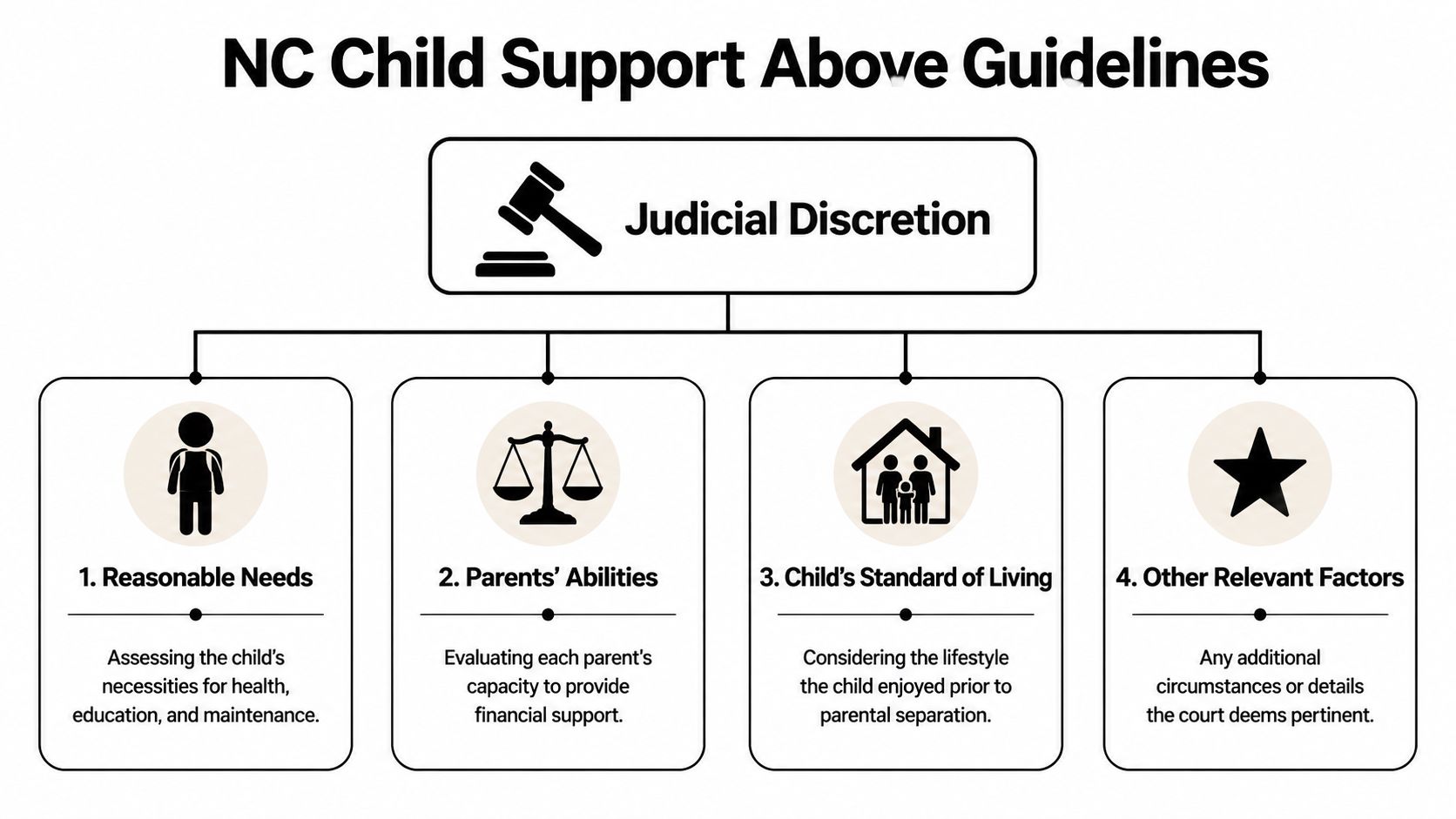
Even without a controlling worksheet, the analysis is not random. Judges usually focus on three practical questions:
| Pillar | What it means in a high-income case |
|---|---|
| Reasonable needs | What the child actually requires for daily living, education, healthcare, activities, and development |
| Accustomed lifestyle | What the child regularly experienced before separation, not what either parent now wishes had happened |
| Ability to pay | What each parent can contribute based on earnings, assets, and the full financial picture |
In practice, the strongest cases are built from records, not assumptions. School invoices, tuition contracts, therapy bills, coaching fees, camp registrations, travel receipts, account statements, and payment histories carry far more weight than broad claims about how the family lived.
That is the strategic shift created by the cap. Once you are above it, the parent with the better paper trail usually has the stronger position.
How NC Courts Determine Support Above the Guidelines
Once a family moves above the guideline threshold, North Carolina courts turn to an individualized analysis under N.C. Gen. Stat. § 50-13.4(c). That means the court looks at the child's reasonable needs, the family's accustomed standard of living, each parent's estate and earnings, and other case-specific facts. It also means the case becomes evidence-driven rather than formula-driven, as summarized in this explanation of North Carolina's updated child support approach.
A common high-income scenario
Take a family in Wake County with two children. Before separation, the children attended private school, traveled for club athletics, worked with a math tutor, and regularly took family trips during school breaks. One parent is a surgeon with variable compensation. The other parent has lower earned income but handled much of the scheduling, school communication, and activity management.
A judge won't ask whether those expenses sound expensive. The judge will ask whether they were real, consistent, and connected to the children's established lifestyle.
That means the proof matters:
- Private school may require enrollment records, tuition invoices, payment histories, and evidence the child was attending before separation.
- Travel athletics may require registration materials, team invoices, hotel charges, transportation records, and a showing that the child was actively participating.
- Tutoring or therapy may require invoices, provider statements, and a clear tie to the child's educational or health needs.
- Household costs may require a sensible allocation showing how housing, utilities, food, and transportation support the child's daily life.
What judges usually find persuasive
Judges tend to respond well to records that tell a coherent story. A stack of unsorted statements is less effective than organized exhibits tied to a clear budget.
The strongest presentations often include:
- A financial affidavit that matches the documents
- Child-specific expense summaries
- Historical spending records that show pattern, not just recent spending
- Income documents that explain base pay and variable compensation
- A witness who can explain the numbers without exaggeration
A parent doesn't help a case by inflating every line item. If the request looks padded, the entire budget loses credibility.
Courts often care as much about the reliability of the presentation as they do about the dollar category itself.
What doesn't work
Several arguments regularly fall flat in these cases.
| Weak approach | Why it creates problems |
|---|---|
| "We were wealthy, so everything should continue" | Courts still require child-focused proof |
| "The other parent earns plenty, so support should be very high" | Income alone doesn't set the amount |
| "These are rough estimates" | Estimates without backup invite skepticism |
| "This expense benefits the household, so count all of it" | Courts want to know how the expense benefits the child |
A high income does not automatically justify an inflated support award. North Carolina law still requires a relationship between the requested support and the child's reasonable needs within the family's lifestyle.
The real battleground
In many above-guidelines cases, the dispute isn't whether a child should be supported well. Both sides usually agree on that. The main fight is over how to define the child's reasonable needs without turning child support into disguised spousal support or a punitive transfer.
That is why careful financial framing matters. A concise, documented, child-centered presentation is usually more effective than a dramatic one.
Proving Your Child's Reasonable Needs and Lifestyle
High-income child support cases are won or lost in this specific area.
North Carolina courts may consider a child's needs broadly in above-guidelines cases, but they still expect proof. Courts scrutinize claimed expenses such as private school, elite extracurriculars, and travel, and when a parent can't connect those items to the child through receipts, account histories, or similar records, the court may reject them under § 50-13.4(c), as noted in this discussion of high-income child support proof issues in North Carolina.

What counts as a reasonable need
In a high-income family, "reasonable needs" usually goes well beyond groceries and rent. The question isn't whether an item is basic. The question is whether it is reasonable for this child, in this family, based on the child's actual history and current circumstances.
Examples that often appear in these cases include:
- Education costs such as private school, tutoring, educational testing, and school technology
- Activity expenses such as club sports, music lessons, coaching, dance, camps, and competition travel
- Health-related items including therapy, specialized treatment, and recurring out-of-pocket care
- Lifestyle-related costs such as family travel tied to the child's established routine
That doesn't mean every claimed expense will be allowed. It means the court may consider them if they're real, consistent, and tied to the child.
The documents that usually matter most
Start gathering records early. Waiting until a hearing date is close usually creates gaps, and gaps create doubt.
A useful document set often includes:
- School records and invoices
- Activity registration confirmations and fee statements
- Bank and credit card statements showing repeated payments
- Receipts for uniforms, equipment, and travel
- Provider invoices for tutoring, therapy, or childcare
- Calendars, emails, and schedules showing the child participated
The goal isn't to overwhelm the court. The goal is to prove pattern and legitimacy.
Evidence point: If you can't show that an expense was part of the child's life before separation, expect pushback.
A practical example
Suppose a parent claims the child should continue private school and year-round competitive tennis. Those requests can be persuasive if the records show long-term enrollment, regular tuition payments, tournament fees, lessons, and a schedule reflecting genuine participation.
The same request becomes weaker if the child was only recently enrolled, the costs are estimated rather than documented, or the expense appears to be more about one parent's preferences than the child's established routine.
That distinction is why these cases aren't won by labels. Saying "private school" or "travel sports" doesn't carry the day. The records do.
Handling bonuses, equity, and non-salary compensation
High-income cases often involve compensation that doesn't show up as a flat paycheck. That may include bonuses, restricted stock, deferred compensation, partnership draws, or business income. Courts look closely at these issues because a child's support shouldn't depend on an artificially narrow definition of income.
If one parent receives large annual bonuses, for example, the court may need a fuller earnings picture than a single pay stub provides. If a business owner pays personal expenses through a company account, the court may examine whether reported income understates actual resources. If a parent appears to be earning less by choice, the court may consider whether income should be imputed, meaning the court assigns earning capacity based on the facts rather than accepting the reduced number at face value.
A short video explanation can help frame how these disputes often unfold in practice.
Build the case around the child, not the conflict
The most effective budgets read like a financial picture of the child's life. The weakest ones read like a dispute between adults.
If you're seeking support, show why each item benefits the child. If you're defending against an inflated claim, challenge expenses that are vague, duplicated, unsupported, or not specifically child-centered. That approach is far more effective than arguing that high earners should pay less because the total looks large.
Navigating Complex Income for High Earners
A parent may walk into my office with a base salary that looks straightforward, then hand me bonus schedules, stock vesting statements, K-1s, and business account records. In an above-guidelines case, that is often the moment the actual fight starts.
Once income rises past the guideline cap, child support stops feeling formulaic. The case becomes a proof problem. The court still needs a reliable income picture, but the larger strategic question is how that income connects to the child's actual life, including the standard of living the child would have experienced if the parents had remained together.

Common income issues in high-earner cases
High earners are often paid in ways that do not fit neatly on one pay stub. A surgeon may receive quarterly productivity bonuses. A technology executive may have restricted stock that vests over time. A business owner may report one number for tax purposes while also receiving personal benefits through the company. A salesperson may have dramatic swings from one year to the next.
Those facts do not prevent a fair support order. They do require a more disciplined presentation of the numbers.
Useful records often include:
- Year-to-date pay records showing salary, bonuses, and other incentive compensation
- Several years of tax returns to show patterns rather than one unusually high or low year
- Equity grant documents and vesting schedules
- Business profit and loss statements, general ledgers, and account records when a parent is self-employed
- Employer correspondence or plan documents that explain how compensation is earned and paid
For self-employed parents, the analysis often gets harder because taxable income and actual cash flow are not always the same. Cases involving child support issues for self-employed parents in North Carolina often turn on whether deductions are legitimate, whether earnings are being retained in the business for a real business reason, and whether the company is paying personal expenses.
Settlement versus litigation
Settlement can work well in high-income cases if both sides have reliable information. A carefully drafted agreement can address irregular compensation with more precision than a generic order. For example, parents may set a base monthly amount, then add a percentage approach for annual bonuses or other variable income. They may also assign direct payment responsibility for specific child-related expenses.
That said, settlement is only as good as the disclosure behind it.
If one parent is understating income, delaying document production, or mixing personal and business spending, litigation may be the better path. Court gives you tools that private negotiation does not. Subpoenas, depositions, forensic review of financial records, and sworn testimony can expose a compensation structure that looked opaque during informal talks.
Here is the practical trade-off:
| Path | Main advantage | Main risk |
|---|---|---|
| Negotiated settlement | Flexibility and privacy | Incomplete information can produce an unfair result |
| Litigation | Better tools to prove disputed income and expenses | More cost, more delay, and less control over the final decision |
If your compensation is complicated, prepare your evidence as if a judge will read every page.
That approach improves your position in either setting. In mediation, organized records and a credible explanation of how income is earned make it harder for the other side to inflate or minimize the numbers. In court, the same preparation helps the judge move from suspicion to findings supported by evidence.
Why preparation changes negotiating power
In high-income child support cases, preparation is not just about showing what a parent earns. It is about showing what can be counted, what is recurring, what is speculative, and what actually affects the child's needs and lifestyle.
I often see the same mistake from both sides. One parent brings a stack of financial documents with no explanation. The other brings a broad lifestyle claim with little backup. Neither approach is as persuasive as a clean timeline of compensation, a child-focused expense summary, and records that tie claimed costs to the child's real life.
One option North Carolina parents may consider for family law disputes involving support and financial issues is working with Law Office of Bryan Fagan, which handles child support and related domestic matters in this state.
Strategies for Negotiation and Litigation
Once you understand the legal standard and the financial issues, the next question is tactical. Should you push toward settlement, or should you prepare for a hearing?
The answer depends on the quality of the information available, the level of trust between the parties, and whether the disputed issues are negotiable. In some cases, mediation can resolve most of the conflict. In others, one side's incomplete disclosure makes litigation unavoidable.
What strong preparation looks like
Before mediation or trial, gather and organize the financial story. That usually means more than handing over tax returns and hoping for the best.
A strong preparation file often includes:
- A complete financial affidavit
- A child-focused budget with backup
- Compensation records that explain income variations
- A separate set of exhibits for school, activities, health care, and recurring expenses
- A concise theory of the case
Your theory of the case matters. The judge or mediator should understand your position in plain English. For example: the requested support reflects the child's established life and documented needs. Or: the proposed budget inflates household spending and overstates what benefits the child.
Discovery is not just paperwork
Formal discovery can be critical in child support for high income earners nc cases. It allows a party to request documents, written answers, and other evidence relevant to income, spending, and assets.
Discovery is especially useful when:
- Compensation is layered through salary, bonus, equity, and deferred pay
- A business owner controls records
- Household spending doesn't match reported income
- One parent claims a dramatic drop in earnings
If the broader case also involves significant property division issues, the strategic concerns often overlap with high net worth divorce matters in North Carolina, especially where business interests, executive compensation, and asset tracing are involved.
The parent who is most organized often looks most credible. In family court, credibility has real value.
Mediation versus trial
Mediation works best when both sides have enough reliable information to evaluate risk. A carefully drafted agreement can deal with practical issues that court orders sometimes handle less elegantly, such as direct payment of tuition, allocation of camp or activity costs, and procedures for exchanging future income information.
Trial may be necessary when the case turns on sharply disputed facts. If one parent alleges hidden income, challenges a claimed lifestyle, or disputes whether certain expenses are child-related, a judge may need to make findings after hearing testimony and reviewing records.
A few practical points help either route:
- Don't overstate. Inflated claims are easy to attack.
- Don't under-disclose. Incomplete disclosure invites suspicion.
- Don't ignore presentation. Judges and mediators both respond better to clear, labeled, organized documents than to boxes of paper.
Frequently Asked Questions About High-Income Child Support in NC
Many parents come into consultation with the same urgent questions. The answers below are specific to North Carolina high-income child support issues and focus on the problems that usually create the most anxiety.
Quick answers to common questions
| Question | Answer |
|---|---|
| Does North Carolina have a maximum child support amount for high earners? | There is no fixed maximum amount that automatically applies once income is above the guideline cap. The court looks at the child's reasonable needs, the family's prior lifestyle, and each parent's ability to pay. |
| Will a judge automatically include private school or expensive activities? | No. Those expenses may be considered, but only if the evidence shows they are reasonable for the child and tied to the child's established standard of living or actual needs. |
| Can a parent still owe support in shared custody? | Yes. Shared custody does not automatically cancel support. If one parent earns substantially more or pays different child-related expenses, support may still be appropriate. |
| What if the other parent's income changes a lot from year to year? | Variable compensation usually requires deeper analysis. The court may look at broader income history and supporting records instead of relying on a single recent paycheck. |
| Can child support be modified later? | Sometimes, yes. A substantial change in circumstances can justify modification, but the party seeking change must prove it with updated facts and financial evidence. |
A few points clients often misunderstand
Some parents believe that once they cross into the high-income category, support becomes unlimited. That's not how North Carolina courts approach it. Judges still look for a reasoned connection between the requested support and the child's actual circumstances.
Others believe that if they are the higher earner, the court will assume they can absorb any request. That also isn't right. The court considers ability to pay, but it also evaluates whether the claimed expenses are legitimate, child-centered, and properly documented.
Questions worth asking early
If you're preparing for a consultation, these are useful questions to bring:
- What records should I start collecting right now?
- How should I present bonuses, stock, or business income?
- Which expenses are likely to be persuasive, and which are vulnerable to challenge?
- Should I try to settle, or is discovery likely necessary first?
Those questions often shape the entire case.
A good high-income child support case is usually built months before the hearing. It starts with records, not arguments.
Schedule Your Consultation with a North Carolina Family Law Attorney
High-income child support disputes in North Carolina require more than a worksheet and a rough estimate. Once a case moves outside the standard formula, the result depends heavily on the quality of the evidence, the credibility of the financial presentation, and the legal strategy behind it.
If you're dealing with disputed lifestyle expenses, executive compensation, business income, or a support demand that doesn't seem grounded in the child's actual needs, it makes sense to get case-specific legal advice early. The same is true if you're the parent seeking support and you need help building a clean, persuasive record.
A thoughtful legal review can help you identify what evidence matters, where your vulnerabilities are, and whether negotiation or litigation is the better route under North Carolina law. The stakes are too high to rely on assumptions.
If you need guidance on child support for high income earners nc, contact Law Office of Bryan Fagan to schedule a consultation. A North Carolina family law attorney can review your income structure, your child's documented needs, and your options for negotiation, litigation, modification, or enforcement.