When a loved one passes away, one of the first and most pressing questions is always, "How long will probate take?" In North Carolina, the process typically takes six to twelve months, but that’s just a baseline. Simple estates might wrap up sooner, while more complicated ones can easily stretch beyond a year.
Losing a family member is difficult enough without the added stress of a long and confusing legal process. This guide is designed to provide clear, practical answers for North Carolina families, explaining the probate timeline, potential delays, and steps you can take to make the process smoother.
Your North Carolina Probate Timeline: What to Expect
Probate is the court-supervised procedure for settling a deceased person's estate. Its purpose is straightforward: validate the will, pay off any outstanding debts, and legally transfer assets to the rightful heirs. While the goal is clear, the journey is rarely a straight line.
Think of it this way: a simple estate with a clear will and few assets is like a short, direct drive. But if the estate involves complex business interests, family disagreements, or unexpected creditor claims, it’s like hitting construction, detours, and traffic jams—each one adding significant time to your journey. Understanding the key stages and potential delays is the first step toward navigating the process with confidence.
North Carolina Probate Timelines at a Glance
Not all estates are created equal, and their complexity directly impacts how long probate will take. To give you a clearer picture, here is a general overview of what you can expect in North Carolina, from straightforward cases to more involved situations.
For a complete overview of the steps involved, you can learn more about the North Carolina probate process in our detailed guide.
| Estate Complexity | Estimated Timeline | Common Characteristics |
|---|---|---|
| Simple Estate | 4–7 Months | Valid will with no disputes, few and easily valued assets (bank accounts, a single property), a small number of beneficiaries, and minimal debt. |
| Average Estate | 6–12 Months | Multiple beneficiaries, a mix of assets (real estate, investments), some creditor claims to resolve, and standard tax filings required. |
| Complex Estate | 12+ Months | Contested will, hard-to-value assets (business interests, art), significant debts, multiple properties, or beneficiaries who are difficult to locate. |
Knowing where your situation might fall on this spectrum is crucial. While you can’t control every factor, being prepared for the road ahead makes all the difference in managing the process effectively.
A Step-by-Step Look at the North Carolina Probate Process
When you’re wondering how long probate might take in North Carolina, it helps to see the process for what it is: a series of legally required steps. It’s not a single, monolithic event but a sequence that has to be followed in a specific order. Think of it less like a sprint and more like an assembly line—each station has a job to do before the next one can begin.
Step 1: Filing the Will and Getting Appointed
The probate journey officially starts at the Clerk of Superior Court in the county where the person lived. Your first task is to present the original will, if there is one, and file an application to be formally named the estate's personal representative.
If the will names you as the executor, the court grants you Letters Testamentary. If there’s no will, or the named executor is unable to serve, the court appoints an administrator and issues Letters of Administration. These "Letters" are the legal documents that give you authority to manage bank accounts, handle property, and take action for the estate. This first step usually takes a few weeks, depending on the court's calendar.
Step 2: Creating an Inventory of Estate Assets
With your Letters in hand, your next job is to find, identify, and value everything the decedent owned. This is one of the most detail-oriented parts of the process and requires some serious detective work.
You’ll need to compile a complete list of all assets, which could include:
- Bank accounts, stocks, and investment portfolios
- Real estate, from the family home to rental properties
- Cars, boats, or any other property with a title
- Personal items like jewelry, artwork, and collectibles
- Any business interests or intellectual property
Under North Carolina law (N.C.G.S. § 28A-20-1), you have three months from the day you are appointed to file this detailed inventory with the court. For estates with complex or hard-to-value assets, this step alone can take up the full three months.
Step 3: Notifying Creditors and Settling Debts
Once you know what the estate owns, it's time to figure out what it owes. North Carolina law is very clear: you must notify all known and potential creditors. This is done by sending direct notices to creditors you know about and by publishing a "Notice to Creditors" in a local newspaper.
This published notice triggers a critical countdown. Creditors have a 90-day window from the first day the notice is published to make a formal claim against the estate. If they miss that deadline, they are generally barred from collecting the debt.
Practical Example: Imagine you're the executor for your father's estate in Wake County. You've just finished the asset inventory and find a large, unexpected medical bill. As long as that hospital files its claim within the 90-day period, you must use estate funds to pay it before any money can be distributed to the family. This creditor period is a mandatory pause and a common reason why probate can't be rushed.
This visual shows how the probate timeline can shift depending on how simple or complex an estate is.
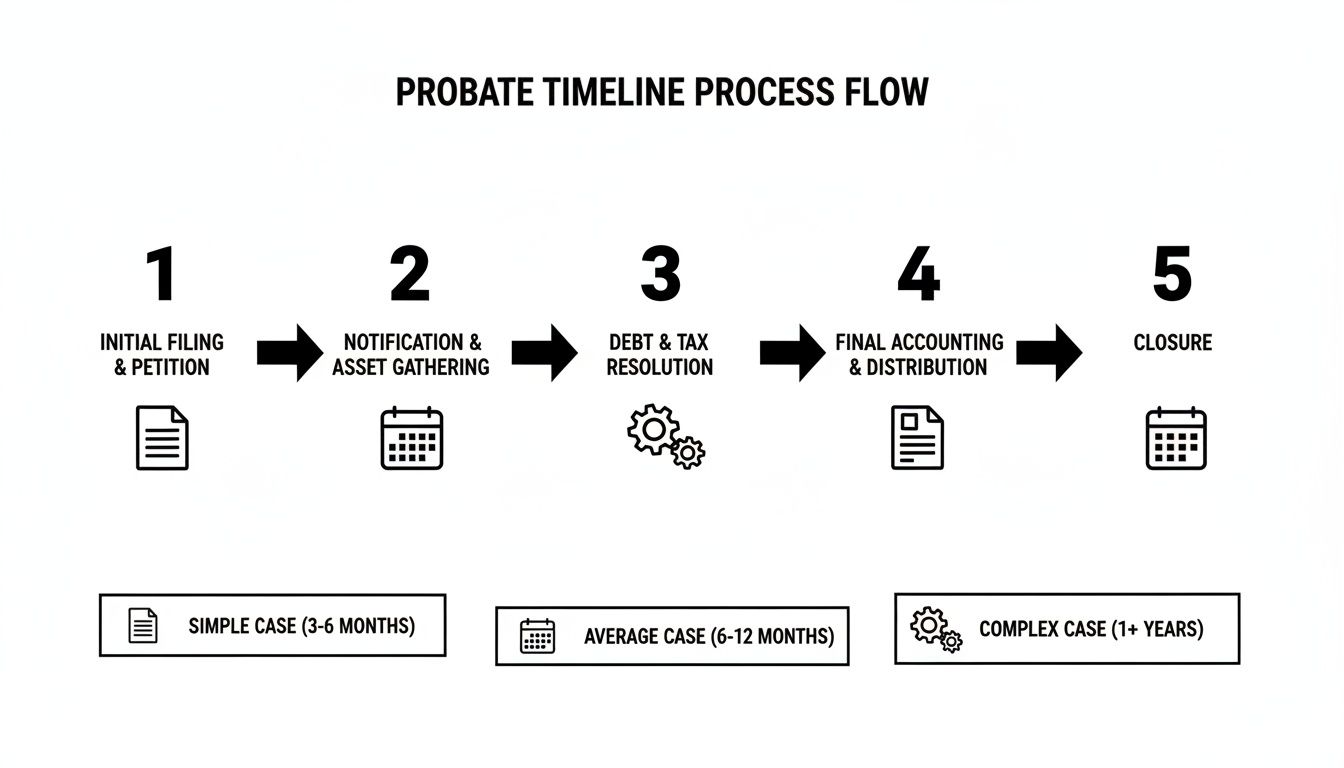
As the infographic shows, every estate goes through the same core steps. However, things like creditor claims, asset disputes, or tax issues can add layers of time and complexity to the process.
Step 4: Paying Taxes and Distributing the Assets
After the 90-day creditor claim period ends and all legitimate debts and administrative costs (like court costs and attorney fees) are paid, you can finally start moving toward the finish line. This stage involves preparing the decedent's final personal income tax returns and, if the estate earned income during probate, an estate income tax return.
Only when all debts and taxes have been fully settled can you distribute the remaining assets to the beneficiaries named in the will or dictated by state law. To do this, you must prepare a Final Accounting for the court, which is a detailed ledger of every dollar that came into and went out of the estate.
The Clerk of Court must review and approve this final accounting. Once satisfied that all your duties have been met, the Clerk will issue an order to close the estate, officially ending the probate process. This final accounting and distribution phase can easily take another one to two months—or even longer if heirs dispute the accounting.
Why Probate Takes Longer Than Expected in North Carolina
Even when you think everything is in order, the probate process can hit unexpected snags. While many North Carolina estates wrap up within the typical six-to-twelve-month window, several common factors can stretch that timeline. These delays aren't just frustrating—they can drive up administrative costs and keep assets tied up when beneficiaries need them most.
When a Will Is Contested
One of the surest ways to bring probate to a screeching halt is a will contest. This happens when an heir or other interested party challenges the will's validity in court. In North Carolina, this formal challenge is called a caveat proceeding, and it stops the probate process cold.
Practical Example: An elderly parent in Mecklenburg County changes their will shortly before passing, leaving the bulk of their estate to the one child who acted as their caregiver. The other children might file a caveat, arguing the new will was the product of undue influence. The moment a caveat is filed, the case is transferred to Superior Court for a trial to determine if the will is valid. This kind of litigation can easily add a year or more to the probate timeline, freezing all asset distributions until it is resolved.
Valuing Complex and Hard-to-Locate Assets
The type of assets in the estate can also create significant delays. The executor has a legal duty to inventory and value every single asset, and some are far more complicated than a simple bank account.
An estate with a checking account and a car is one thing. But what if it includes assets like these?
- A family-owned business: A formal business appraisal is required, a process that can take months.
- Collections of art or antiques: These require specialized appraisers to determine fair market value.
- Out-of-state property: Owning property in another state kicks off a separate legal process known as ancillary probate in that state's court system.
Locating Unknown or Missing Heirs
The executor must give official notice to all heirs and beneficiaries. But what happens when you can't find one? You cannot skip this step. The executor must prove they made a diligent effort to locate every person, which can involve hiring investigators, publishing notices, and documenting every attempt for the court. This can add significant time and expense.
Dealing with an Insolvent Estate
An estate is insolvent when its debts are greater than its assets. This makes probate far more complicated because North Carolina law has a strict pecking order for who gets paid. For example, administrative costs, funeral expenses, and certain taxes must be paid before credit card bills. Paying the wrong creditor first can make the executor personally liable for the mistake. Managing an insolvent estate requires careful court supervision, slowing the process to a crawl.
Can You Skip the Full Probate Process in North Carolina?
The good news is that not every estate has to go through the full, formal probate process. North Carolina law provides alternatives that can save families significant time, money, and stress. Instead of waiting months, these streamlined procedures can often be completed in a matter of weeks.

Collection by Affidavit for Small Estates
The most common shortcut is Collection by Affidavit, often called a "small estate affidavit." As defined in N.C.G.S. § 28A-25-1, this allows an heir to collect and distribute personal property without opening a full probate estate.
An estate may qualify for this streamlined process if:
- At least 30 days have passed since the date of death.
- The total value of the deceased's personal property (minus liens and debts) does not exceed $20,000 (or $30,000 if the surviving spouse is the sole heir).
This method is incredibly useful for quickly accessing a parent’s bank account to cover funeral costs or for transferring a car title to an heir. It bypasses the need for an executor and avoids the lengthy creditor notification period. However, it can only be used for personal property, not real estate.
Summary Administration for Spouses
Another expedited option is Summary Administration (N.C.G.S. § 28A-28-1). This offers a much faster path forward but is available only to a surviving spouse who is the sole heir of the deceased, either by will or by state law if there is no will. The spouse files a simple petition, and once approved, they immediately receive all of the estate's property without the formal appointment of a representative or detailed accounting.
Many families discover that a well-drafted estate plan makes it much easier to qualify for these shortcuts. You can learn more about how to avoid probate in North Carolina in our detailed guide.
Practical Ways to Help Speed Up the Probate Process
While you can’t control every part of the probate timeline, proactive steps can make a real difference. For families across North Carolina, the key to avoiding frustrating delays is preparation.

For the Executor: Get Organized and Communicate Clearly
As the personal representative, your organization directly impacts how quickly probate moves. Start immediately by gathering the original will, death certificates, deeds, bank statements, and tax returns. Create a clear ledger to track every asset, debt, and expense.
Open and consistent communication with beneficiaries is just as important. Providing regular updates on your progress and being transparent about the estate's status can prevent misunderstandings and reduce the likelihood of disputes that add months to the process.
For the Estate Planner: Keep Your Assets Out of Probate
The single most effective way to shorten the settlement of your affairs is to structure your estate to avoid probate entirely. North Carolina law provides powerful tools that allow assets to transfer directly to your loved ones without court supervision.
The most common of these is the Revocable Living Trust. When you transfer your major assets—like your home, bank accounts, and investments—into a trust, they are no longer part of your probate estate upon your death. Your chosen successor trustee distributes the assets according to your private instructions, completely bypassing the court system. This process is private, significantly faster, and avoids the costs associated with probate.
Other planning tools can also help specific assets avoid probate, such as adding a "Payable on Death" (POD) designation to bank accounts or owning property as "Joint Tenants with Right of Survivorship." By taking these steps now, you can save your family a tremendous amount of time, money, and stress down the road.
When You Need a North Carolina Probate Attorney
While some simple North Carolina estates can be settled without legal help, it is critical to know when to call a probate attorney. An estate can be far more complex than it first appears, and trying to navigate certain situations on your own can lead to costly mistakes and intense family stress.
Scenarios That Demand Legal Expertise
Think of a probate lawyer as a skilled navigator for the most challenging parts of the journey. You should seek professional guidance if you encounter any of these situations:
- A Contested Will: If a family member files a "caveat," the process turns into a lawsuit that requires formal legal proceedings you cannot handle alone.
- Complex or High-Value Assets: Valuing a family business, commercial real estate, or extensive investment portfolios requires specialized knowledge to ensure accuracy and defend against challenges.
- An Insolvent Estate: When debts exceed assets, North Carolina law sets a strict payment priority. Paying the wrong creditor first can make you personally liable for the financial mistake.
- Family Disputes: Even without a formal will contest, disagreements among beneficiaries can stall progress. An attorney can mediate disputes and enforce the estate's legal requirements.
A probate attorney becomes your strategic partner, ensuring every deadline is met and every document satisfies North Carolina's strict legal standards. Their involvement protects you from liability and ensures the decedent’s final wishes are honored correctly.
An experienced probate lawyer does far more than just fill out paperwork. They anticipate problems, properly manage creditor claims, and communicate with difficult beneficiaries so you don’t have to. For those also thinking about the future, our firm offers comprehensive services to help families organize their affairs. You can find more information in our guide on estate planning in North Carolina.
Frequently Asked Questions About NC Probate
How long does probate take in North Carolina if there is a will?
Even with a valid will, the average probate process in North Carolina takes six to twelve months. A will simplifies the process by naming an executor and outlining the deceased's wishes, but the estate must still go through required steps like inventorying assets, notifying creditors (a mandatory 90-day period), and getting court approval for the final distribution.
What happens if an estate is not probated in North Carolina?
If an estate that requires probate is not opened, assets cannot be legally transferred to the heirs. This means bank accounts will remain frozen, real estate cannot be sold or retitled, and heirs will not receive their inheritance. Creditors may also sue the heirs for any outstanding debts. For small estates, you may be able to use a simplified process like Collection by Affidavit to avoid formal probate.
How much does an estate have to be worth to go to probate in NC?
There is no specific dollar amount that automatically triggers probate in North Carolina. Instead, it depends on the type of assets. If the deceased owned assets in their name alone (like a house or bank account without a co-owner or beneficiary), probate is usually necessary to transfer them. However, if the estate's personal property is valued under $20,000 (or $30,000 for a surviving spouse who is the sole heir), you can likely use the much faster Collection by Affidavit process and avoid full probate.
Can you sell a house during probate in North Carolina?
Yes, you can sell a house during probate in North Carolina, but the executor must first get authority from the court. If the will grants the executor the "power of sale," the process is more straightforward. If not, or if there is no will, the executor must petition the Clerk of Superior Court for permission to sell the property to pay debts or to facilitate distribution to the heirs. This step requires court oversight and can add time to the probate process.
Navigating Probate in North Carolina Doesn't Have to Be Overwhelming
Trying to manage the details of probate while you're grieving can feel like an impossible weight. You don’t have to carry it by yourself. The experienced team at the Law Office of Bryan Fagan is here to offer the clear guidance and compassionate support North Carolina families need during this difficult time.
We understand North Carolina probate law and are dedicated to helping you honor your loved one's legacy efficiently and correctly. We can help you understand your duties, protect the estate’s assets, and ensure the process moves forward as smoothly as possible.
Schedule a consultation with us today to get the help you deserve.