You're probably looking at a child support worksheet because something important is already happening. A separation. A custody case. A support review. Maybe you found several forms online, and now you're trying to figure out which one applies to your family without making an expensive mistake.
That confusion is normal. In North Carolina, the worksheet choice isn't just paperwork. It drives the support calculation. If the wrong worksheet is used, the final number can be off from the start, even if the income information is otherwise accurate. That's why learning how to choose the correct child support worksheet nc matters before you plug in a single pay stub or childcare expense.
Navigating North Carolina Child Support The First Step
A parent comes into my office with a custody order that says “joint custody,” an online calculator pulled up on a phone, and a handwritten overnight count on the back of a school calendar. That usually means one thing. The support number they have in mind may already be based on the wrong worksheet.
North Carolina uses three child support worksheets, and the right one depends on the parenting schedule. Labels in the court order help only if they match what happens during the year. If the children sleep primarily in one home, one worksheet applies. If each parent has enough overnights to meet the shared-custody standard, a different worksheet applies. If the parents split the children between homes, that is a third category. A broader explanation appears in this guide to North Carolina child support guidelines.
Clients often assume worksheet selection is a clerical step. It is not. It affects the starting support figure, the way settlement talks unfold, and whether an online estimate has any value at all.
The first question is simple. Where do the children spend the night, over the course of a full year?
That sounds easy until real life gets involved. Alternating weekends are easy to count. Teacher workdays, summer breaks, holiday rotations, and midweek overnight visits are where parents make mistakes. I also see confusion in hybrid schedules, such as one child spending more time with one parent while the other child follows a different plan, or a parent claiming “50/50” because decision-making is shared even though the overnight count is not close to equal.
The worksheet follows the custody facts
Many parents say they have “joint custody.” For child support purposes, that phrase does not answer the worksheet question. Courts focus on physical custody and overnights. They also look at whether all children are on the same schedule.
A common mistake is counting evening visits as overnights when the child sleeps elsewhere. Another is using the schedule the parents hoped to follow instead of the one they followed in practice. If you are choosing a worksheet, start with a calendar that reflects real practice, not assumptions.
Practical rule: Count overnights carefully, child by child if necessary, before using any calculator.
A quick way to frame the three worksheets
| Worksheet | Used when | Core issue |
|---|---|---|
| A | One parent has primary physical custody | One home has the children most of the year |
| B | Parents share custody | Overnight count is often disputed |
| C | Split custody | Each parent has primary custody of at least one child |
Using the wrong worksheet can skew the whole analysis. I have seen parents rely on a shared-custody calculation, only to learn that a few disputed holiday nights put the case in a different category. I have also seen the reverse. A parent used the primary-custody worksheet, but a careful annual count showed enough overnights to require a shared-custody analysis instead.
That is why worksheet choice should be settled before arguing about income, daycare, or health insurance. If the form is wrong, the math that follows will be wrong too.
Understanding Worksheet A When One Parent Has Primary Custody

A parent walks into my office and says, “We have joint custody, so I assumed we use the shared worksheet.” Then I review the calendar. The children sleep in one home almost every school night, one parent covers the homework, doctor visits, and Monday morning routine, and the other parent has alternating weekends plus some holidays. In that situation, Worksheet A is usually the right starting point, even when both parents are active and involved.
Worksheet A applies when one parent has primary physical custody in practice. The label on the custody order matters less than the actual schedule. If one parent has the children most nights of the year, and the other parent does not cross into the shared-custody overnight range, Worksheet A is generally the form the court uses. If you want a form-specific walkthrough, this guide to Worksheet A in North Carolina child support cases can help.
What primary physical custody means in real life
Clients often expect a legal term to answer the worksheet question. Usually, it does not.
For Worksheet A, the practical question is simple: which home is the child in most nights, over the course of a normal year? School-week custody often drives that answer, but not always. I have seen parents assume Worksheet A applied because one parent handled weekdays, only to find that summer blocks, holiday rotations, and teacher workdays changed the annual count more than expected.
Hybrid arrangements create trouble here. A family may have one schedule during the school year and a different one all summer. Or one child may stay more often with one parent because of sports, driving privileges, or a better fit with a school district. Online calculators rarely catch those details. Courts and lawyers have to.
What to gather before you fill out Worksheet A
A clean Worksheet A calculation depends on records, not guesses.
Start with these:
- Income information: recent pay stubs, W-2s, tax returns, and proof of bonuses, commissions, self-employment income, or other recurring income
- Health insurance costs: the part of the premium specifically attributable to the child
- Work-related childcare expenses: daycare, after-school care, summer care, or other employment-related childcare
- A real custody calendar: not the schedule parents hoped to follow, but the one they in fact followed
Low-income adjustments can affect a Worksheet A case, and the child support guidelines also address cases at the upper end of the income schedule. Those points can materially change the analysis. They are also easy to apply incorrectly if someone plugs rough numbers into a calculator without checking how the guidelines treat income, credits, and allowable expenses.
Here's a short overview that may help if you're sorting through the form itself:
Common Worksheet A mistakes
The first mistake is assuming “primary custody” means the same thing in conversation that it means on the worksheet. It does not. A parent can have substantial parenting time and still be in a Worksheet A case.
The second mistake is using incomplete expense information. Health insurance gets overstated or understated all the time. Childcare is often listed as a flat monthly number even though the cost changes during summer or after a job change. Self-employed parents may also present income figures that do not match what the court will treat as actual gross income for support purposes.
The third mistake is ignoring schedule drift. I see this often after separation. The order says one thing, but the family settled into something else. If the paper schedule and the lived schedule are different, that discrepancy needs attention before anyone relies on the worksheet result.
Worksheet A is straightforward only when the facts are organized. When the overnights are close, the expenses are uneven, or the schedule changed over time, a quick calculator result can give a parent false confidence.
Decoding Worksheet B The 123-Night Rule for Shared Custody
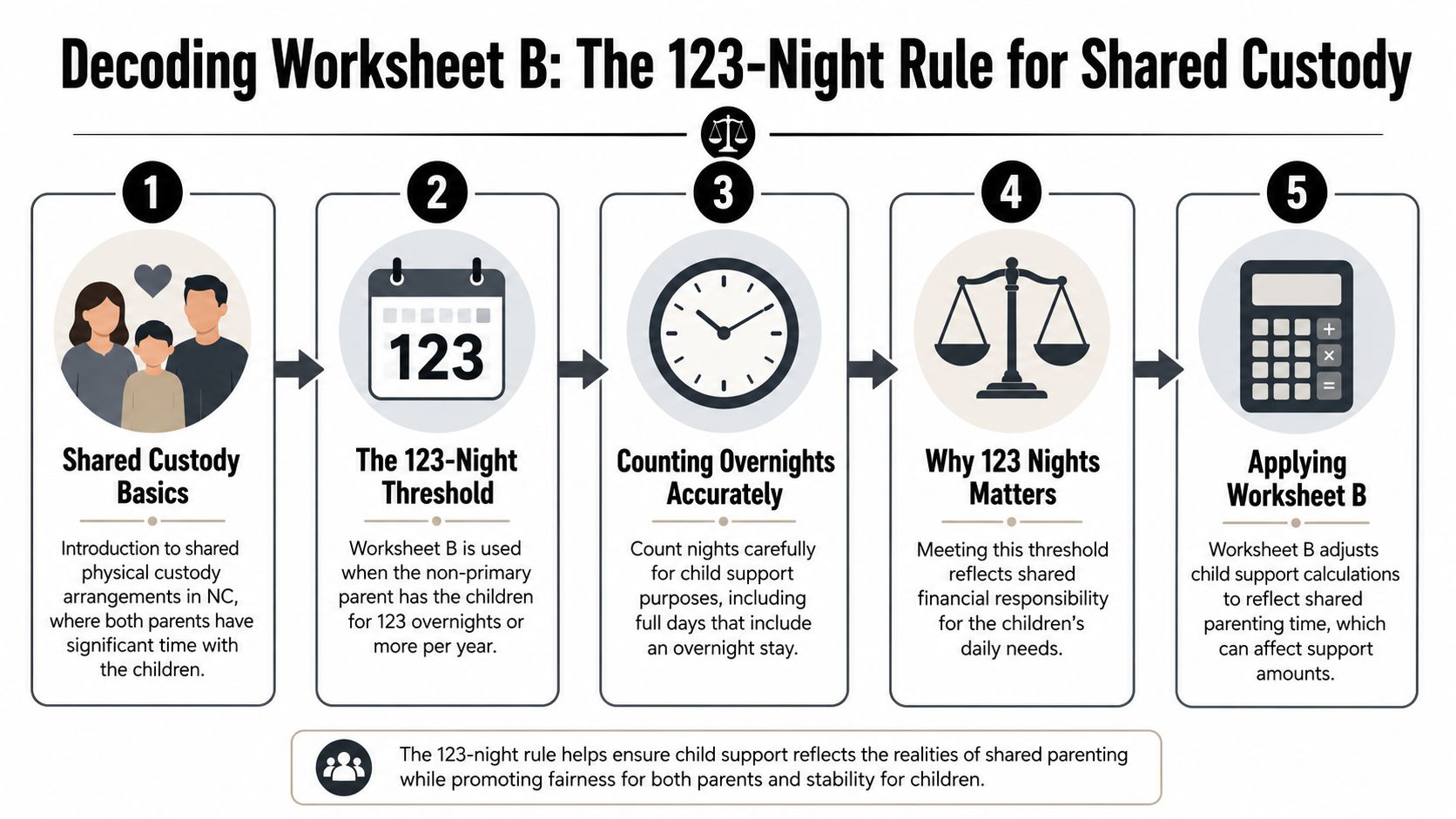
Worksheet B is where many child support disputes stop being intuitive. Parents may share substantial time, both may provide bedrooms and clothing, and both may think they know the right answer. The problem is that North Carolina uses a specific overnight threshold.
According to this discussion of North Carolina child support and overnight calculations, if the non-primary parent has fewer than 123 overnights per year, Worksheet A is used. If that parent has 123 nights or more, Worksheet B is required. The same source warns that parents often miscount overnights by including partial days or by failing to account carefully for holidays, school breaks, and summer schedules. For a practical explanation with examples, review this guide to Worksheet B in North Carolina.
How to count overnights the right way
The overnight count should come from the actual schedule over a full year. That means you need to include ordinary weeks, holidays, teacher workdays, summer vacation, and any rotation changes that happen during the year.
Parents get into trouble when they count time emotionally instead of mechanically. “I have him half the time” may feel true because a parent handles pickup, activities, homework, and dinner several days a week. But if the child sleeps in the other home those nights, those aren't your overnights.
A better method is this:
- Start with the court order or written parenting agreement. Use the exact rotation as your base.
- Map it onto a full twelve-month calendar. Don't estimate by month.
- Add holiday overrides. These often alter the regular pattern.
- Add summer provisions separately. Summer can move a case across the threshold.
- Check actual practice if the parents haven't followed the order. That issue may require legal advice before filing.
Common counting mistakes
Some mistakes show up again and again:
- Counting partial days as overnights: If the child spends the day with you but sleeps elsewhere, that usually doesn't count as your overnight.
- Ignoring school calendars: Long weekends, spring break, and rotating holiday schedules can materially change the count.
- Using rough math: “Every other weekend plus one night a week” needs to be converted into actual annual overnights.
- Forgetting child-specific differences: In some families, one child follows a different schedule from another.
Client warning: An error of even a few nights can put you on the wrong worksheet, and the support result can be wrong by thousands of dollars annually.
Why Worksheet B changes the discussion
Worksheet B reflects the idea that both households are carrying more day-to-day child-related costs because the children spend substantial time in each home. That doesn't mean support disappears. It means the formula changes.
This is why generic online calculators often mislead people. If the calculator doesn't ask the right custody questions, or if you enter a guessed overnight number, the answer may look precise while being legally unreliable. Worksheet B cases reward careful recordkeeping. They punish assumptions.
Handling Complex Custody Split and Hybrid Arrangements
Some families don't fit neatly into Worksheet A or B. That's where people often get trapped by online tools that only ask one or two custody questions.
Worksheet C is for split custody, meaning each parent has primary custody of at least one child. North Carolina recognizes that this arrangement is different enough to require its own worksheet. The clean version of Worksheet C is straightforward on paper. Child one primarily lives with Parent A. Child two primarily lives with Parent B. There is no shared arrangement layered on top.

When split custody is not the hard part
True split custody cases are less common, but they are at least conceptually distinct. The more difficult problem is hybrid custody. That happens when one child is in a primary-custody arrangement, while another child is in a shared-custody arrangement.
According to this discussion of hybrid North Carolina child support worksheet problems, hybrid custody is a major source of confusion because the official guidelines don't resolve every mixed-family scenario with perfect clarity. The same source gives a familiar example: one child primarily lives with Parent A, while another child splits time equally. In that setup, it may be unclear whether the correct approach is Worksheet A, Worksheet B, or some combination.
Why DIY tools often fail here
Most online calculators assume all children follow the same custody pattern. Real families often don't.
A hybrid case can involve:
- Different schedules for different children: Teenagers may live differently from younger siblings.
- A phased custody plan: One child may have transitioned into more shared time while another has not.
- Blended parenting arrangements: Parents may have adapted over time without formally updating the order.
That's why DIY calculations in hybrid cases are often rejected or challenged. The issue isn't just arithmetic. It's legal classification.
Courts want a worksheet that matches the actual custody structure. If the family structure is mixed, a one-size-fits-all calculator usually won't get there.
A practical example
Suppose there are two children. One child lives primarily with the mother during the school year and spends alternate weekends with the father. The second child, because of age or school location, follows a much more evenly divided schedule. A parent who picks Worksheet A for both children may understate the shared-custody component. A parent who chooses Worksheet B for both may overstate it.
That doesn't mean there's a universal answer. It means the case should be reviewed carefully before anything is filed or signed. In these cases, the right approach is often less obvious than people expect, and a confident guess can be worse than no calculation at all.
When the Worksheets Are Not the Final Word High Income and Deviations
Even when you choose the correct worksheet, that still may not be the end of the analysis. In North Carolina, the guideline amount is generally presumptive, which means the court starts there. But a judge can depart from that amount in the right case.
According to this overview of the North Carolina child support guide and deviations, the guidelines are presumptive up to a combined parental income of $480,000 per year, and up to 25% of child support orders may deviate from the presumptive amount based on UNC School of Government data. The same source explains that a judge may order a different amount if the worksheet result would be unjust or inappropriate.

Situations that may justify a different result
Deviation arguments usually require evidence, not just frustration. A parent cannot say the guideline amount feels unfair.
Some recurring examples include:
- Extraordinary child-related expenses: significant medical needs or private school costs.
- Extreme income disparities: cases where a strict worksheet number may not reflect the circumstances of the family.
- Other unusual facts affecting fairness: circumstances that make the guideline result inappropriate for that child.
Why high-income cases need more than a calculator
Once family income gets closer to the upper limits of the guidelines, support questions become more fact-sensitive. The discussion often shifts from a form-driven result to a more detailed look at the child's reasonable needs, the parents' financial circumstances, and whether the worksheet amount fits the case.
That's where legal judgment matters. Some parents assume the worksheet is rigid. Others assume a judge can set any number based on instinct. Neither view is right.
The worksheet is the starting point. The evidence is what moves a case toward or away from that presumptive number.
If you're dealing with substantial income, unusual expenses, or a support amount that doesn't seem to fit the family's reality, don't treat the worksheet as the whole case. Treat it as one part of the case.
Common Questions About NC Child Support Worksheets
Where do I find the official North Carolina child support worksheets
The worksheets come from the North Carolina Child Support Guidelines. In practice, many parents first encounter them through the court process, a lawyer, or family court forms used in support cases. The important point isn't just finding a PDF. It's making sure you're using the right worksheet for your custody facts.
Can parents agree on child support without using a worksheet
Parents can reach agreements, but support issues should still be formalized properly through the court. An informal side agreement can create enforcement problems later. If the agreed amount doesn't track the guidelines, the court may still want a valid basis for the result.
What counts more for worksheet choice, legal custody or physical custody
For worksheet selection, physical custody and overnight allocation are what usually drive the answer. Joint legal custody by itself does not make Worksheet B the right form.
What if our schedule changed after the last order
That can matter a great deal. A changed overnight pattern can change the worksheet, and a different worksheet can change support. If the actual schedule has drifted away from the old order, get advice before relying on an online calculator or informal estimate.
What if I think the other parent is understating income
That issue usually can't be solved by guessing. It requires documentation, analysis, and often a more formal review of earnings and financial records. If income is disputed, the worksheet is only as reliable as the numbers going into it.
Protect Your Rights and Your Children's Future Schedule a Consultation
Choosing the right child support worksheet in North Carolina sounds simple until you apply it to a real family. Overnight counts aren't always obvious. Children don't always follow the same schedule. Some cases involve split custody, mixed arrangements, unusual expenses, or income levels that make the guideline amount only the beginning of the discussion.
That's why parents get into trouble when they rely on labels like “joint custody,” rough calendar estimates, or one-click calculators. The court is looking for a worksheet that matches the actual facts. If the worksheet is wrong, the support position built on it may be wrong too.
For North Carolina parents, this isn't just about forms. It's about protecting financial stability, avoiding avoidable disputes, and making sure support is calculated on a defensible foundation. Careful legal review can help identify the right worksheet, spot weaknesses in the other side's calculation, and present the facts clearly if the case goes before a judge.
If you're not sure whether your case belongs on Worksheet A, B, or C, or if your family has a hybrid or disputed custody schedule, it's worth getting case-specific guidance before you file, agree, or argue from the wrong number.
If you need help sorting out child support, custody schedules, or support modification issues in North Carolina, schedule a consultation with the Law Office of Bryan Fagan. The firm works with North Carolina families to evaluate worksheet selection, review financial documents, and build a child support position grounded in the actual facts of the case.