You may already be in the position many North Carolina parents know too well. The other parent says he has little or no income, but what you see suggests a different truth. He drives a newer vehicle, pays his bills, takes trips, posts business activity online, or works for cash, yet insists there's nothing available for child support.
That disconnect is frustrating, and it can make you feel like the system will only look at whatever appears on a pay stub. In North Carolina, that isn't how these cases have to end. Courts can look beyond a parent's self-reporting and examine what he actually earns, what he has earned before, and what he is capable of earning if he's choosing to earn less.
The practical problem in a child support if father denies income nc case is proof. Suspicion alone won't carry a hearing. A well-built record often will. That means gathering financial documents, tracing spending, using discovery tools the right way, and presenting a clear explanation for why the reported income doesn't match real life.
A common example is a father who says he is unemployed, but bank deposits continue, business accounts stay active, and monthly spending doesn't slow down. Another is a parent who suddenly takes a lower-paying position right before court after years in a better-paying field. North Carolina judges see these patterns, but they still need evidence tied to the legal standard.
Introduction When a Parent's Claimed Income Doesn't Add Up
The most common starting point is simple. You know the numbers on paper don't reflect what's happening in real life. Maybe support has never been set. Maybe there's already an order, and the other parent is asking for less. Maybe he says, “I have no job,” while still operating like someone with steady cash flow.
North Carolina law gives judges room to address that problem. If a parent is hiding income, minimizing income, or choosing not to work up to his ability in bad faith, the court can look at earning capacity instead of just claimed wages. That shift matters because child support is supposed to reflect a parent's real financial ability, not just the version he chooses to present.
Practical rule: If the story and the documents don't match, focus on records, not arguments.
In many cases, the path forward starts with ordinary documents that tell an extraordinary story. Tax returns may show one thing. Bank statements may show another. A loan application, business ledger, or social media post may fill in the gap. When those pieces are organized well, a judge can see the pattern.
Effective strategy is crucial. Some parents walk into court and say, “He's lying.” That rarely gets far. The stronger approach is to show income history, current spending, work background, and missing records that should exist if the claim were true.
A child support dispute involving denied income can feel personal, but the courtroom question is narrower. What can be proven about his true ability to pay, and how does that affect support for your child?
North Carolina Law and a Parent's True Earning Capacity
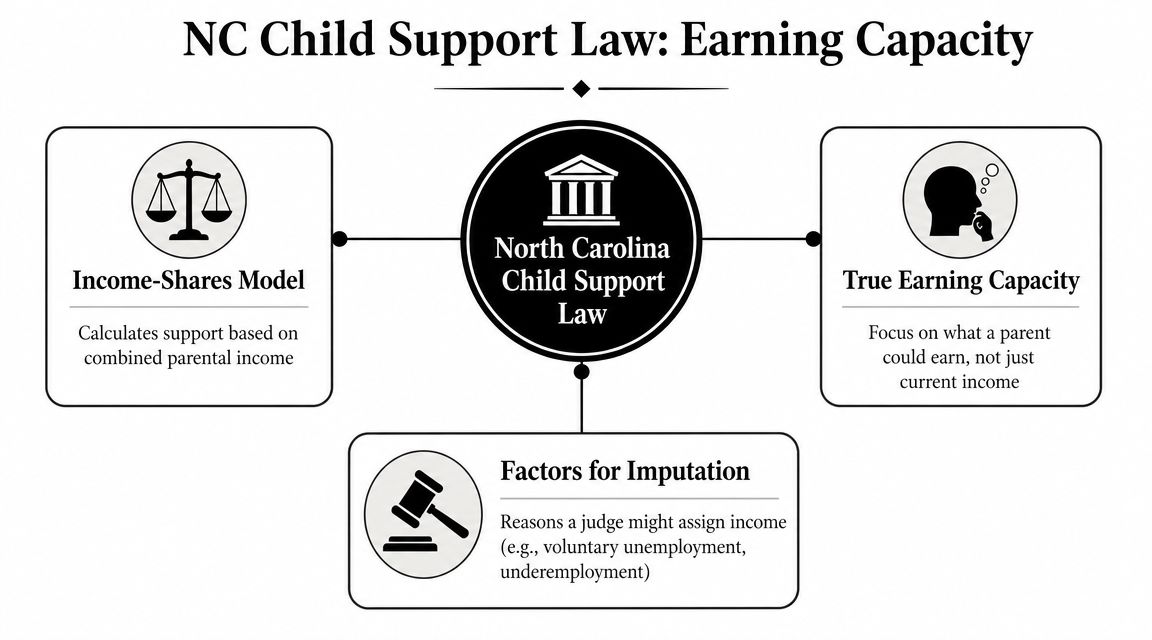
North Carolina calculates child support under an income-shares model. In plain English, the court looks at both parents' incomes because the law tries to approximate the support a child would have received if the parents were living together. The model is guideline-driven in many cases, but it becomes more fact-intensive when income is disputed or unusually high.
As summarized in North Carolina family-law commentary on high-income child support cases, the Guidelines presumptively apply when the parents' combined adjusted gross income is under $40,000 per month or $480,000 per year as of the 2023 update. Above that level, courts are no longer bound by the standard worksheet table and rely more on evidence, budgets, and financial documentation. The same commentary explains that when a parent appears to hide, minimize, or understate income, the case often shifts from a formula exercise to a hearing about actual financial ability.
What imputed income means in North Carolina
The key phrase in these cases is imputed income. That means the court assigns income to a parent for child support purposes, even if that parent says he isn't earning that amount now.
North Carolina courts don't do that automatically. The judge must find bad faith. In practice, that usually means the parent is voluntarily unemployed or underemployed to avoid family responsibilities or with reckless disregard for them. The court may then look at prior earnings, work history, qualifications, spending habits, and business records to decide what income should fairly be used.
For a closer look at how this concept works, see this overview of imputed income in North Carolina child support cases.
Bad faith versus a real setback
This distinction matters more than anything else in a denied-income case.
A father who loses a job in a layoff and is making a genuine effort to find comparable work presents one type of situation. A father who quits a solid job just before a hearing, starts working fewer hours by choice, or moves income through a business while claiming poverty presents another.
The first scenario may justify lower available income, at least temporarily. The second may justify imputation.
A simple comparison helps:
| Scenario | Likely issue for the court | Why it matters |
|---|---|---|
| Job loss after a layoff | Whether the parent is making a good-faith effort to regain income | Lower income may be real, not manipulative |
| Voluntary move to a lower-paying role before support litigation | Whether the income drop was intentional | The court may treat prior earning ability as more reliable |
| Claim of no income while spending remains high | Credibility and hidden cash flow | Reported income may not reflect actual resources |
| Self-employment with incomplete records | Reliability of business reporting | The court may look beyond tax forms |
What the court is really trying to decide
Judges don't expect every parent's income to be perfectly tidy. They do expect the evidence to make sense. If the father's claimed earnings are inconsistent with his work history, lifestyle, business operations, or documented spending, the court can draw conclusions from those inconsistencies.
That is especially true under N.C. Gen. Stat. § 50-13.4, which governs child support in North Carolina and gives courts authority to set support based on the facts before them. The legal fight usually isn't over whether support should exist. It is over which income figure the judge should trust.
A denial of income doesn't end the child support analysis. It changes the case from a worksheet problem into an evidence problem.
Building Your Case How to Uncover a Parent's True Income
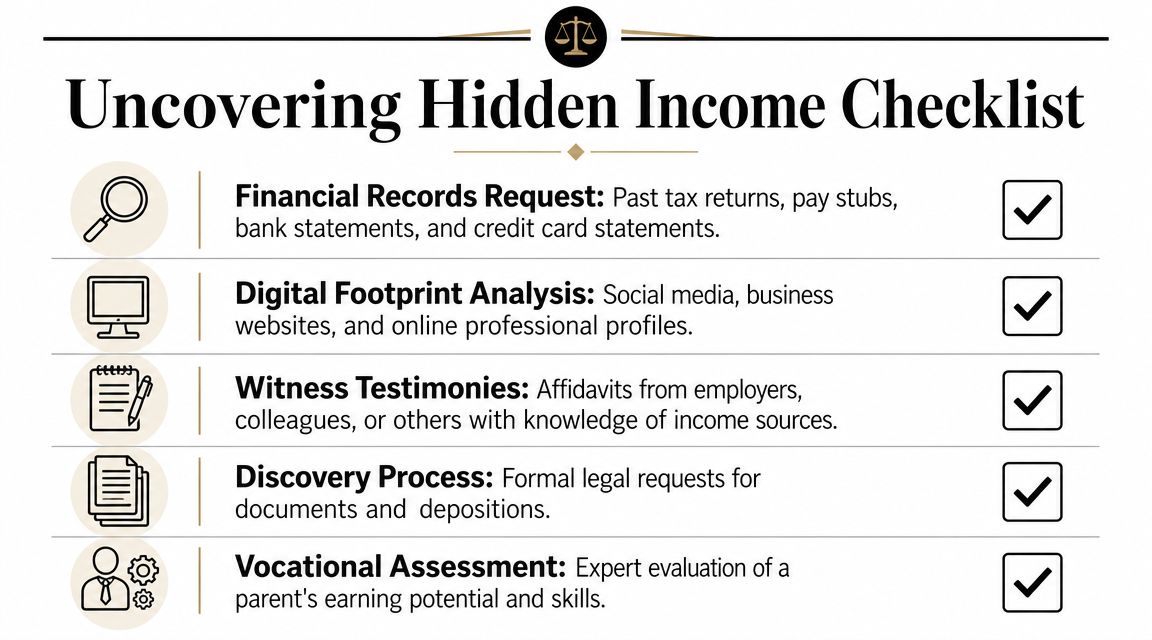
The strongest denied-income cases are built before the hearing. By the time you reach court, you should already know what records exist, what records are missing, and what story those records tell. In North Carolina, that work usually happens through discovery, which is the formal process for requiring the other side to provide information and documents.
This is also where many parents weaken their position. They rely on texts, assumptions, or a few screenshots, when what they really need are bank records, tax returns, business documents, and a timeline that ties everything together.
Start with formal discovery
Discovery tools sound technical, but the basic idea is simple. You ask for information in a format the other party must answer.
The main tools are:
- Interrogatories ask written questions that must be answered under oath. These are useful for identifying employers, business interests, side income, recent job changes, and account locations.
- Requests for Production require the other parent to turn over documents. These documents are usually the starting point for the paper trail.
- Subpoenas go to third parties, such as banks, employers, payment processors, or business partners, when you need records that won't come voluntarily.
A well-run case often uses all three. Interrogatories pin the parent to a position. Requests for Production test whether the documents support that position. Subpoenas fill gaps and expose omissions.
What documents usually matter most
Not every document carries equal weight. Some records are especially useful because they are difficult to explain away.
Ask for, and review carefully:
- Personal tax returns for multiple years. They help compare current claims against prior earnings and reveal patterns.
- Business tax returns and profit-and-loss statements if the father is self-employed or owns part of a company.
- Bank statements because deposits often tell a fuller story than wages alone.
- Credit card statements that reveal spending inconsistent with claimed lack of income.
- Pay stubs or payroll summaries if there is formal employment.
- Loan or mortgage applications because people often report income more aggressively when seeking credit.
- Business ledgers, invoices, and client payment records if cash work or off-the-books income is suspected.
- Venmo, Cash App, PayPal, or similar payment histories when side work or informal payments may be involved.
- Retirement account statements or investment records when money may be flowing from non-wage sources.
For parents dealing with a business owner or contractor, this guide on child support for self-employed parents in North Carolina is often relevant because business income disputes rarely resolve cleanly through a single pay stub.
North Carolina guidance summarized by the UNC School of Government on the state's child support guidelines notes a practical proof sequence in disputed-income cases. First, establish current income through pay records, tax returns, bank deposits, business ledgers, and lifestyle evidence. Second, compare that information to work history, qualifications, and local wage benchmarks. Third, argue voluntary unemployment or underemployment if the numbers do not line up. That same guidance also notes that courts can't impute income unless the judge finds deliberate suppression of income to avoid family responsibilities or reckless disregard of support duties.
Here is the video many parents find useful when thinking through the proof problem:
Lifestyle evidence can be powerful
Some of the best evidence doesn't come from payroll. It comes from ordinary life.
If a father says he has no income but regularly pays for travel, rent, lease payments, entertainment, tools, inventory, or expensive hobbies, that spending may support an argument that his reported income is incomplete. Social media can help identify leads, but screenshots alone usually aren't enough. Use them to point toward records, witnesses, or subpoena targets.
A useful checklist includes:
- Track visible purchases. Vehicles, trips, home upgrades, business equipment, and recurring entertainment can all matter.
- Create a timeline. When did the claimed income drop happen, and what spending continued afterward?
- Match spending to records. A photo of a vacation is more helpful if bank or card statements show who paid for it.
- Preserve posts carefully. Don't alter images or remove context that could raise authentication problems later.
The judge doesn't need proof of every dollar. The judge needs enough reliable evidence to decide that the reported income isn't credible.
Don't neglect the child's expense side of the case
Parents sometimes become so focused on proving the other side's income that they ignore their own documentation. That is a mistake. Child care, health insurance, and extraordinary expenses are part of the support calculation and can change the outcome materially under North Carolina guidance.
Keep your own file current. That means receipts, invoices, policy information, and a clean summary of recurring child-related costs. A denied-income case is strongest when both sides of the worksheet are supported.
Presenting Your Evidence in a North Carolina Courtroom
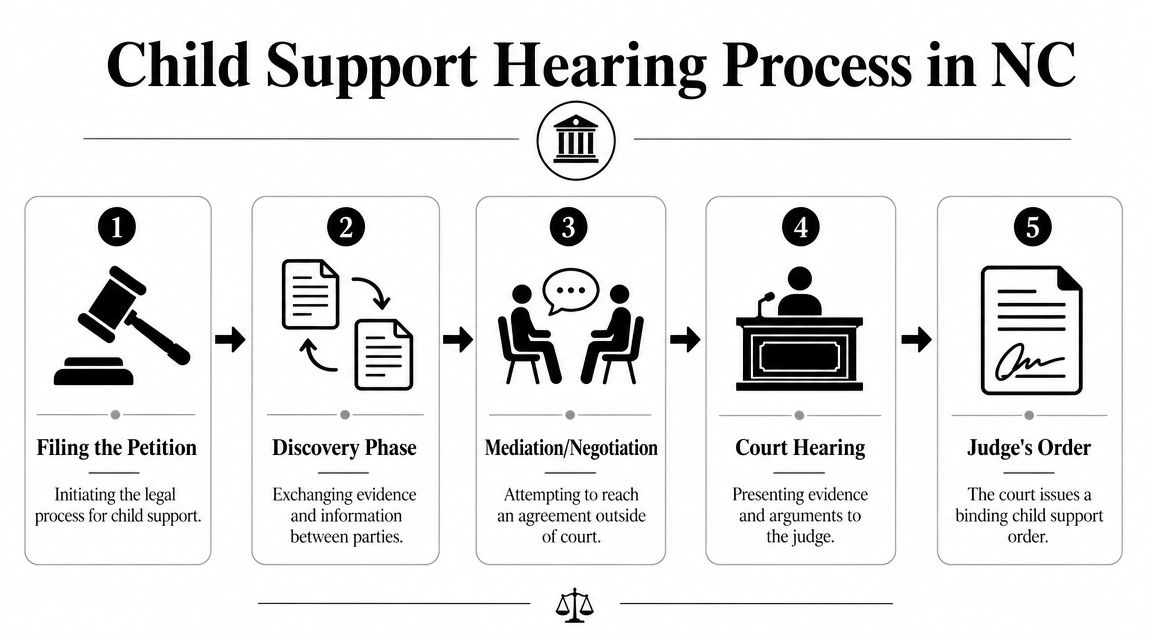
A hearing with disputed income is rarely won by a stack of papers alone. It is won when those papers are organized into a clear narrative the judge can follow. The court needs more than suspicion and more than volume. It needs a reasoned explanation of what the evidence proves.
Think about a common courtroom scenario. A father testifies that he has no meaningful earnings. He submits a financial affidavit reflecting little income. But the records show regular deposits, ongoing business expenses, and spending that doesn't fit the story. The judge is then deciding two things at once. First, whether the parent is credible. Second, what income figure is more reliable than the one he reported.
Turn records into a timeline, not a pile
The most effective presentation usually follows a sequence. Start with what the father claims. Then compare that claim to records from the same period. Then show why the difference matters under North Carolina law.
For example, a clean courtroom presentation might look like this:
| Part of the presentation | What it shows |
|---|---|
| Financial affidavit | The father's claimed income |
| Tax returns and pay records | Formal reported earnings |
| Bank deposits | Actual inflow of funds |
| Business documents | Income sources not reflected in wages |
| Spending evidence | Lifestyle inconsistent with claimed poverty |
| Work history and qualifications | Earning capacity if current income is understated |
That structure helps the judge move from question to conclusion. It also limits the other side's ability to dismiss your case as speculation.
Witnesses matter, especially on credibility
In many support hearings, the judge hears directly from both parents. That testimony matters. If a father gives evasive answers about accounts, work arrangements, or cash payments, credibility becomes part of the evidence.
Other witnesses can matter too. Depending on the case, that might include a bookkeeper, employer representative, business associate, or someone familiar with the father's actual work pattern. The point isn't to add drama. It's to add context and foundation.
A parent should be prepared to testify clearly about:
- Observed work activity
- Known prior employment and earnings
- Changes that happened close to litigation
- Household expenses being paid despite claimed low income
- Child-related costs that support should address
When a vocational expert can help
Some cases benefit from a vocational expert. This is a professional who evaluates the parent's education, job history, skills, and the kinds of jobs available in the local market. The expert does not decide the case. The expert gives the judge an objective basis to estimate earning capacity.
That can be especially useful where the father claims he cannot earn more, but his background suggests otherwise. A judge may find the expert's testimony persuasive if it connects qualifications to realistic employment opportunities and income ranges in the relevant North Carolina labor market.
Courts often separate two questions that parents blend together. “What is he earning now?” is not always the same as “What could he earn if acting in good faith?”
What works and what usually doesn't
Some evidence persuades. Some just creates noise.
What tends to work
- Documents from neutral sources
- A clear timeline
- Specific contradictions between claimed income and actual cash flow
- Proof of qualifications, prior earnings, or business activity
- Focused testimony tied to exhibits
What often falls flat
- General accusations with no records
- Social media posts with no supporting financial proof
- Bringing in every grievance from the relationship
- Using the hearing to argue custody issues that are legally separate
- Assuming the judge will infer hidden income without a factual bridge
North Carolina judges hear difficult family stories every day. The cases that stand out are the ones with disciplined proof. If you're asking a court to impute income, your presentation should make it easy for the judge to explain that ruling on the record.
What Happens After a Judge Sets the Child Support Order
A support order only helps if money gets paid. In North Carolina, enforcement tools matter because some parents continue denying income or resisting payment even after the judge has ruled. That is why post-order strategy is part of the case, not an afterthought.

Wage withholding is usually the first collection tool
According to the North Carolina Department of Health and Human Services child support FAQ, wage withholding is the default collection method for periodic support, and employers must begin withholding upon proper notice and forward funds to the state within seven business days. If the father is on payroll somewhere, this is often the cleanest route because it reduces missed payments and lowers the need for repeated enforcement motions.
That said, wage withholding only works well when there is a reachable employer and regular wages to withhold. It is less effective when a parent changes jobs often, works in cash, or manipulates income through self-employment.
Contempt is serious, but it has rules
If support is ordered and not paid, a court may use contempt proceedings. Contempt is the court's way of enforcing compliance with an existing order. It can carry serious consequences, but North Carolina still requires process. As NCDHHS explains, a parent can't be arrested solely for nonpayment without a show-cause process and a judicial finding of contempt.
That matters because many parents hear threats about jail and assume enforcement is automatic. It isn't. The court must determine whether the parent failed to comply and had the present ability to comply or to take reasonable steps toward compliance.
Other enforcement pressure points
Parents should also understand the practical consequences of arrears.
The same NCDHHS guidance notes that arrears can lead to liens, refund interception, and license consequences. Those tools often become important in cases involving chronic avoidance, especially where wage withholding does not solve the problem.
A short comparison is useful:
| Enforcement tool | When it helps most | Limitation |
|---|---|---|
| Wage withholding | Parent has formal employment | Less useful for cash work or unstable jobs |
| Contempt motion | Parent is willfully refusing to comply | Requires hearing and findings |
| Tax refund interception | Past-due support has accumulated | Depends on refund eligibility and arrears status |
| Liens and license consequences | Long-term noncompliance | Often works as pressure, not immediate cash |
One issue causes repeated damage in these cases. Parents attempt to use custody or visitation to gain advantage over support. North Carolina treats those as separate obligations. A parent doesn't get to stop paying because visitation is being denied, and a parent doesn't get to deny visitation because support isn't being paid. Mixing them usually makes both cases harder.
If income drops for a real reason after an order is entered, seek modification promptly. Waiting often means arrears continue to build under the existing order.
North Carolina Child Support FAQ
Can I still prove income if he's paid in cash?
Yes, but cash-income cases require a tighter paper trail. Bank deposits, recurring expenses, business purchases, online advertising, invoices, messages with customers, and witness testimony can all help show work activity that isn't reflected on payroll records.
The key is to stop thinking only in terms of pay stubs. Cash work often leaves indirect evidence. The court can consider patterns, especially when cash flow and lifestyle are inconsistent with a claim of no income.
Can a father quit his job to avoid child support in North Carolina?
Not successfully if the court finds bad faith. North Carolina allows income to be imputed when a parent is voluntarily unemployed or underemployed to avoid support responsibilities. That is why timing matters. A sudden drop in income right before litigation often receives close scrutiny.
The legal question is not whether he earns less now. It is whether he chose that reduction in a way the court views as deliberate and unfair to the child.
What if he says I can't get support because he sees the child less, or because I denied visitation?
That is a common misconception. North Carolina treats support and visitation as separate issues. The support obligation is based on the legal framework for support, not on a parent's personal decision to withhold payment because he is unhappy with parenting time.
Practitioner and state sources summarized in this discussion of imputed income and support enforcement in North Carolina note that the statutory minimum child support order is $50 per month, that support is based on both parents' incomes, and that denying visitation is not legal justification for withholding support. The same discussion also notes that delinquent cases may be pursued through wage withholding and tax intercepts. For federal tax refund interception, the obligor must owe at least $500 in past-due child support in non-public-assistance cases or $150 in public-assistance cases. It also cites USAFacts reporting that about 30% of parents owed child support receive nothing, which shows why denied-income cases deserve careful attention.
How long does a child support if father denies income nc case take?
There isn't one reliable timeline that fits every county or every docket. Cases involving disputed income usually take longer than straightforward worksheet cases because discovery, subpoenas, and contested hearings add work. A self-employed parent, a cash-income claim, or incomplete records often extends the process further.
The practical question is whether delay can be reduced by better preparation. Usually, it can. The more organized your records are at the beginning, the less time gets lost chasing missing information later.
Is it worth spending money to fight over hidden income?
That depends on the facts, but many parents ask the right question the wrong way. They focus only on short-term legal cost instead of the long-term effect of an unfair support amount. If the father's true earning ability is materially higher than what he claims, the issue isn't just this month. It can affect the order going forward and shape enforcement options later.
That doesn't mean every suspicion justifies a major court fight. It means the case should be evaluated strategically, with attention to the available evidence, the likely proof problems, and the child's actual needs.
Protect Your Child's Future with Experienced Legal Guidance
When a father denies income, the case often turns on discipline and proof. North Carolina courts can address hidden income, understated earnings, and bad-faith underemployment, but they won't do it based on frustration alone. They need records, testimony, a coherent timeline, and a legal argument tied to the facts.
That's why these cases reward careful preparation. The strongest approach usually starts with the right discovery requests, builds through financial analysis and spending evidence, and ends with a focused courtroom presentation that gives the judge a practical basis to set fair support. If there is already an order, enforcement may be just as important as the original calculation.
For North Carolina parents, the goal isn't punishment. It's accuracy. Your child is entitled to support based on real financial ability, not a paper version of it that leaves out cash flow, business income, or earning capacity.
If you're dealing with a disputed-income support case, it helps to speak with someone who handles these issues regularly and understands how North Carolina courts evaluate them. This overview of working with a North Carolina child support lawyer is a useful starting point if you're weighing your next step.
A careful consultation can clarify whether you need discovery, modification, enforcement, or all three. It can also help you avoid the costly mistake of going to court with the right instinct but the wrong proof.
If you live in North Carolina and need guidance on a child support dispute involving hidden, denied, or understated income, schedule a consultation with the Law Office of Bryan Fagan. The firm works with North Carolina families on child support, custody, divorce, and enforcement matters, with a focus on clear advice, strategic preparation, and practical solutions specific to the facts of your case.