When parents search for how to win a custody case in North Carolina, they're usually not looking for theory. They're looking for something they can do tonight, this week, and before the next court date. Maybe the other parent has become unpredictable. Maybe you're worried that the child's routine is falling apart. Maybe you already know a hearing is coming and you're afraid the judge won't see what daily life looks like.
That fear is real. Custody cases are personal, stressful, and full of bad advice from friends, family, and the internet. The hard truth is that custody cases in North Carolina aren't won by sounding more upset, more deserving, or more morally right. They're won by building a case the court can use.
Your Strategic Guide to Winning a Custody Case in North Carolina
A strong custody case usually starts with a parent who finally realizes that emotion and proof are not the same thing. One parent says, “I've always been there for my child.” The other parent walks into court with school emails, appointment records, calendars, messages about pickups, and a proposed schedule that works. The second parent has given the judge something concrete to evaluate.
That difference matters in North Carolina.
If you want to know how to win a custody case in North Carolina, focus on three things. First, understand what the judge is deciding. Second, gather evidence that connects directly to your child's daily needs. Third, avoid the behavior that makes judges doubt your credibility, even when your concerns are legitimate.
Practical rule: A custody case gets stronger when your evidence answers the court's real question, which is what arrangement serves your child, not what arrangement feels fair to the parents.
Some cases are relatively straightforward. Others involve allegations of substance abuse, domestic violence, school instability, untreated mental health issues, or a parent who refuses to cooperate. In either setting, the same principle applies. Broad accusations rarely carry a case. Specific, organized proof often does.
The pages below are written the way I'd want a potential client to hear it. Plain English. No false promises. No generic “be a good parent” advice. Just what tends to work, what usually backfires, and how to prepare for the process in a way that gives you a real chance to present a persuasive case.
Understanding North Carolina Custody and the Best Interest Standard
A parent can walk into a North Carolina courtroom convinced the judge will see who has been the better mother or father. That is rarely how custody decisions are made. Judges decide custody by asking a narrower and more practical question: what arrangement serves this child's best interests based on the evidence in front of the court.
North Carolina uses a gender-neutral custody standard. Courts are not supposed to award custody based on whether a parent is the mother or the father, as discussed in this North Carolina custody overview. In real cases, that means a parent who presents organized proof of stability, sound judgment, and consistent involvement usually stands in a stronger position than a parent who relies on assumptions or emotion.
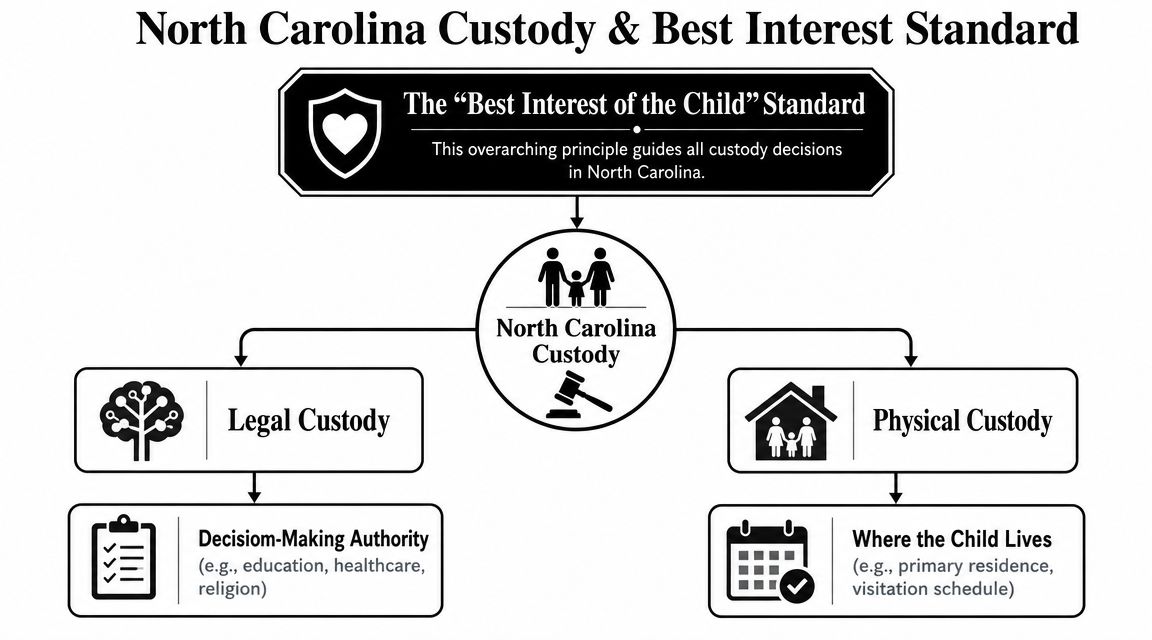
Legal custody and physical custody mean different things
Parents often say they want “full custody” without realizing the court separates custody into two categories.
| Type of custody | What it usually means in practice |
|---|---|
| Legal custody | Authority to make major decisions about the child's life, such as education and healthcare |
| Physical custody | Where the child lives and how parenting time is divided |
Those categories matter because the facts may support one request but not another. A parent may be capable of sharing major decisions yet still not be in a position to exercise equal parenting time because of work schedules, distance from school, housing problems, or a history of missed exchanges. Judges look closely at those details.
For a closer explanation of what courts weigh, see this guide to best interest of the child factors in North Carolina.
How judges apply the best interest standard in actual cases
“Best interests” is a broad legal phrase, but courtroom decision-making is usually concrete. Judges want facts they can tie to the child's daily life.
They often focus on who handles school communication, who schedules and attends medical appointments, whether the child has a reliable routine, how each parent communicates, and whether each parent can make reasonable decisions without creating unnecessary conflict. In higher-conflict cases, the court may also weigh domestic violence, substance abuse, untreated mental health conditions, neglect, unsafe partners, or repeated efforts to interfere with the child's relationship with the other parent.
This is the point many parents miss. The standard is broad, but the proof is specific.
A judge is not evaluating love in the abstract. A judge is deciding whether your proposed arrangement is stable, safe, workable, and supported by facts. If one parent can show attendance records, therapy records, messages about missed pickups, and a calendar reflecting the child's routine, that parent has given the court something usable. If the other parent offers only general complaints, the case is harder to prove even if some of those complaints are true.
The “mother always wins” myth hurts custody cases
That assumption causes strategic mistakes on both sides.
Fathers sometimes spend too much time arguing that the system is biased against them instead of building a record of parenting involvement. Mothers sometimes assume they will receive a preference and fail to document the problems that matter to a judge. Neither approach helps. North Carolina custody cases are won by proving facts tied to the child's welfare.
For unmarried parents, there is another issue that affects strategy early. Until paternity is legally established, the mother is generally treated as having custody. A father who wants custody or visitation usually needs to address parentage before the court can enter a custodial schedule. That point was noted earlier in the same source.
What this means for your case
The best interest standard is not vague once you approach it the right way. Build your case around proof that answers predictable judicial concerns.
Show who meets the child's needs. Show which schedule fits school, healthcare, transportation, and stability. Show whether the other parent follows through, communicates responsibly, and supports the child's relationship with you. In a difficult case, show the safety issue with records, witnesses, or other documentation.
That is how the standard becomes a strategy.
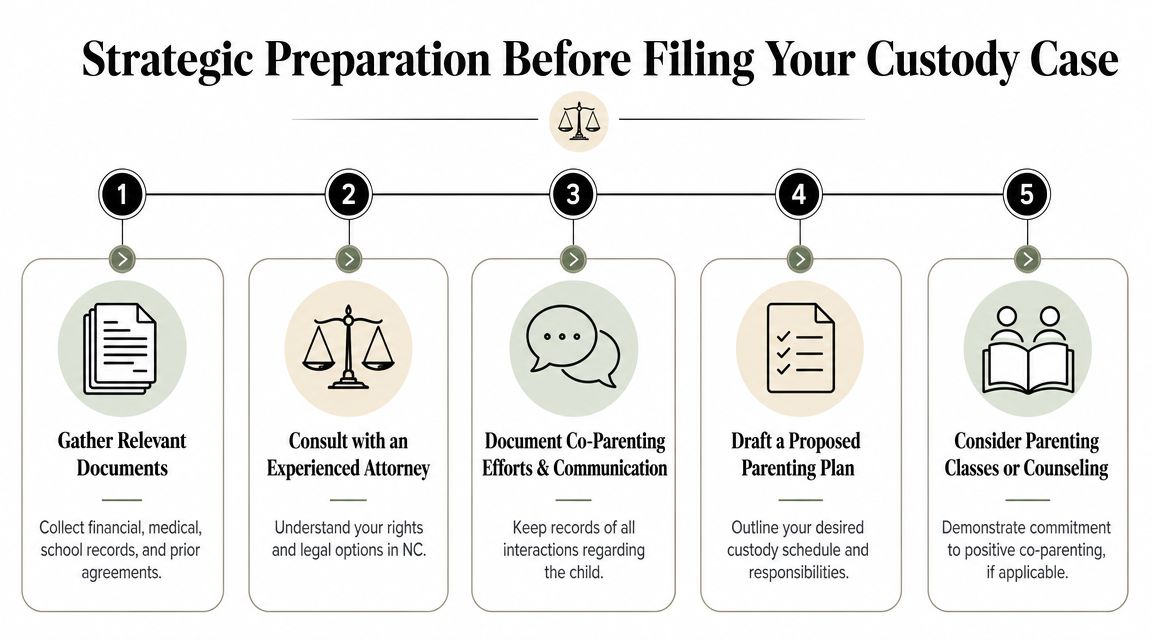
Strategic Preparation Before Filing Your Custody Case
A parent often calls my office after a blowup at pickup, a threat to “take this to court,” or a sudden change in the child's schedule. Filing that day can feel decisive. It can also leave you walking into a custody case without the records, timeline, or parenting plan needed to prove why your request serves your child better.
Preparation before filing is not about delay for the sake of delay. It is about building proof that matches the questions a North Carolina judge is likely to ask. In high-conflict cases, that early work often separates a focused custody claim from a complaint built on frustration.
North Carolina procedure matters, but strategy starts before the paperwork. You need to know where the case will be filed, what local rules apply, whether mediation will be required, and whether there is a real basis to seek temporary relief instead of waiting for the normal track. Good preparation keeps avoidable mistakes from shaping the case before the facts do.
Build your file before you file your complaint
Start with the documents that show daily parenting, not just conflict.
Judges make custody decisions based on the child's actual life. That means records tied to school attendance, medical care, therapy, transportation, routines, and follow-through carry more weight than broad statements about who is the “better parent.” Before filing, gather the material that shows who handles those responsibilities and how consistently they get done.
Useful records often include:
- School information: attendance reports, teacher emails, report cards, disciplinary notices, IEP or 504 documents, and messages showing who attends meetings or handles school problems
- Medical and mental health records: appointment histories, medication information, therapy scheduling, insurance records, and communications about treatment decisions
- Parent communication: texts, emails, co-parenting app messages, and calendar entries showing schedule changes, missed exchanges, refusal to cooperate, or reasonable efforts to solve problems
- Household and work records: lease or mortgage information, bedroom arrangements, work schedules, childcare plans, and transportation details that show the child can follow a stable routine in your care
Collect with a purpose. Every document should help answer a specific best-interest question.
Define the existing pattern of care
Before any judge hears your case, your child is already living a routine. That routine matters.
If your child has been with you most school nights, if you handle homework and tutoring, or if you are the parent who gets the call when the child is sick, document it in a way that can be explained clearly later. Do not rely on memory. Build a running timeline now.
A simple calendar often works well. Track overnights, school drop-offs, medical appointments, extracurriculars, missed visits, and important parent communications. In a close case, that timeline can become one of the most useful pieces of evidence because it shows a pattern instead of a one-time claim.
If the situation cannot wait, review this guide on how to get temporary custody in North Carolina. Temporary relief can be appropriate when there is a genuine safety issue or serious disruption to the child's stability.
Decide what result fits the facts
“Full custody” is not a strategy. It is usually a sign that the parent has not yet defined the actual problem.
The better approach is to identify the specific order that fits the child's needs and the proof you can present. In practice, that may mean asking for primary physical custody because the child's school-week routine already centers on your home. It may mean joint custody with a detailed schedule because both parents are involved but conflict is disrupting transitions. It may mean requesting final decision-making authority in one area, such as education or medical care, because the parents are deadlocked and the child is paying the price.
Overreaching hurts credibility. A narrow, well-supported request is often stronger than a broad demand you cannot back up.
Separate true urgency from a bad moment
Some cases should be filed immediately. Repeated neglect, substance abuse around the child, unsafe supervision, domestic violence, or extreme instability can require fast action.
Other cases feel urgent because emotions are high. That distinction matters. If the child is safe but the co-parenting relationship is deteriorating, the smarter move may be to spend a short period organizing records, identifying witnesses, and preparing a realistic parenting plan before filing. That usually puts you in a better position at mediation and in court.
This is also the point where legal advice can save you from expensive mistakes. A North Carolina family lawyer can assess whether your facts support emergency action, temporary orders, or a standard custody filing, and can spot county-specific issues early. The Law Office of Bryan Fagan handles North Carolina custody and family law matters, and parents in contested cases often benefit from getting that case assessment before the first filing goes out.
Building a Persuasive Evidence File to Support Your Case
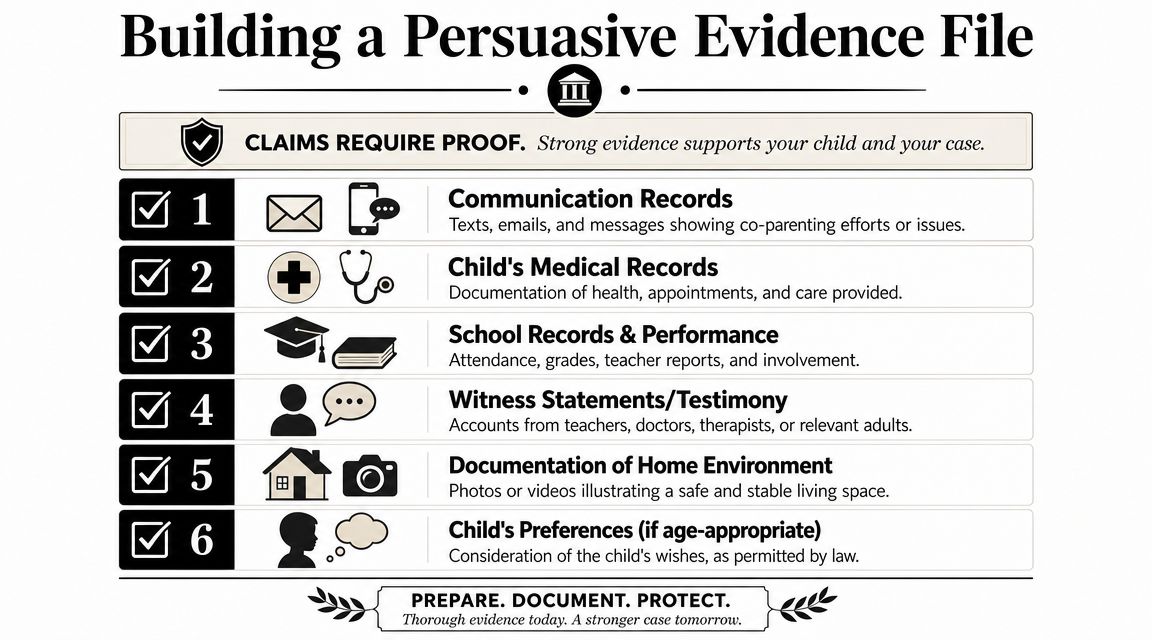
If you remember only one point from this article, remember this one: claims don't win custody cases. Records do.
North Carolina State Bar guidance explains that a parent seeking joint physical custody should be able to show a workable schedule, enough room and time to care for the child, that the arrangement would be least disruptive to the child, substantial prior involvement in the child's upbringing, and a history of cooperation and communication with the other parent. It also makes clear there is no automatic 50/50 presumption. The parent with the better documented, more stable, child-focused record is usually in the stronger position, according to North Carolina State Bar custody guidance.
Start with the ordinary facts of daily parenting
A persuasive file usually begins with the least dramatic evidence. That surprises people. They assume the case will turn on one explosive event. Sometimes it does. More often, it turns on a pattern.
A judge wants to understand who does the work of parenting. That means evidence of meals, homework help, transportation, school involvement, medical appointments, bedtime routines, and communication with teachers or providers.
Good evidence often looks like this:
- A parenting calendar: Show when the child stayed with you, when exchanges occurred, and who covered school nights.
- School emails: Preserve messages showing who responds to teacher concerns, attends conferences, or handles school problems.
- Medical records and logs: Track appointments, follow-up care, and who took responsibility for treatment.
- Child activity records: Keep notices, registrations, and schedules for sports, tutoring, therapy, or church activities if they matter in your family.
That kind of file gives the court a practical picture of your role.
Organize communication the right way
Text messages and emails can help or hurt. Don't dump hundreds of screenshots into a folder and assume your lawyer or the judge will figure out the story. Organize them by issue.
Create categories such as schedule changes, school problems, medical concerns, refusal to cooperate, and your own efforts to resolve disputes. Keep each category in date order. Make brief notes explaining why the exchange matters.
For example, a single angry message may prove very little. But a series of messages showing that you repeatedly offered exchange options, asked for school information, or tried to confirm appointments can demonstrate consistency and cooperation.
This short video gives a useful overview of evidence issues parents often overlook in custody disputes.
Match each document to a legal issue
The strongest evidence file is not just a pile of records. It is a mapped argument.
| Evidence | What it can help show |
|---|---|
| Attendance records | Stability, routine, and school support |
| Medical appointment logs | Consistent caregiving and attention to health needs |
| Messages about schedule planning | Cooperation and reliability |
| Photos of living space | A safe and appropriate home environment |
| Witness testimony | Third-party confirmation of parenting behavior |
Think like this: if you're asking for more custodial time, what proof shows that your home, schedule, and past conduct support that request? If you're raising safety concerns, what independent records support the concern beyond your own accusation?
Courtroom reality: A detailed calendar and neutral records often carry more weight than a parent saying, “I'm the one who always does everything.”
High-conflict cases require a different level of proof
When a case involves allegations of domestic violence, substance abuse, neglect, school instability, or serious mental health concerns, your proof needs to be stronger and more disciplined.
In those cases, helpful evidence may include:
- Police reports
- Medical records
- School records
- Counseling or treatment records, when properly available and relevant
- Witness statements from neutral adults
- Messages showing threats, intimidation, repeated impairment, or dangerous conduct
A common mistake is relying on informal stories from family members who are strongly aligned with one side. Sometimes those witnesses matter, but neutral witnesses are often more persuasive. A teacher, counselor, doctor, coach, or childcare provider may help the court understand what the child is experiencing without the same appearance of bias.
What not to include
Not every complaint belongs in your evidence file.
Leave out material that doesn't affect the child's welfare or the custody analysis. Judges usually don't care that the other parent is annoying, immature, or difficult in ways that don't relate to parenting. They care if the behavior affects safety, stability, decision-making, communication, or the child's relationship with each parent.
That's why a targeted file works better than an emotional one.
Build a narrative, not a scrapbook
Your goal is to tell a factual story the court can follow:
- This is the child's actual routine.
- This is my role in maintaining it.
- These are the problems affecting the child.
- This proposed arrangement addresses those problems with the least disruption possible.
When parents learn how to win a custody case in North Carolina, this is usually the moment things click. The case is not about saying the right things. It's about proving the right things.
Navigating Mediation Hearings and Courtroom Strategy
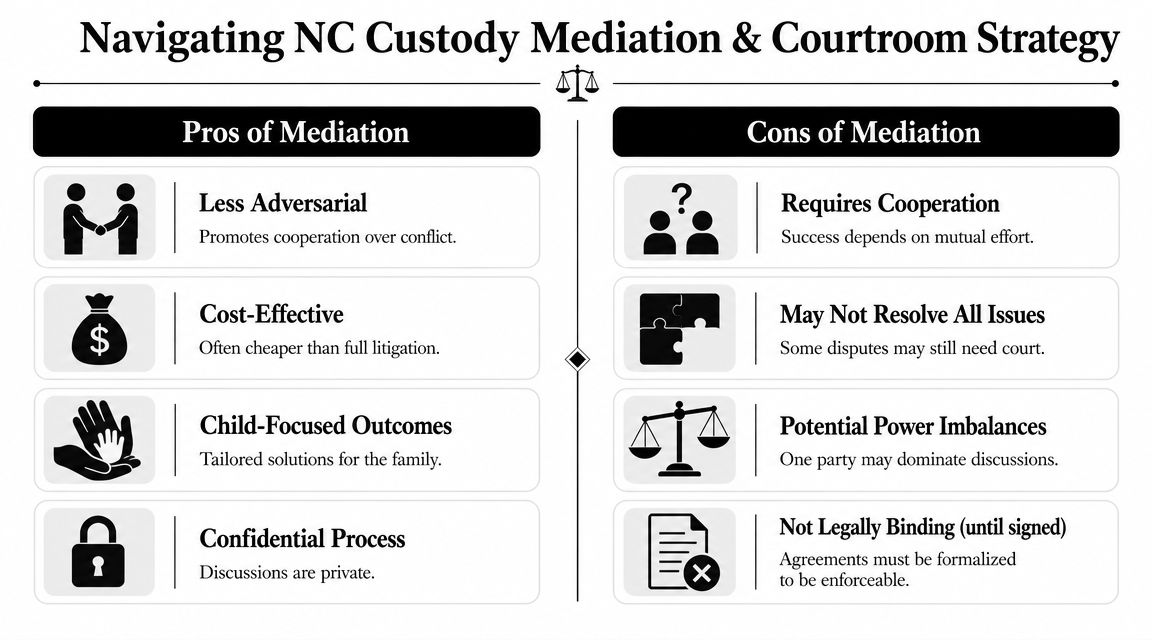
Many parents think the case begins when they walk into a courtroom. It usually doesn't. In North Carolina, mediation often shapes the outcome long before a trial date arrives, and your conduct during that stage can help or damage your case.
Mediation is commonly required before a final hearing unless an exception applies, such as domestic violence, according to the earlier cited North Carolina process guidance. Treat that requirement seriously. Parents who show up unprepared often waste a chance to resolve useful parts of the case or, at minimum, learn what the underlying disputes are.
How to prepare for mediation
Mediation works best when you arrive with a workable proposal instead of a list of grievances.
Bring a draft parenting plan. Know your school-year schedule, holiday preferences, transportation position, and how decision-making should work. Be ready to explain why your proposal fits the child's routine.
You don't need to concede important issues to be reasonable. But you do need to sound like a parent trying to solve a child-centered problem.
Temporary hearings and discovery
If the case doesn't resolve early, the next phase may involve temporary orders, discovery, and trial preparation. Discovery is the formal process for exchanging information and requesting records. In custody cases, that can matter when one parent controls school information, medical records, or communications that the other parent needs to present a complete case.
A temporary hearing can also set the tone. If there is already a temporary order in place, follow it carefully. Judges notice who treats orders seriously and who treats them like suggestions.
Credibility is part of the evidence
In North Carolina custody cases, judges evaluate behavior along with documents. Actions that undermine credibility, including disparaging the other parent, violating temporary orders, or making unilateral schedule changes, are viewed unfavorably, and strong custody presentations tie specific proof to the best-interest factors, as discussed in this North Carolina custody court guide.
That matters because many parents unintentionally damage a good case through bad conduct.
- Stay child-focused: Answer questions with facts about the child's needs, not speeches about the other parent's character.
- Follow existing rules: If an order says exchange at a certain time, comply unless your lawyer advises a lawful response to a real emergency.
- Avoid courtroom performance: Judges tend to trust calm, direct testimony more than rehearsed outrage.
- Use witnesses carefully: The strongest witness is often someone who observed parenting firsthand and can stay specific.
If you want to understand the factors courts weigh in contested cases, this article on how judges decide custody in North Carolina offers useful context.
The parent who appears organized, steady, and focused on workable solutions often presents better than the parent who seems determined to “win” at any cost.
What a judge wants to hear
Judges usually respond well to testimony that is concrete and restrained. For example:
- “I took our child to these appointments, and I have the records.”
- “This school schedule has worked consistently, and I'm asking to preserve it.”
- “I'm willing to support contact with the other parent if exchanges are structured this way.”
That kind of testimony helps the court make findings. Statements like “She's impossible” or “He never cares” usually don't.
Common Mistakes That Can Weaken Your Custody Case
A lot of parents don't lose ground because their concerns are weak. They lose ground because their behavior makes the court question their judgment. North Carolina law is focused on the child's best interests, not on proving one parent is morally superior. Conduct that looks like parental alienation or unilateral decision-making can hurt your case, and building a record of stability and cooperation is generally more effective than attacking the other parent without concrete proof of harm, as explained in this discussion of sole custody strategy in North Carolina.
Turning the case into a character contest
Parents often think the way to win is to show the judge that the other parent is selfish, lazy, dishonest, or difficult. Some of that may be true. But unless it connects to the child's well-being, it usually won't carry much weight.
A better approach is to prove specific effects on the child. Missed school. Missed medical care. Chaotic exchanges. Unreliable supervision. Refusal to share information.
Using the child as a messenger or ally
This mistake shows up in subtle ways. A parent asks the child to report what happens at the other house. A parent vents to the child about the case. A parent tries to win loyalty by making the other parent look bad.
Judges tend to view that conduct poorly because it puts the child in the middle of adult conflict. If you need information, get it through lawful communication, records, or witnesses, not through pressure on your child.
Ignoring orders, schedules, or communication
Parents often justify unilateral changes by saying they were only doing what made sense. That explanation usually sounds better at home than it does in court.
If there is a temporary order, follow it. If you need to request a change, do it the right way. If communication with the other parent is difficult, keep your messages short, respectful, and focused on the child.
Posting about the case
Social media creates unnecessary problems. Angry posts, indirect comments, screenshots, and new-relationship drama can all become distractions or impeachment material.
The safer course is simple. Don't post about the other parent, the case, or facts that could be twisted to question your judgment.
If you wouldn't want the judge reading it aloud in court, don't send it and don't post it.
Frequently Asked Questions About NC Custody Cases
Can a child choose which parent to live with in North Carolina
Not in the way many parents assume. A child does not get to make the final decision. In some cases, a judge may consider a mature child's preferences as part of the overall evidence, but the controlling issue remains the child's best interests.
What is the difference between sole and joint custody
Joint custody means both parents share some part of custody. That may involve shared decision-making, shared physical time, or both. Sole custody means one parent has primary authority over one or both aspects of custody, though the other parent may still have visitation or limited rights depending on the order.
In practice, the label matters less than the details. The essential question is who makes decisions, where the child lives, and what schedule governs parenting time.
Do I have to go to mediation in a North Carolina custody case
Often, yes. In many counties, parents must attempt mediation before a judge will hear the custody dispute unless an exception applies, such as domestic violence. Whether an exception applies depends on the facts and the local court process.
If mediation is required, treat it as a serious step. It can narrow disputes even when it doesn't resolve everything.
Can I win custody if I have been the child's main caregiver
Being the primary day-to-day caregiver can be very important, but it is not automatic. You still need to prove that role with records and show why your proposed arrangement supports the child's needs. Courts respond better to documented caregiving than to unsupported claims.
What if the other parent is making false accusations
Stay disciplined. Don't answer exaggeration with exaggeration. Gather records, preserve communication, identify neutral witnesses, and make sure your case stays anchored in proof. False accusations often lose force when one parent keeps producing organized, credible evidence and the other side keeps producing emotion.
Protect Your Rights and Your Child's Future in North Carolina
A strong custody case in North Carolina usually comes down to disciplined preparation. Know the legal standard. Build proof that fits it. Follow procedure. Stay credible. Ask for a parenting arrangement that works in real life, not one driven by anger.
If your case involves school instability, safety concerns, substance abuse, communication breakdowns, or a dispute over who has really been carrying the day-to-day load, the details matter. So does timing. A small mistake early can become a bigger problem later if it affects temporary orders, mediation, or the evidence you're able to present.
You don't have to sort through that alone. A focused legal strategy can help you decide what to document, what to stop doing, and how to present a case that gives the court usable facts instead of noise.
If you're facing a custody dispute, schedule a confidential consultation with the Law Office of Bryan Fagan to discuss your North Carolina case, your evidence, and the legal options available to protect your child's future.