
Being handed divorce papers can make the room go quiet. The exact words on the page often fade; the feeling remains. Their stomach drops, their mind jumps ahead to the house, the kids, the bank account, and whether they're about to lose control of everything at once.
If you're searching for what to do after being served divorce papers in NC, the first goal is simple. Slow the panic down enough to make smart moves. In North Carolina, the early steps matter because they shape what options you still have later. A rushed text, a missed deadline, or a bad decision with money can create problems that are much harder to fix once the case is moving.
Your First 24 Hours Understanding the Clock and the Claims
The worst first response is avoidance. Leaving the papers on the counter and hoping nothing happens won't protect you. It usually gives the other side an advantage.
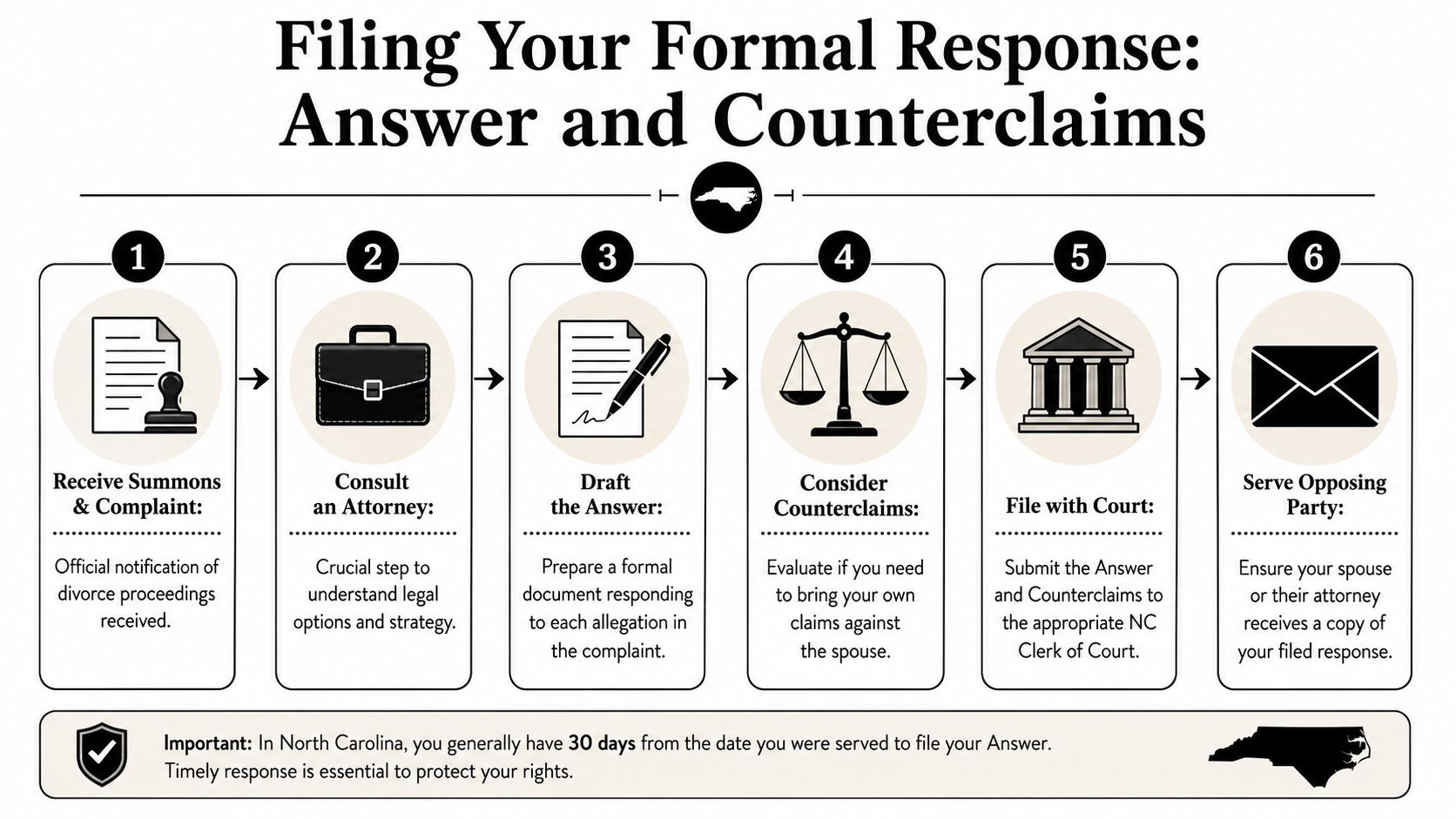
North Carolina procedure gives a served spouse 30 days to file an answer, and missing that deadline can let the court enter a default judgment or move the case forward without that person's input, as noted in this North Carolina divorce response overview. That is why the very first day should be about identifying the deadline and understanding exactly what was filed.
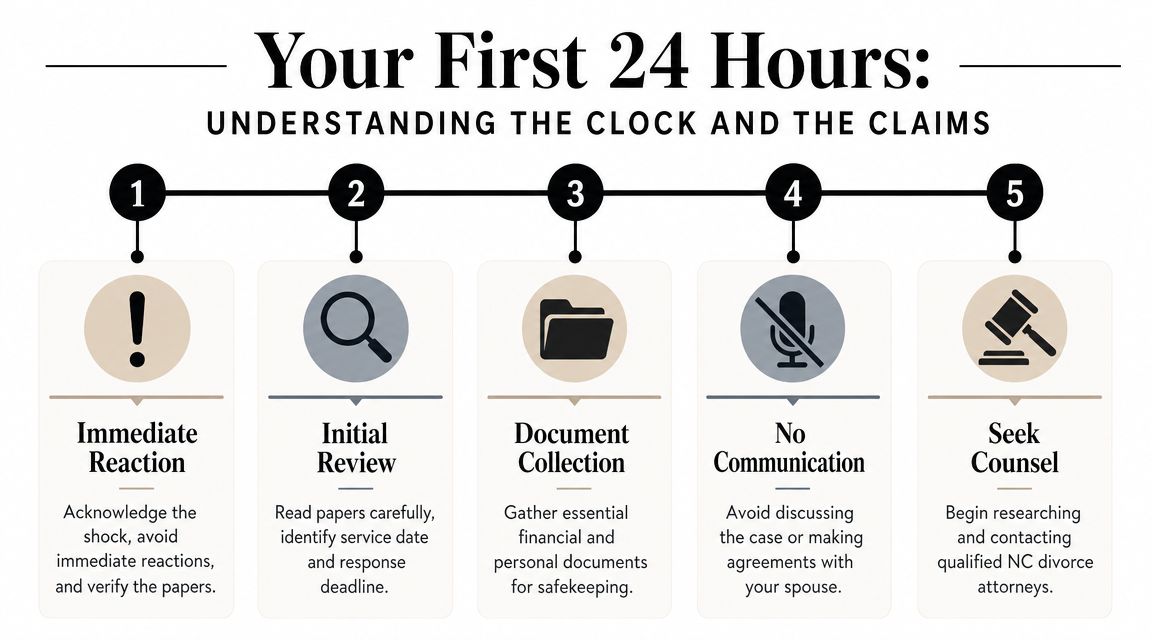
Read the papers like a checklist
Typically, recipients are served with at least two core documents.
| Document | What it means in plain English | Why it matters |
|---|---|---|
| Summons | The court's formal notice that a lawsuit has been filed against you | It tells you that your response time has started |
| Complaint | Your spouse's written claims and requests | It shows what your spouse is asking the court to do |
You may also see terms that feel cold or unfamiliar.
- Plaintiff means the person who filed the case.
- Defendant means the person responding to it.
- Allegation means a statement one side is making in the filing.
- Relief requested means what that person wants the court to order.
Don't assume every statement in the complaint is true just because it appears in a court document. Filing a complaint is not the same thing as proving a claim.
What to mark right away
Take a pen and mark up the papers. That's often more useful than rereading them in a panic.
- Date of service: Write down the day you received the papers.
- Court county: Check which North Carolina county the case was filed in.
- Claims made: Look for references to custody, child support, alimony, property division, or possession of the home.
- Requests for immediate action: See whether your spouse is asking for anything urgent.
Practical rule: Don't rely on memory. Put the response deadline on your phone calendar, your paper calendar, and any reminder app you actually use.
A common early mistake is calling a spouse immediately to argue about what the complaint says. That usually creates new evidence, not new clarity. If emotions are high, a short message about child logistics may be necessary. A debate about the case usually isn't.
Your first-day triage list
If you need a narrow set of next moves, use this order:
- Confirm the date you were served.
- Read every page once without reacting.
- Read it again and highlight claims that affect children, money, or the home.
- Save the envelope, service paperwork, and all attachments together.
- Start looking for legal guidance immediately.
If your spouse's filing surprises you, that doesn't mean you're already behind beyond repair. It means the clock is running, and your job is to respond strategically instead of emotionally.
Protect Your Position With Financial and Evidence Preservation
Once the immediate shock settles, the next issue is preservation. People often hurt their own cases in the first week because they act out of fear. They empty accounts, delete messages, change access to everything, or start making side agreements they later regret.
A better approach is simple. Preserve first. Decide second.
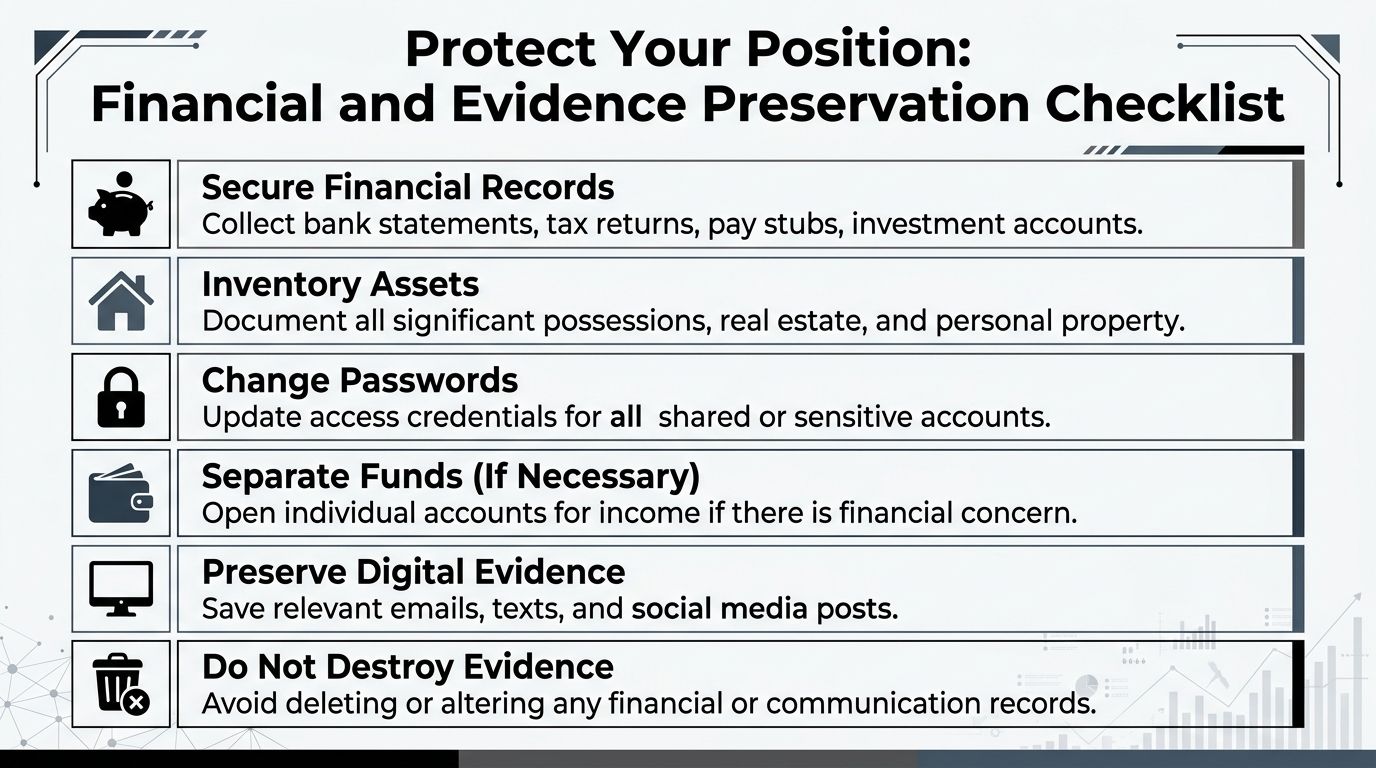
Evidence you should keep
Divorce cases often turn on communication patterns, financial conduct, and parenting behavior. That means ordinary records matter.
Keep copies of relevant:
- Texts and emails: Especially messages about parenting, finances, separation, threats, or agreements.
- Social media posts: Save screenshots if a post could later disappear.
- Calendars and schedules: These can matter in custody disputes.
- Photos and documents: Property conditions, household items, and financial paperwork can all become important.
Don't edit messages before saving them. Don't clean up a thread. Don't delete old posts because they feel embarrassing. Once a case starts, deleting potentially relevant material can become its own problem.
Save first in a stable format, then discuss relevance with your lawyer. People make bad judgment calls when they decide too early what “won't matter.”
Here's a real-world example of the kind of mistake that causes trouble. A spouse receives divorce papers, gets angry, and deletes a month of texts because the messages are messy and emotional. Later, those texts might have shown who handled school pickups, who proposed temporary support, or who escalated conflict. Deleting them doesn't erase the issue. It can make your position harder to defend.
Financial moves that help and financial moves that backfire
Money decisions right after service should be measured. The court can look closely at conduct around accounts, debts, and property.
Do this
- Secure records: Gather bank statements, pay stubs, tax returns, retirement statements, loan documents, and account screenshots.
- Inventory property: Make a practical list of vehicles, real estate, major household items, business interests, and valuable personal property.
- Protect digital access: Change passwords to your personal email, cloud storage, and individual financial accounts.
- Open a separate account if needed: If your paycheck is at risk or access to money is unstable, talk with counsel about safe next steps.
Don't do this
- Don't drain joint funds out of anger.
- Don't hide cash or move property to relatives.
- Don't run up new debt to punish your spouse.
- Don't destroy records, journals, or devices.
This video gives additional context on how early divorce decisions can affect the case:
A practical way to think about the first week
If an action would look defensive, secretive, or retaliatory when explained to a judge, pause before doing it. That doesn't mean you must stay passive. It means your protective steps should be organized and reasonable.
The strongest early position usually comes from documentation, not drama.
Address Urgent Needs with Temporary Orders
Many people think they have to wait until the divorce is final before the court can help with parenting or financial stability. In North Carolina, that's often wrong.
North Carolina requires one year of separation before an absolute divorce can be filed, and at least one spouse must have lived in North Carolina for six months before filing. But major issues can still be addressed during separation, including property division, alimony, custody, visitation, and child support, as explained in this North Carolina divorce separation overview.
When temporary orders matter
Temporary orders are short-term court rulings designed to stabilize daily life while the larger case is pending. They are often essential when one spouse controls the money, when parenting time is disputed, or when the children need immediate structure.
Common examples include requests involving:
- Child custody and visitation
- Child support
- Post-separation support
- Use of certain property or access to key records
A familiar scenario is the dependent spouse who stayed home with the children and suddenly finds the household funds cut off after service. In that situation, waiting passively can create avoidable damage. A request for temporary financial relief may be necessary to keep housing, food, transportation, and routine expenses from collapsing.
Stability now can affect leverage later
Temporary orders don't decide everything forever, but they often shape the lived reality of the case. If children settle into a schedule, or one spouse carries the financial burden alone for months, that practical pattern can influence later negotiations.
For parents dealing with immediate custody concerns, this guide on temporary custody in North Carolina can help you understand when faster court action may be appropriate.
Early court intervention is sometimes less about “winning” and more about stopping instability from becoming the new normal.
If you're worried about where the children will stay next week, whether bills can be paid, or whether your spouse is making unilateral decisions, temporary relief may be the right next move. Waiting out the separation period without a plan rarely works well in high-conflict cases.
File Your Formal Response Your Answer and Counterclaims
At some point, strategy has to become paperwork. In North Carolina, that usually means filing an Answer. This is the formal response to the complaint. It is not a letter to the judge, and it is not a chance to tell your whole life story.
An Answer responds to the complaint paragraph by paragraph. For each allegation, you generally admit it, deny it, or state that you lack sufficient information to admit or deny it. Precision matters. Overreacting in an Answer can damage credibility. Admitting too much can limit your room to argue later.
What an Answer does and does not do
Think of the Answer as your official first response inside the court system.
| Filing step | What it does | What it does not do |
|---|---|---|
| Answer | Responds to your spouse's allegations | It does not automatically ask for everything you want |
| Counterclaims | Raises your own requests for relief | They do not replace the need to answer the complaint |
| Motion to dismiss | Challenges a filing in limited situations | It is not a general shortcut around responding |
The legal system rewards clean, disciplined pleading. It does not reward outrage.
Why counterclaims can be strategically important
A lot of people assume that if they deny enough allegations, that's enough. It usually isn't. If you want the court to award or decide something in your favor, you may need to raise your own claims formally.
Counterclaims may involve requests tied to issues such as:
- Custody or visitation arrangements
- Child support
- Alimony or post-separation support
- Equitable distribution of property and debts
If you file only an Answer, you may be defending without affirmatively stating what relief you want. That can be a weak posture in a contested case.
For a broader overview of how these filings fit into the process, review this page on North Carolina divorce papers.
A strong response doesn't just say, “I disagree.” It also says, “Here is what I am asking the court to do.”
When a motion to dismiss may come up
A motion to dismiss can be appropriate in some cases, but it is not the standard response for individuals served with divorce papers. It usually applies when there is a legal defect in the pleading or some threshold issue that prevents the case from proceeding as filed.
That's why this stage benefits from legal review. The right filing posture depends on what was alleged, what relief is being sought, and what you need to preserve now rather than trying to fix later.
Deciding When to Hire a North Carolina Divorce Lawyer
You may be telling yourself you can wait a few weeks, see how your spouse acts, and hire a lawyer only if things get ugly. That choice can cost you. In North Carolina, early decisions shape advantage, deadlines, and what issues are preserved for the court to decide.
Some cases stay relatively contained. Many do not. A complaint that looks simple on day one can turn into a dispute over custody, support, possession of the home, hidden spending, or who controls the financial records.
The practical question is not whether you can technically respond on your own. The better question is whether you can spot the legal and strategic risks in time to avoid giving up ground.
Situations where waiting is risky
Hire counsel early if any of the following applies:
- Children are involved: Parenting time, school decisions, travel, and communication rules often need structure fast.
- There is a large income difference: Support exposure and short-term access to money can affect every other decision.
- You own a house, retirement accounts, investments, or significant debt: Property cases are often won or lost in the details and documentation.
- A family business or self-employment income is part of the picture: Income may be harder to pin down, and records matter.
- There has been domestic violence, intimidation, or coercive control: Safety planning and court strategy need immediate attention.
- Your spouse hired a lawyer first: That usually means the case is already being framed with specific goals in mind.
- You suspect missing money, unusual transfers, or account changes: Delay makes fact-gathering harder and explanations more polished.
A lawyer also helps in less obvious situations. For example, many people do not realize that being reasonable and being passive are not the same thing. Courts value calm conduct, but calm conduct still needs a clear legal position behind it.
What a lawyer changes early in the case
Good representation is not about adding conflict. It is about making deliberate choices while there is still time to make them.
That can include reviewing the claims against you, identifying what must be filed now, deciding whether temporary relief should be requested, and preventing informal arrangements from turning into damaging patterns. It also means giving you a realistic view of trade-offs. Pushing hard on one issue can affect settlement on another. Asking for too little can create a weak starting point that is difficult to correct later.
I often tell people this: the cheapest point to fix a mistake is before it happens.
The Law Office of Bryan Fagan handles North Carolina divorce, custody, support, and property cases for people who need clear advice after service. If you are not sure what to bring or how to get organized before meeting with counsel, this guide on preparing for a North Carolina divorce consultation can help.
A practical way to decide
Ask yourself three questions:
- Do I understand every claim my spouse made?
- Do I know what relief I want the court to grant me?
- Would I be comfortable making decisions this week that could affect custody, support, or property months from now?
If the answer to any of those is no, getting legal advice now is usually the safer move.
People often wait because they want to save money, avoid escalation, or believe they can stay cooperative if they do not involve lawyers too soon. Sometimes that works. Often, it leaves one spouse reacting while the other spouse sets the pace. In a North Carolina divorce case, that is rarely the stronger position.
Your Next Steps A Checklist for Your Consultation
A consultation goes better when you show up with the right material. You do not need a perfect binder. You do need enough information for a lawyer to spot immediate risks and likely next moves.

Bring these items if you have them
- The papers you were served with: Summons, complaint, and anything attached.
- A short marriage timeline: Separation date, when conflict escalated, major parenting or financial changes.
- Income information: Recent pay stubs or proof of earnings.
- Basic asset and debt list: House, cars, accounts, loans, credit cards, retirement, and major personal property.
- Key communications: Relevant texts, emails, or screenshots.
- Questions you want answered: Write them down. People forget under stress.
What makes a consultation productive
Be direct. If there was an affair, hidden spending, domestic violence, addiction, job loss, or a threat to take the children, say so. Lawyers can only protect what they know about.
If you want help getting organized before that first meeting, this guide on preparing for a North Carolina divorce consultation is a useful place to start.
A good consultation should leave you with more clarity than fear. You may not get every final answer on day one, but you should come away knowing what needs immediate attention, what can wait, and what not to do in the meantime.
North Carolina Divorce FAQ
Do I have to move out of the marital home after being served?
Not automatically. Being served doesn't by itself force you to leave the home. Whether staying or leaving is wise depends on safety, children, finances, and the overall conflict level. Moving out without legal advice can affect your bargaining power in some cases, so get guidance before making that decision if possible.
Does it matter who files first in North Carolina?
Usually, filing first doesn't guarantee a better outcome by itself. What matters more is what claims are included, whether deadlines are met, and how well each side documents the facts. Filing first can sometimes offer procedural advantages, but it doesn't mean one spouse automatically “wins.”
Can we settle issues before the divorce is final?
Yes. Many spouses resolve custody, support, property, and other disputes before the final divorce judgment. In some cases, early agreements reduce cost and conflict. In others, fast agreements create long-term problems because one side agreed before getting legal advice.
What if my spouse is saying false things in the complaint?
That is one reason the formal response matters. Allegations in a complaint are claims, not proven facts. A careful Answer and, where appropriate, counterclaims help you put your position before the court in the proper form.
If you've been served with divorce papers in North Carolina, getting clear advice early can make the next steps far less overwhelming. The Law Office of Bryan Fagan works with North Carolina residents on divorce, custody, support, and property issues, and a consultation can help you understand your deadlines, your options, and the smartest way to protect your position.