When people hear “contested divorce,” their minds often jump to dramatic courtroom battles. While some cases do end up in front of a judge, the reality in North Carolina is usually more about process, negotiation, and resolving fundamental disagreements. A contested divorce simply means you and your spouse cannot agree on one or more key issues required to finalize your separation.
It’s not a fight over whether you can get divorced, but a dispute over the terms of the divorce itself. Because you can't reach an agreement on your own, you need the court system to step in and make decisions for you.
What a Contested Divorce Means in North Carolina

At its heart, a contested divorce in North Carolina means you and your spouse have reached a point where you cannot independently resolve the critical details of ending your marriage. This is where the legal process provides a necessary, structured framework to help you move forward.
Think of it like dissolving a business partnership. You have to divide assets, settle debts, and create a plan for any shared responsibilities—in this case, your children. When the partners can’t agree on how to do that, a neutral third party is needed to make binding rulings. In a divorce, that third party is the North Carolina court system.
The Foundation: A One-Year Separation
Before any divorce can be finalized in North Carolina—contested or not—you and your spouse must meet a mandatory waiting period. This is a strict requirement with no exceptions.
Under North Carolina General Statutes § 50-6, you must live separate and apart for one full year with the intent that the separation is permanent.
This separation is non-negotiable and serves as the primary grounds for a “no-fault” divorce in our state. You don't have to prove wrongdoing like adultery to get divorced; you just have to prove you've lived apart for the required time.
This one-year period is far from dead time. It’s a crucial opportunity to gather financial documents, consult with an attorney, and begin the work of untangling your lives. It’s also when you start negotiating the issues that make your case contested.
Uncontested vs Contested Divorce in North Carolina
Understanding the core differences between an uncontested and a contested divorce is key to knowing what to expect. The path you take will dramatically affect your timeline, costs, and stress levels.
| Aspect | Uncontested Divorce | Contested Divorce |
|---|---|---|
| Agreement | Spouses agree on all issues (property, custody, support) before filing. | Spouses disagree on one or more major issues. |
| Process | Primarily involves paperwork; a Separation Agreement is drafted and signed. Often no court appearances are needed. | Involves formal legal steps: filing, discovery, mediation, hearings, and potentially a trial. |
| Timeline | Can be finalized relatively quickly after the one-year separation is met. | Can take many months or even years to resolve, depending on the complexity of the disputes. |
| Cost | Significantly less expensive due to fewer legal hours and no litigation costs. | Far more expensive due to attorney's fees, court costs, expert witness fees, and mediation. |
| Control | Spouses retain control over the final outcome by creating their own agreement. | A judge makes the final decisions on disputed issues, taking control away from the spouses. |
While an uncontested divorce is always preferred for its simplicity and lower cost, it’s only possible if both sides are fully aligned. If you’re facing disagreements, you are, by definition, in a contested situation.
What Are You Actually Contesting?
In a contested divorce, you aren't arguing about the divorce itself. The conflict is about the specific, tangible issues that come with separating a shared life. These disputes almost always fall into three main categories:
- Equitable Distribution: This is the legal term for dividing your marital property and debt. Fights often erupt over what’s considered “marital” vs. “separate” property, how to value a family business or pension, or who is responsible for the credit card debt.
- Child Custody and Child Support: For parents, nothing is more important than the children. Determining a parenting schedule (custody) and calculating financial support can become highly emotional and contentious. The court’s guiding principle is always the “best interest of the child.”
- Alimony and Post-Separation Support: This is financial support paid by one spouse to the other. Disputes over whether support should be paid at all, how much, and for how long are incredibly common, especially in marriages with significant income differences.
An uncontested divorce resolves these issues in a signed agreement before court involvement. A contested divorce uses the court system to resolve them for you.
The Contested Divorce Process Step by Step
Going through a contested divorce in North Carolina can feel like you’ve been dropped into a new country with no map. But there is a clear, predictable path from start to finish. Knowing what’s coming next can give you a sense of control during a time when everything feels uncertain.
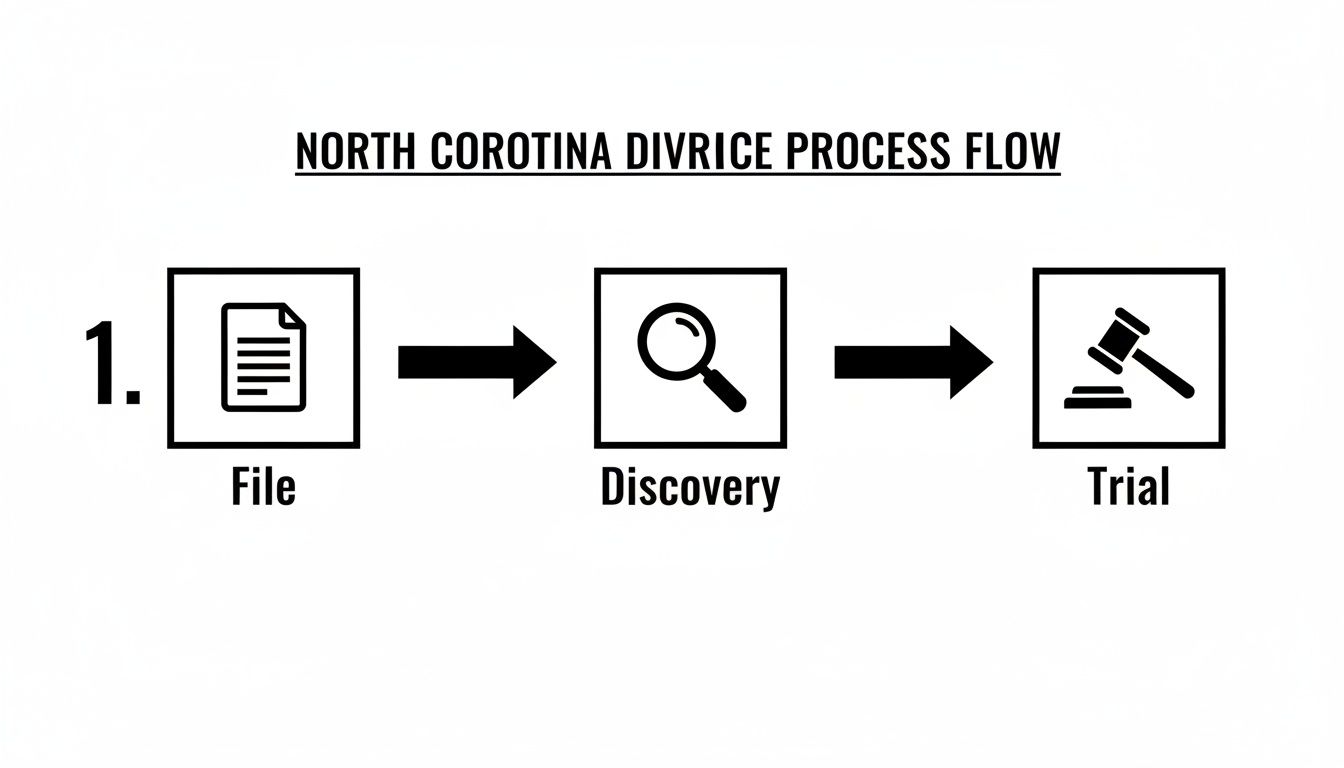
The whole journey kicks off the moment one spouse takes the first legal step.
Filing the Complaint and Initial Pleadings
The first official move is for one spouse to file a Complaint with the court. This isn't just a simple form; it's a detailed legal document that tells the court and your spouse exactly what you're asking for. Your Complaint will lay out your claims for things like equitable distribution (how you want property divided), post-separation support or alimony, and if you have children, child custody and child support.
Once the Complaint is filed, it has to be legally delivered, or "served," to your spouse along with a formal summons. From that point, your spouse typically has 30 days to file their formal response, which is called an Answer. In their Answer, they’ll respond to each point in your Complaint and can also bring their own claims, known as counterclaims. This back-and-forth of legal documents sets the stage and officially defines the issues the judge will need to help you resolve.
Navigating the Discovery Process
With the initial paperwork filed, your case moves into the discovery phase. Think of this as the official fact-finding mission for your divorce. This is the formal, court-supervised process where both sides get to gather evidence and information from each other and from third parties like banks or employers.
In North Carolina, we rely on a few key discovery tools:
- Interrogatories: These are written questions your spouse is required to answer in writing and under oath.
- Requests for Production of Documents: This is a formal demand for specific documents like bank statements, tax returns, deeds, pay stubs, and business records.
- Depositions: This is out-of-court testimony given under oath. Attorneys get to question your spouse or other important witnesses in front of a court reporter, who creates a transcript of everything that's said.
Discovery is where we build the foundation of your case. For instance, if you’re worried your spouse isn't being honest about their finances, discovery is how your attorney can uncover hidden accounts or assets to ensure the property division is truly fair.
A thorough discovery process is the bedrock of a strong legal strategy. It makes sure that every decision, whether in negotiation or in court, is based on a full and honest set of facts—not just guesswork.
Temporary Orders and Hearings
A contested divorce doesn't happen overnight—it can take many months to resolve. But your bills and your children's needs can't be put on pause. That’s where temporary orders come in. Either you or your spouse can ask the court to step in and make temporary decisions on urgent issues, including:
- A temporary child custody schedule
- Temporary child support payments
- Post-Separation Support (a temporary form of alimony)
- Who gets to live in the family home while the divorce is pending
A judge puts these orders in place after a court hearing, giving your family a measure of stability and financial predictability until you reach a final agreement or go to trial.
North Carolina’s Mandatory Mediation
Before you can ask a judge to make the final call in a trial, North Carolina law requires you and your spouse to try and work it out first. For disputes over property and custody, mediation is a mandatory step. It’s a confidential and structured negotiation session guided by a neutral professional mediator.
The entire point of mediation is to find common ground and reach your own agreement, saving you the immense stress and expense of a courtroom battle. If you settle everything, you’ll sign a binding contract that resolves your case. If you only agree on some things, that's still a win—those issues are settled, and you'll only have to go to trial on the few matters that remain in dispute.
The Final Step: Trial
If you’ve gone through mediation and still can’t reach an agreement on every issue, your case will be scheduled for trial. A trial is your day in court. Both sides will present evidence, question witnesses, and make their legal arguments directly to a family court judge.
After hearing everything, the judge will issue a final, binding court order that resolves all the contested issues. That order is the final judgment that legally defines the terms of your divorce.
Navigating Key Issues in a NC Contested Divorce
When you and your spouse can’t agree on the fundamental terms of your separation, the divorce is considered “contested.” These disagreements almost always center on three core areas: how to divide your property, how to co-parent your children, and whether one spouse requires financial support from the other.
Understanding how North Carolina law addresses each of these issues is the first step toward building a strong legal strategy and protecting your future.
Equitable Distribution: Dividing Marital Property
One of the most common battlegrounds in a contested divorce is Equitable Distribution. This is North Carolina’s legal framework for dividing the property and debts you both acquired during your marriage. A frequent point of confusion is the word "equitable"—it does not automatically mean a 50/50 split.
Under North Carolina General Statute § 50-20, the court starts with the presumption that an equal division is fair. However, a judge has the authority to order an unequal division if one party can prove it would be more just. To make this decision, the court will weigh several factors, including:
- The income, property, and debts of each spouse.
- The length of the marriage.
- The physical and mental health of both spouses.
- A spouse’s contributions to the other's education or career advancement.
- Contributions that increased the value of what was otherwise separate property.
Real-World Example: Imagine a scenario where one spouse managed the household and raised the children for 15 years, allowing the other to build a thriving business. That business is a marital asset, but valuing and dividing it is rarely simple. The court will carefully consider the non-financial contributions of the stay-at-home spouse when deciding what a truly "equitable" division looks like, potentially awarding them more than 50% of the total marital estate to account for their role in the business's success.
Properly identifying, valuing, and dividing assets—especially complex ones like businesses, pensions, or stock options—is critical. You can explore this topic further in our detailed guide on Equitable Distribution in North Carolina.
Child Custody and Child Support
For any parent, nothing is more important than the well-being of their children. In North Carolina, every decision regarding child custody is made according to a single legal standard: the “best interest of the child.” This isn't just a phrase; it's the specific test a judge must apply in every custody case.
There is no automatic preference for mothers or fathers in North Carolina. A judge will look at all relevant factors to design a parenting arrangement that will “best promote the interest and welfare of the child.” These factors often include:
- Each parent’s ability to create a stable, loving, and safe home.
- The child's existing relationship with each parent.
- The role each parent played in the child’s life before the separation.
- Any history of domestic violence, substance abuse, or other issues that could impact the child's safety.
Child support is the financial side of the custody equation. North Carolina uses specific Child Support Guidelines to determine the amount. This calculation is driven primarily by both parents' gross monthly incomes and the custody schedule, or how many overnights the child spends with each parent. Other costs, like health insurance and work-related childcare, are also factored into the final support order.
Disputes often arise when one parent suspects the other is intentionally underemployed to lower their support obligation, or when there are disagreements over the true costs of raising the child.
Alimony and Post-Separation Support
Financial support paid by one spouse to another—known temporarily as Post-Separation Support (PSS) and then as alimony—is often one of the most contentious issues in a divorce.
A spouse is considered "dependent" if they are financially reliant on the other spouse for their maintenance and support. The court determines this by looking at income, reasonable expenses, and each spouse's earning capacity. To grant alimony, a judge must find that one spouse is dependent, the other is a supporting spouse, and an award would be fair under the circumstances.
However, under North Carolina General Statute § 50-16.3A, marital misconduct can have a decisive impact.
- If the court finds the dependent spouse (the one seeking support) committed adultery before the date of separation, they are prohibited from receiving alimony.
- On the other hand, if the supporting spouse (the one who would pay) committed adultery, the court must award alimony to the dependent spouse.
These black-and-white rules are a key reason why disagreements over assets, support, and parenting can quickly escalate, driving up the time and expense of a divorce.
How to Prepare for Your Contested Divorce

In a contested divorce, preparation is your single greatest advantage. While your attorney will steer the legal strategy, the case itself is built on the information and documents you provide. Getting organized now protects your rights, makes the process more efficient, and gives us the tools to advocate effectively for your future.
Think of it this way: the more prepared you are, the stronger your position becomes. When you bring us organized facts and clear documentation, we can build a compelling case right from the start.
Gather Your Financial Documents
The discovery phase of every contested divorce in North Carolina demands full financial transparency. You can save yourself a tremendous amount of time and stress by beginning to collect these documents immediately.
Your mission is to paint a complete picture of your marital finances. Start gathering these key items:
- Income Information: At least three years of personal and business tax returns, your most recent pay stubs, your spouse’s recent pay stubs (if you have access), and any W-2 or 1099 forms.
- Banking Records: At least 12 months of statements for every checking, savings, or money market account, regardless of whether it’s held jointly or in one person’s name.
- Debt Statements: The latest statements for all credit cards, mortgages, home equity lines of credit (HELOCs), vehicle loans, and any other personal loans.
- Retirement and Investment Accounts: The most recent statements available for all 401(k)s, IRAs, pensions, brokerage accounts, and stock option plans.
Create an Asset and Debt Inventory
With your documents in hand, the next step is to create a straightforward list of everything you and your spouse own and owe. This inventory is absolutely vital for the equitable distribution negotiations.
List out every major asset and make a note of when it was acquired—before or during the marriage. Then, estimate its current value. Do the exact same thing for all debts, listing the current balance owed. This exercise helps you and your attorney clearly distinguish between marital property (acquired during the marriage) and separate property (owned before marriage or received as a gift/inheritance), a cornerstone of any North Carolina divorce.
Document Everything That Matters
When it comes to disputes over child custody or alimony, your own records often become the most persuasive evidence. Do not trust your memory alone when the stakes are this high.
Keep a calm, factual journal to log events, conversations, and other interactions relevant to your case. Always include dates, times, and specific, objective details. This is especially critical in custody disputes, where a parent’s day-to-day involvement is central to the court’s “best interest of the child” analysis.
For instance, if you are the parent who consistently handles school runs, doctor’s appointments, and homework help, documenting it creates an undeniable record of your role. You should also save important texts or emails with your spouse—but refuse to get drawn into angry, emotional arguments. Your attorney can use concrete facts, not just emotional accounts.
Critical Mistakes to Avoid
During a contested divorce, what you don’t do is just as important as what you do. Steer clear of these common mistakes that can inflict serious damage on your case:
- Posting on Social Media: You must assume that your spouse's lawyer will read everything you post. Do not discuss your case, your spouse, or your social activities online. Period.
- Making Rash Financial Decisions: Do not drain bank accounts, max out credit cards, or sell off major assets without speaking to your attorney first. These actions can have severe consequences.
- Putting Children in the Middle: Never use your kids as messengers or say negative things about their other parent in front of them. North Carolina judges have zero tolerance for this behavior.
Your conduct from the moment of separation matters. By staying organized, documenting the facts, and avoiding impulsive decisions, you give yourself the best possible chance at a strong, favorable outcome.
The Critical Role of Your Divorce Attorney
Trying to handle a contested divorce in North Carolina on your own is a massive risk. With emotions running high and your financial future on the line, going it alone can lead to costly, irreversible mistakes.
An experienced family law attorney isn’t a luxury in these situations—they are essential for protecting your rights, your assets, and your family. When the issues get complicated, your attorney acts as your objective guide and your strongest advocate, translating dense legal rules into a clear, actionable plan.
Strategic Case Planning and Advocacy
A skilled attorney does much more than just file paperwork. They are your strategist. They start by analyzing the unique facts of your case to build a comprehensive plan—one that identifies your goals, anticipates your spouse’s arguments, and maps out the most effective path forward. Their representation is not a guarantee of any specific result, but it ensures your case is presented as strongly as possible.
Their role is to protect you at every stage:
- Legal Guidance: They explain exactly how North Carolina laws on equitable distribution, child custody, and alimony apply to your specific situation.
- Evidence Management: They manage the formal discovery process, gathering the financial records, communications, and other documents needed to build a strong, evidence-based case.
- Negotiation and Mediation: Your lawyer represents you in negotiations and mandatory mediation, fighting for a fair settlement while shielding you from direct, unproductive conflict with your spouse.
- Courtroom Advocacy: If your case goes to trial, they become your defender in the courtroom, presenting evidence and making persuasive legal arguments to the judge on your behalf.
For example, if you suspect your spouse is hiding assets, your attorney knows precisely which legal tools to use—like subpoenas and depositions—to uncover the truth. Without that professional insight, critical information could stay hidden, resulting in a deeply unfair division of your marital property.
More Than a Lawyer—An Objective Partner
Beyond legal tactics, one of the most valuable roles an attorney plays is that of a rational advisor. It’s easy to make emotional decisions during a divorce that could harm you for years to come. Your attorney provides a calm, objective perspective focused on one thing: securing the best possible legal outcome for you.
Learn more about how a dedicated North Carolina divorce lawyer can make a critical difference in your case.
An effective attorney not only protects your assets and parental rights but can also save you significant money in the long run. By helping you avoid costly mistakes and securing a fair settlement, their representation is an investment in your future financial stability.
They manage the court’s strict deadlines, handle all communication with your spouse’s attorney, and navigate complex procedures on your behalf. This frees you to focus on what truly matters: taking care of yourself and your family as you prepare for the next chapter of your life.
Frequently Asked Questions About Contested Divorce in NC
When you're facing a contested divorce, it's natural to have a long list of questions and feel a deep sense of uncertainty. Getting clear, straightforward answers rooted in North Carolina law is the first step toward feeling more in control. Here are the answers to some of the most common questions we hear from clients in your exact situation.
How long does a contested divorce take in North Carolina?
While a simple, uncontested divorce can be over soon after the one-year separation, a contested case is a different story. In North Carolina, you should prepare for a contested divorce to take between 6 and 18 months. The final timeline depends on the complexity of your finances, the level of disagreement, and the local court's schedule. It's a marathon, not a sprint, because it involves necessary legal steps like discovery, temporary hearings, and mandatory mediation.
Do I have to go to court for a contested divorce?
Not necessarily. It's a common myth that "contested" means you're guaranteed a dramatic courtroom battle. The truth is, North Carolina's legal system is designed to help you settle things without ever seeing a judge. Most counties require you to attend mediation for property division and child custody disputes. A surprising number of "contested" cases are fully resolved this way, saving everyone the stress and expense of a trial. If mediation fails, then yes, the final step is to have a judge decide the remaining issues in court.
Can I get alimony if I committed adultery in North Carolina?
In most cases, the answer is no. North Carolina is one of the strictest states on this issue. Under North Carolina General Statute § 50-16.3A, if the court finds that the spouse asking for alimony (the dependent spouse) engaged in "illicit sexual behavior" like adultery before the date of separation, they are almost always barred from receiving alimony. Conversely, if the supporting spouse (the one with the higher income) committed adultery, the court is required to award alimony to the dependent spouse. This makes marital misconduct a powerful factor in any alimony case.
Who pays attorney fees in a North Carolina contested divorce?
The general rule is that each person pays for their own lawyer. However, for claims involving child custody, child support, and alimony, a judge has the authority to order one spouse to pay some or all of the other's legal fees. This isn't automatic. The person asking for help must prove two things: that they have a good claim, cannot afford a lawyer on their own, and that their spouse has the financial ability to pay.
Schedule Your Consultation with a NC Divorce Attorney
Going through a contested divorce is one of the toughest things you’ll ever do, and you shouldn't have to face it alone. The decisions made in the coming months will directly impact your financial future and family life for years. Protecting your rights isn't just an option—it’s a necessity.
If you’re a North Carolina resident dealing with these high-stakes issues, your next step is to get clear, professional guidance tailored to your specific situation. An experienced attorney can help you understand the law, gather the right evidence, and advocate for a fair outcome, whether in negotiation, mediation, or the courtroom. The proactive steps you take today are what secure your stability for tomorrow.
A confidential consultation is your first chance to build a real strategy. Understanding your legal options is what empowers you to move forward with confidence instead of uncertainty.
We invite you to contact our office for a private meeting to discuss your case. Let us help you understand your rights, protect what you’ve built, and create a solid plan for moving forward with strength. Don't wait to get the support you need.
The Law Office of Bryan Fagan is committed to helping North Carolina residents navigate difficult family law matters. Take control of your future by scheduling your consultation at https://bryanfaganlaw-nc.com.