A lot of parents land on this issue the same way. A separation is underway, the parenting schedule is still unsettled, and someone has started asking the urgent questions. Who pays what. When does it start. What if income changed. What if the other parent is hiding money. What if the worksheet does not reflect real life.
That uncertainty is not a sign you are behind. It is normal. Child support in North Carolina is technical, document-heavy, and tied closely to custody, income proof, and court procedure.
A good nc child support attorney does more than fill out forms. The attorney spots problems early, frames the evidence correctly, and helps you avoid orders that are difficult to change later.
Navigating Child Support in North Carolina
A common scenario looks like this. One parent has the children most school nights. The other parent wants more time, but the schedule is still being negotiated. Both parents are paying for the children in different ways already, and neither trusts the other's income numbers. The pressure builds fast because child support affects rent, groceries, insurance, and childcare right away.
North Carolina handles child support at a very large scale. The state's Child Support Program serves approximately 368,000 cases as of State Fiscal Year 2021 to 2022, according to the NCDHHS annual child support performance report. That number matters because it shows two things at once. First, you are not alone. Second, the system is busy, standardized, and not built around the details of your family unless someone presents those details properly.

Why the process feels harder than expected
Many parents assume support is a simple percentage of income. In North Carolina, it is not that simple. The amount can turn on overnights, health insurance, work-related childcare, and whether the court uses Worksheet A, B, or C.
It also matters who is handling the case. Some families go through the state child support system. Others proceed through private counsel or directly through the court. Each path has trade-offs in speed, control, and strategy.
Where legal help changes the outcome
The first major mistake people make is treating child support like a math exercise only. It is partly math, but the inputs drive the result. If the wrong income is used, if overnights are counted loosely, or if a key expense is undocumented, the "correct" worksheet result can still be wrong for your case.
A second mistake is agreeing too quickly because the proposed amount sounds fair in the moment. Orders last. Even when modification is possible later, correcting a weak order often costs more time and money than building a strong one from the start.
Practical takeaway: The earlier a parent gets legal advice, the easier it is to gather the right records, protect against bad assumptions, and build a support position that will hold up in court.
Understanding North Carolina Child Support Fundamentals
Child support cases often start with a basic question that has a complicated answer: "What is the court looking at?" In North Carolina, the legal starting point is simple. A child has the right to financial support from both parents. The harder part is applying that rule correctly to the facts of your family, your custody schedule, and your finances under N.C. Gen. Stat. § 50-13.4.
That first step matters more than many parents realize. If you misunderstand the purpose of child support, it is easy to make bad concessions early, agree to vague terms, or focus on issues the court will treat as irrelevant.
What child support is really paying for
Child support is not limited to one bill or one category of expense. It is the legal method the court uses to assign the cost of raising a child between two households after separation. North Carolina follows an income shares model, which is explained further in this discussion of child support in NC laws.
In practical terms, the court is trying to determine how parents should continue sharing child-related financial responsibility now that they are no longer living together. That includes ordinary living expenses and the costs that tend to create disputes later, such as health insurance, childcare, and other recurring needs tied to the child's care.
From a strategy standpoint, parents often get off track regarding this. One parent may focus on what feels fair between the adults. The court focuses on support for the child. Another parent may assume informal spending, buying clothes, paying for activities, covering extra meals, will automatically reduce a formal support obligation. Often it will not, unless the order or calculation accounts for it the right way.
Terms that cause confusion
A few legal terms shape the case from the beginning, and confusion here can lead to expensive mistakes later.
- Custodial parent: Usually the parent with more day-to-day physical custody.
- Non-custodial parent: Usually the parent with less physical custody, although that label alone does not determine the support amount.
- Income shares model: A formula-based approach that estimates how much both parents would have spent on the child if they remained in one household, then divides that responsibility.
- Equitable distribution: Division of marital property. This is a separate issue from child support.
I regularly see parents mix these subjects together. A parent may believe the property division was unfair and try to argue child support as a way to offset that result. North Carolina courts do not treat child support as a tool to correct every other dispute in the case. If the argument does not connect to the child's support, it usually does not help.
How long support usually lasts
In many families, child support continues until the child reaches adulthood, subject to the usual high-school-related issues that often come up near the end of the obligation. The exact cutoff is not always as clean as parents expect, so it is worth getting the language of the order right the first time.
There are exceptions. Under N.C.G.S. § 50-13.8, support can continue beyond the usual endpoint if a child is physically or mentally incapable of self-support. That issue should be addressed carefully and early, because a poorly drafted order can create uncertainty for both parents.
Why private representation and state enforcement are not the same thing
North Carolina has a Title IV-D child support system through Child Support Services. That system can establish and enforce support, but parents should understand what it does and what it does not do. The attorney involved through the agency represents the state agency's role in the case, not your individual legal interests.
That difference has practical consequences. A private nc child support attorney can evaluate whether income is being reported accurately, whether a proposed consent order creates future enforcement problems, whether a deviation argument is realistic, and whether settlement language protects you if circumstances change. The agency process serves an administrative function. It is not built to give one parent strategic advice.
| Option | Primary role |
|---|---|
| State child support enforcement | Establishes and enforces support through the agency process |
| Private nc child support attorney | Advises and advocates for your personal legal position |
For some parents, the state process is enough to get a basic order in place. For others, especially where income is disputed, custody is not settled, or enforcement problems are already developing, private representation can prevent mistakes that are hard and expensive to fix later.
How Child Support Is Calculated in North Carolina
A parent walks into my office convinced the numbers will be simple. Then we compare the actual overnight schedule, insurance premium, daycare costs, and both parents' income records. The estimate they started with is often wrong before we even get to court.
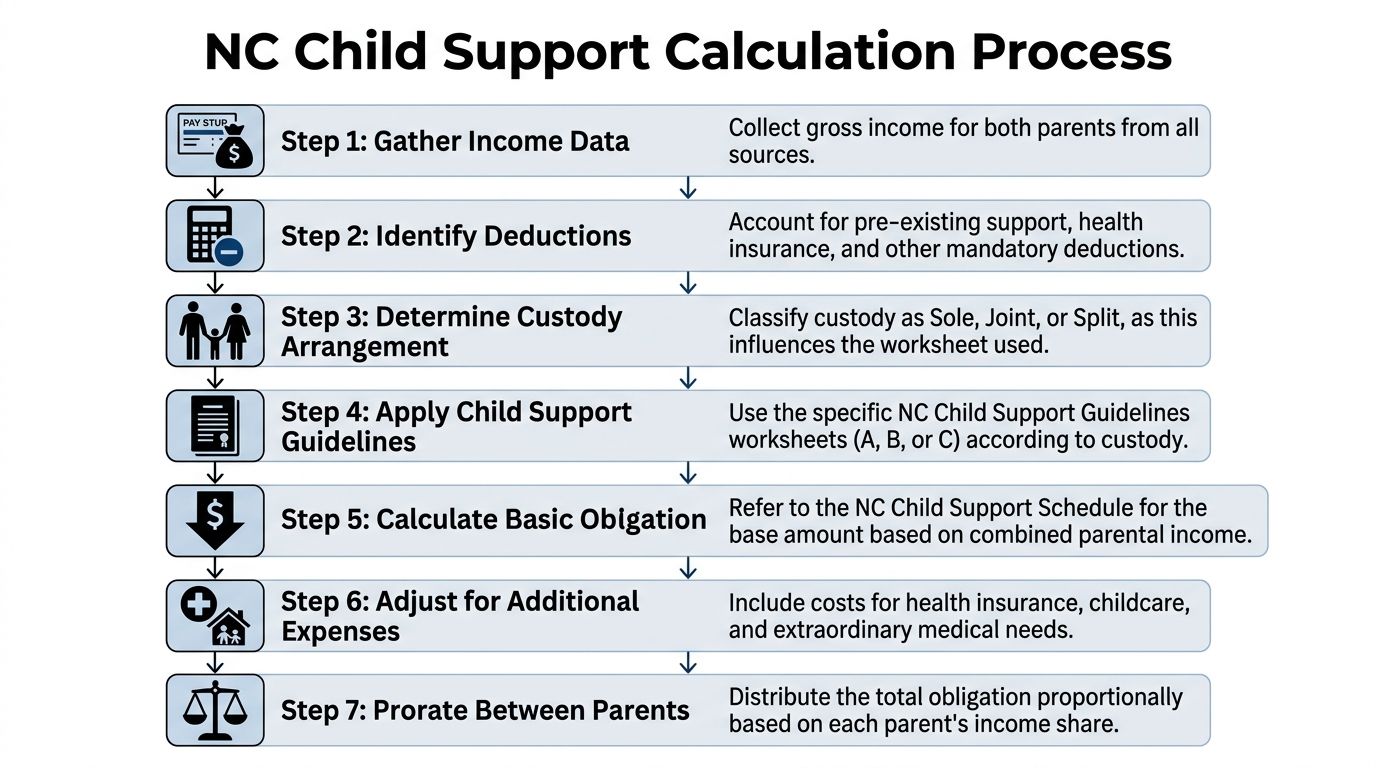
North Carolina calculates child support under statewide guidelines using three worksheets, A, B, and C. The worksheet selected depends largely on the custody arrangement. The amount produced by the worksheet is presumptive, which means the court begins there unless a parent proves a legally supported reason to deviate under G.S. 50-13.4(c), as outlined in this overview of calculating North Carolina child support.
The worksheet choice can change the result
Parents sometimes focus on income first. In many cases, the first disputed issue is the worksheet.
- Worksheet A: Used when one parent has primary physical custody.
- Worksheet B: Used in shared custody cases when each parent has enough overnights to qualify under the guidelines.
- Worksheet C: Used in split custody cases involving multiple children, where each parent has primary custody of at least one child.
That distinction matters in settlement talks and at hearings. A parenting schedule that feels close to equal may still be treated as primary custody under the guidelines if the overnight count does not meet the required standard. I often see parents make costly assumptions here, especially when they rely on a rough verbal schedule instead of a calendar, school records, and the actual court order.
Income means more than a paycheck
The court does not look only at base salary. Child support can involve wages, overtime, bonuses, commissions, self-employment income, rental income, and other recurring earnings. In some cases, one parent's reported income on paper does not match bank deposits, business spending, or lifestyle evidence. That is usually where careful document review starts to matter.
The calculation also includes certain child-related expenses that can shift the final amount, such as:
- Health insurance premiums for the child's coverage
- Work-related childcare costs
- Other child-specific expenses that may require separate proof and legal argument
These details are not minor. A case can turn on whether a childcare expense is work-related, whether an insurance premium is allocated correctly, or whether a claimed income figure reflects current reality.
Small input errors create large support disputes
A parent may say, "I have the child almost half the time." Courts do not calculate support from impressions. They calculate it from documented overnights.
The same problem comes up with income. One parent brings a recent pay stub. The other has variable compensation, a side business, or cash flow that does not show up neatly on one document. Without proper records, the worksheet can look precise while still producing the wrong result.
Tip: Do not guess on overnights, childcare, or insurance numbers. Support orders often last for years, and bad inputs at the start can create expensive problems later.
High-income cases require a different strategy
For high-income cases, the guidelines do not always control the outcome. Once combined parental income rises above the guideline ceiling, the court looks more closely at the child's reasonable needs and the family's standard of living. At that point, the case becomes less about plugging numbers into a formula and more about presenting credible evidence.
That is where self-prepared estimates often break down. Online calculators can be useful for a rough starting point. They do not address disputed compensation, business income, hidden earnings, or whether a deviation argument is likely to succeed.
What helps the court, and what hurts your case
The strongest child support presentations usually include:
- Current income records that reflect present earnings, not outdated assumptions.
- Reliable overnight documentation tied to the actual parenting schedule.
- Clear proof of add-on expenses such as insurance and daycare.
- A legally grounded deviation argument when the guideline amount does not fit the facts.
The weakest cases usually involve avoidable mistakes:
- Verbal side agreements that were never written into an order
- Proposed custody terms treated as if they were already in effect
- Claimed expenses without invoices, statements, or payment history
- Old tax returns used to describe income that has already changed
A good nc child support attorney does more than run numbers through a worksheet. The primary task is checking whether the inputs will hold up under scrutiny, whether the correct worksheet is being used, and whether the evidence supports the result you are asking the court to enter.
The Attorney's Role in Establishing Child Support
The establishment stage is where parents often underestimate the stakes. If the initial order is built on weak financial proof, sloppy language, or an unrealistic parenting schedule, the problem does not stay small. It follows the family for years.
Financial disclosure is not a paperwork formality
One of the most valuable things an attorney does early is push for complete and usable financial information. That sounds obvious, but it is where many self-represented parents struggle.
A parent may provide pay stubs but omit bonuses. Another may submit a tax return that no longer reflects present income. In more difficult cases, one parent has control over a business, expense accounts, or variable compensation that requires deeper review.
An attorney knows what to ask for, how to compare documents, and when the numbers do not match the lifestyle being presented to the court.
The right evidence matters more than strong feelings
Parents are often right about what is unfair. The problem is that fairness alone does not carry the hearing. Courts decide support issues based on admissible evidence, guideline inputs, and legally recognized reasons to deviate.
That can include:
- Childcare proof: Contracts, invoices, and payment records.
- Insurance documentation: Premium cost tied specifically to the child.
- Custody records: Calendars and orders that support the worksheet used.
- Special-needs evidence: Documentation showing why ordinary guideline treatment may be inadequate.
A parent without counsel may arrive with a stack of papers but no clear theory connecting those papers to the result requested.
Negotiation can save time, but only if the agreement is durable
Settlement is often a smart path in child support cases. It can reduce conflict and give parents more control over timing and terms. But a quick agreement is not always a good agreement.
A useful support agreement should do more than state a monthly figure. It should be clear about related obligations, reimbursement issues, health insurance, payment mechanics, and how the number was reached. Vague drafting creates future litigation.
Key takeaway: A negotiated order only helps if it is specific enough to enforce and realistic enough to survive changes in work, custody, and the child's needs.
Deviation arguments require disciplined advocacy
Some parents assume the worksheet amount is untouchable. Others assume the court will freely depart from it. Both assumptions are wrong.
The guideline amount is the starting point. If a party wants the court to deviate, the request needs to be tied to the child's needs and the parents' circumstances in a way that fits North Carolina law. Few can improvise this type of argument in the courtroom.
A seasoned nc child support attorney helps in three ways at this stage. The attorney identifies whether a deviation is worth pursuing, gathers the right proof to support it, and avoids weak deviation arguments that undermine credibility.
Navigating Complex Child Support Scenarios
Some support cases do not fit neatly inside a standard worksheet. These are the matters where legal strategy matters most, because the conflict usually turns on interpretation, proof, and credibility rather than simple arithmetic.

High-income families and off-guideline disputes
When family income exceeds the guideline ceiling discussed earlier, courts are no longer just plugging numbers into a chart. The focus shifts to the child's reasonable needs and the standard of living the child would have experienced if the parents remained together.
That sounds simple. In practice, it creates disputes over lifestyle, discretionary spending, private schooling, activities, travel, savings patterns, and what is for the child versus what benefits a parent. These cases usually require cleaner presentation and more disciplined budgeting evidence than middle-income cases.
A parent who walks into court asking for "the lifestyle the child deserves" without organized proof often struggles. A parent who can connect spending categories to the child's established way of life is in a much stronger position.
Self-employed parents and business owners
Self-employment cases are some of the most contested child support matters in North Carolina. The guidelines look to gross income minus ordinary and necessary business expenses, but courts examine deductions closely when those expenses also provide personal benefit. This issue is significant enough that data from NC Child Support Enforcement suggests approximately 20% of cases involve self-employment verification challenges, as noted in this discussion of child support issues for NC parents.
What creates conflict here is not just the tax return. It is the difference between tax treatment and support treatment. A deduction that may be acceptable for tax purposes may still be challenged in a child support case if it reduces apparent income unfairly.
Common problem areas include:
- Personal expenses run through the business
- Irregular cash flow
- Owner-controlled compensation
- Depreciation and paper losses
- Loans or retained earnings that blur the true financial picture
A parent on either side of this issue should treat document gathering seriously. Bank statements, profit and loss statements, general ledgers, tax returns, and business account records often matter more than one summary page.
If unpaid support is also in dispute, related issues can overlap with retroactive child support and create additional urgency about records and timelines.
Here is a short video that helps frame the bigger picture of difficult support disputes:
Support beyond age eighteen for a disabled adult child
Another issue many parents do not learn about until they are already in crisis is post-majority support for a disabled child. Under N.C.G.S. § 50-13.8, North Carolina courts may order support past age eighteen if the child is physically or mentally incapable of self-support.
These cases are different from ordinary support disputes because the proof is different. The court may need detailed medical evidence, educational records, functional assessments, and careful testimony about the child's daily limitations and long-term care needs.
This is also where timing matters. Families who wait too long to address the issue can find themselves trying to solve a complex legal and care-planning problem under pressure.
Practice point: In disability-related support cases, broad statements about a diagnosis are usually not enough. Courts need evidence showing how the condition affects the child's ability to live independently and support themselves.
Modifying and Enforcing a Child Support Order
A child support order is not frozen forever. Life changes. Income changes. Parenting schedules changes. Children's needs change. North Carolina law allows modification when there has been a substantial change in circumstances.

When modification is realistic
North Carolina recognizes a 15% difference between the current order and the amount produced by a new guideline calculation as a presumed substantial change in circumstances, as discussed in this North Carolina child support modification and calculation overview. That same discussion notes criticism of the state's system for "cliff effects" tied to custody thresholds.
In practical terms, modification often becomes appropriate when:
- Income shifted materially
- The custody schedule changed enough to affect the worksheet
- Childcare costs started or ended
- Health insurance for the child changed
- The existing order no longer reflects current facts
If you are evaluating whether your order should change, this guide to child support modification in NC is a useful starting point.
How attorneys approach modification cases
The strategy depends on which side you are on.
If you are seeking an increase or decrease, the work usually starts with updated records and a clean comparison between the old order and present circumstances. If you are defending against modification, the focus may be on whether the claimed change is real, lasting, and legally sufficient.
A lawyer also helps with timing. Filing too early with weak proof can hurt credibility. Waiting too long can leave arrears or underpayment issues growing in the background.
Enforcement tools can be powerful
When support is not paid, North Carolina has real enforcement mechanisms. As noted earlier in the article, the state's child support enforcement system works through established procedures and tools that can include wage garnishment, tax intercept authority, and license revocation, as described in the North Carolina Child Support Services handbook.
Enforcement cases are not only for the parent seeking payment. They also matter to the parent accused of nonpayment, especially if the problem involves disputed credits, changed employment, or prior informal arrangements that were never formalized.
A few practical points matter here:
- Keep records of every payment.
- Do not rely on verbal agreements to reduce or suspend support.
- Act quickly if a payment problem started after job loss or illness.
- Take enforcement notices seriously.
Parents sometimes believe good intentions will protect them. Courts usually need orders, records, and properly filed motions.
Common Questions About NC Child Support
How is child support decided if we share time with the child?
North Carolina looks closely at overnights. If each parent has enough overnights to meet the shared-custody threshold, the case may use a different worksheet than a primary-custody case. That is why calendars and custody orders matter so much.
Can I change child support if my income dropped?
Possibly. A support order may be modified if there has been a substantial change in circumstances. Whether your change qualifies depends on the facts, how lasting the change is, and whether updated calculations support a different amount.
Does the state child support lawyer represent me?
Not in the private-attorney sense. In the state enforcement system, the CSS attorney represents the agency rather than either parent individually. That distinction affects advice, strategy, and confidentiality expectations.
Does child support always stop at age eighteen?
Not always. Under N.C.G.S. § 50-13.8, a North Carolina court may continue support beyond age eighteen if the child is physically or mentally incapable of self-support, as explained in this North Carolina child support discussion addressing post-18 disability support. These cases usually require strong medical proof and careful legal presentation.
What if the other parent is self-employed?
That usually makes the case more document-intensive. Business records, deductions, and owner-paid personal benefits often become important. A parent should not assume the tax return alone tells the whole story.
Protect Your Family's Future with an Experienced NC Attorney
Child support decisions affect daily life and long-term stability. The right number depends on the right facts, and the right facts are not always easy to prove. That is especially true when custody is disputed, income is inconsistent, or an existing order no longer fits reality.
An experienced nc child support attorney helps you protect your position at every stage. Initial calculation. Negotiation. Establishment. Modification. Enforcement. Each step carries different risks, and each requires a different legal response.
If you live in North Carolina and need clear advice about child support, custody-related support issues, or enforcement concerns, schedule a consultation and get answers specific to your situation.
If you need guidance from a North Carolina family law team, contact the Law Office of Bryan Fagan. The firm works with parents across North Carolina on child support establishment, modification, and enforcement matters, and can help you evaluate your options in a confidential consultation.