You're sitting at the kitchen table with a will downloaded years ago, a retirement account that still lists a former beneficiary, and no clear answer about who could access your online accounts if you became seriously ill. Your family may know what you intended, but North Carolina law doesn't transfer property based on family assumptions. It relies on properly drafted documents, account ownership, beneficiary designations, and procedures handled through the Clerk of Superior Court.
A North Carolina estate planning attorney helps connect those pieces. The work isn't limited to writing a will. It includes planning for incapacity, coordinating nonprobate transfers, addressing spousal rights, preparing fiduciaries for court procedures, and identifying digital assets that could otherwise remain inaccessible.
Why North Carolina Families Need Specialized Legal Guidance
A family can have a valid will and still face confusion after a death. The document may name an executor, but the executor generally must be formally qualified before acting for the estate. The decedent's county of domicile matters, and filings begin through the local Clerk of Superior Court, not through a generic national probate system. The North Carolina Judicial Branch explanation of estates describes this qualification process and the role of the clerk.
Consider a surviving child who finds a signed will, a deed, several bank statements, and a phone protected by two-factor authentication. The child may assume the will immediately gives them authority to collect everything. In practice, the personal representative needs the proper appointment and authority before marshaling estate property, issuing required notices, or dealing with institutions. A mistake at the beginning can delay later steps and create avoidable disputes among heirs.
Local court procedure changes the practical experience
North Carolina's probate workload is substantial. One neutral industry source estimates about 65,000 probate cases annually, approximately 20,000 active guardianships, and about $2 billion in estate value managed each year in the state. The same source estimates about 95,000 deaths each year, projected to exceed 130,000 by 2035, a projected 37% increase that could expand demand for wills, trusts, probate administration, and related legal services. Those estimates appear in the North Carolina Courts wills and estates materials.
Estate files, wills, and related filings can also become part of the public record through the clerk and the state's online portal. That creates a practical privacy concern. A carefully structured plan may reduce unnecessary court involvement, but a poorly coordinated plan can expose family disagreements, asset information, and procedural problems in a public file.
Practical rule: A document prepared for another state may not account for North Carolina's clerk-based probate process, spousal protections, execution requirements, or local administration customs.
An attorney's value often appears before a dispute begins. The attorney can coordinate ownership, beneficiary forms, fiduciary appointments, and incapacity documents so the family isn't forced to solve disconnected legal problems during grief. That local strategy is usually more useful than choosing a template solely because it looks complete.
Core Estate Planning Documents in North Carolina
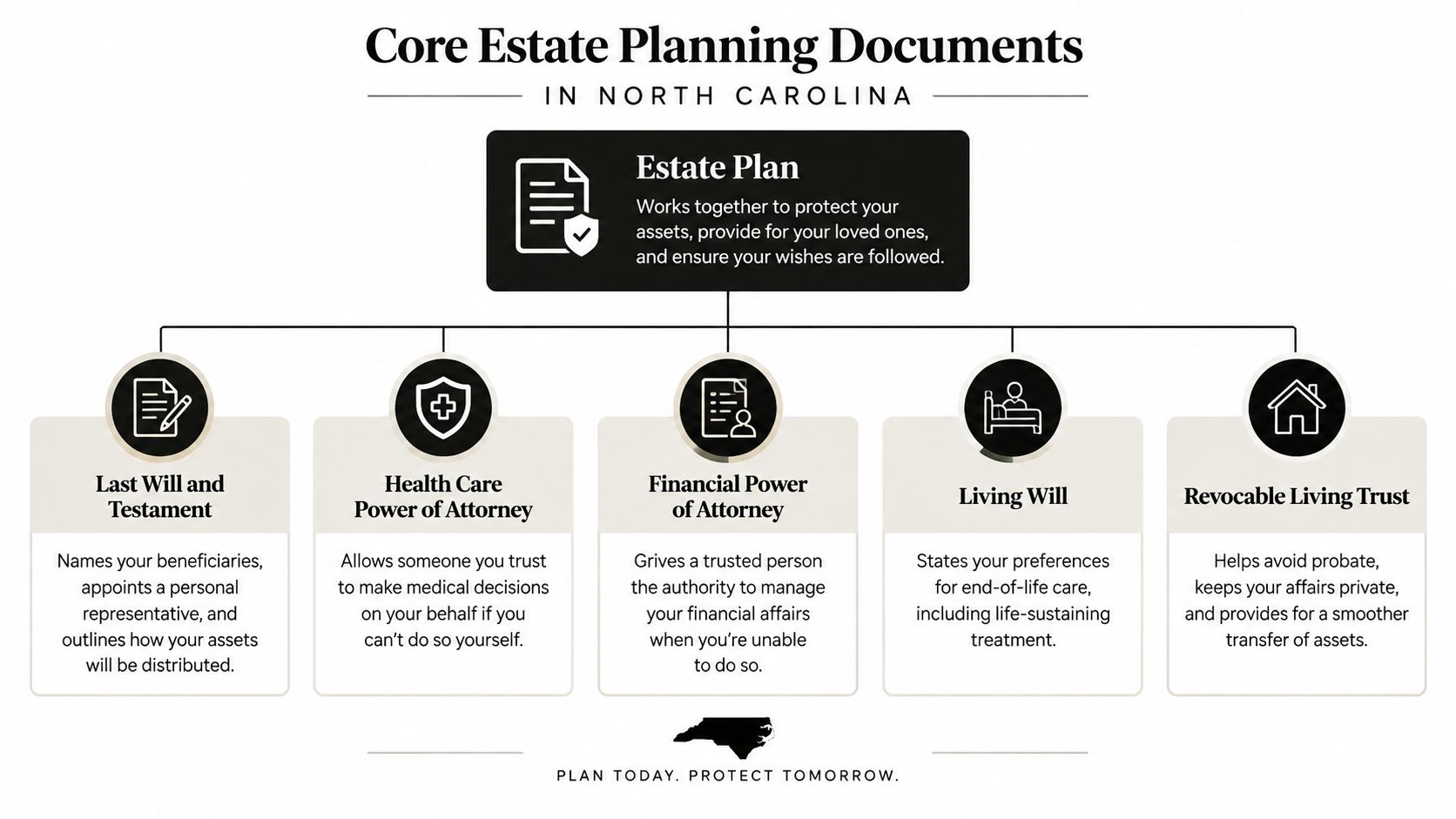
A sound North Carolina plan usually combines several documents rather than relying on a will alone. Each document answers a different question: Who receives property after death? Who manages property during incapacity? Who makes medical decisions? What authority exists over online accounts?
The will directs property and nominates people
A last will and testament states how probate assets should be distributed and identifies the person you want to serve as personal representative. Parents can also nominate a guardian for minor children. A will doesn't control every asset, however. Property held in a trust, jointly owned property with survivorship rights, and accounts with beneficiary designations may pass outside the will.
That distinction matters in a common situation. A person may write a will leaving everything equally to three children, but a life insurance policy may still name only one child. The policy's beneficiary designation can control that transfer, while the will governs property that remains subject to probate.
A revocable trust can organize management and transfer
A revocable living trust can hold property during your lifetime, allow a successor trustee to manage it if you become incapacitated, and provide instructions after death. Assets properly transferred to the trust generally don't pass through the same probate process as individually owned assets. The trust only works as intended if it's funded, which may require changing account ownership or preparing and recording appropriate real estate documents.
A trust isn't automatically the right tool for every resident. It can involve additional drafting, administration, and maintenance. The decision should depend on the estate's assets, family structure, privacy concerns, incapacity planning needs, and transfer goals.
Powers of attorney and health directives protect you while living
A durable financial power of attorney names an agent who can handle financial matters if you're unable to do so. The agent's authority may cover banking, real estate, taxes, insurance, and other transactions, depending on the document's terms. North Carolina residents can review practical information about this tool through durable power of attorney guidance.
An advance directive for a natural death communicates medical wishes, while a health care power of attorney appoints someone to make health decisions when you can't communicate. These documents reduce uncertainty and help avoid a guardianship proceeding in situations where a trusted agent can act.
Digital assets need separate attention. A will, trust, or power of attorney should address access to email, cloud storage, cryptocurrency, social accounts, and online financial platforms. Provider terms and legacy settings can affect access, so merely listing a password may not give a fiduciary the authority needed.
For readers handling multiple legal concerns, North Carolina Divorce Residency Requirements addresses the six-month residency rule for filing divorce in North Carolina.
Navigating North Carolina Probate and Tax Realities
Probate begins with procedure, not distribution. In North Carolina, the estate is initiated through the Clerk of Superior Court in the decedent's county of domicile. The proposed personal representative must qualify formally before acting. Once qualified, the representative receives authority through Letters Testamentary when there is a will, or Letters of Administration when there isn't one.
That first appointment is more than paperwork. Before qualification, a family member generally can't validly marshal estate assets, send estate notices, or bind the estate as fiduciary. A careful filing therefore identifies the correct county, gathers the will and supporting information, and presents the clerk with a workable administration plan. The North Carolina probate process can involve several stages, including collection, notice, creditor handling, tax work, accounting, and distribution.
Timing and cost require realistic expectations
A neutral North Carolina probate reference estimates that probate typically takes 9 to 18 months, with court filing fees ranging from $120 to $600 and an estate-administration fee capped at $6,000. These figures come from North Carolina probate estate-file guidance. Actual complexity can depend on creditor claims, real estate, contested issues, missing beneficiaries, tax questions, and the condition of the decedent's records.
North Carolina's 100 counties each have a Clerk of Superior Court handling probate filings, so local procedural familiarity can matter. A simple estate may move differently from an estate involving business interests, multiple properties, disputed beneficiary forms, or incomplete records.
State and federal tax questions are different
North Carolina doesn't impose a state estate tax or inheritance tax. For high-value estates, the main transfer-tax concern is federal estate tax. The same neutral reference estimates the federal estate-tax exemption at $15 million per person in 2026. That figure must be confirmed during planning because federal law can change, and a plan built around tax assumptions may become outdated.
Tax planning isn't only about the exemption. Families may need liquidity to pay expenses, coordinate beneficiary-controlled accounts, review ownership, and avoid forcing a sale of valuable property at an unfavorable time. For many estates, administrative friction, timing, and family coordination matter more than a state transfer tax that North Carolina doesn't impose.
North Carolina's long probate tradition also shows why careful administration matters. State digital collections preserve wills dating from 1663 to 1789, a historical record of estate administration that continues today through modern clerk offices and online access.
Hidden Pitfalls That Invalidate Basic Estate Plans
A basic will may be properly signed and still fail to accomplish what the family expects. The problem usually isn't that the will has no legal effect. The problem is that the will may not control the asset, provide enough authority, or account for rights that exist outside the document.

Digital property can be legally identified but practically unreachable
Families now inherit more than real estate, vehicles, and bank accounts. They may need access to cloud photographs, email, cryptocurrency, subscription records, password managers, social media, and online financial accounts. A fiduciary may encounter encryption, two-factor authentication, provider contracts, and platform-specific legacy tools.
North Carolina-focused guidance recommends specific digital-asset clauses in wills, trusts, and powers of attorney. It also warns that a platform's own legacy settings may override or limit document language. The North Carolina digital-asset probate update explains why explicit authority and access mechanics deserve more than a passing reference.
The practical solution isn't to place every password in a will. Wills can become part of a public court record. Instead, an attorney can help coordinate authority language with a secure inventory and separate access instructions.
A spouse may have rights beyond the will
North Carolina's elective share law protects a surviving spouse even when the will appears to leave the spouse little or nothing. The spouse must file a verified petition within six months after Letters Testamentary or Letters of Administration are issued, in the county where the estate administration is pending. The deadline is established by North Carolina General Statutes Chapter 30.
The elective share isn't a flat percentage. Under the statute, the share is 15% when the marriage lasted less than 5 years, 25% after at least 5 but less than 10 years, 33% after at least 10 but less than 15 years, and 50% after 15 years or more. The sliding scale appears in the North Carolina probate and estates law reference.
A will can express an intention, but it can't erase every statutory right.
Small estates and titling require careful analysis
Certain small estates may use an affidavit instead of full probate. The commonly cited threshold is $20,000 in personal property, reduced by liens and encumbrances, and the affidavit generally can't be used until at least 30 days after death. If the surviving spouse is the sole heir, the threshold rises to $30,000, as described in this North Carolina small-estate reference.
That shortcut doesn't apply simply because the family wants a faster process. Real estate, account ownership, beneficiary forms, and outstanding obligations must be reviewed. An online will won't fix an account titled incorrectly, and a trust won't help with assets never transferred into it. A North Carolina attorney can test the plan asset by asset, including the issues addressed in this North Carolina will template discussion.
Understanding Attorney Fees and Choosing the Right Fit
Estate planning fees vary because the legal work varies. A simple will package may involve a defined scope and a flat fee. A plan involving a revocable trust, business interests, blended-family concerns, real estate in multiple places, digital assets, or federal tax analysis may require broader drafting, funding, and follow-up.
The lowest initial quote may not represent the lowest total cost. A document that doesn't coordinate with beneficiary designations or property titles can leave the family with a probate problem that the original plan never addressed. Ask what the fee includes, what falls outside the scope, and whether funding a trust or reviewing account designations is part of the engagement.
Comparing common billing structures
| Fee Type | Best For | Key Advantage |
|---|---|---|
| Flat fee | Defined planning packages with a clear scope | Predictable cost for the agreed work |
| Hourly billing | Customized advice, disputes, or changing administration needs | Payment tracks the time and complexity required |
| Hybrid arrangement | A defined document package plus separate implementation or administration | Separates predictable drafting from variable work |
A consultation should also examine fit. Ask whether the attorney regularly works with North Carolina Clerks of Superior Court, how the office handles digital assets, whether the attorney reviews nonprobate transfers, and how the plan will be updated after marriage, divorce, a child's birth, a death, a major acquisition, or a change in capacity.
Questions that expose gaps early
- Scope: Will the engagement include wills, trusts, financial powers of attorney, health care documents, and digital-asset provisions?
- Coordination: Will the attorney review deeds, joint ownership, retirement-style accounts, insurance, and beneficiary designations?
- Implementation: If a trust is recommended, who handles or explains the transfer of assets into it?
- Maintenance: What happens if North Carolina law or federal tax rules change?
- Administration: Can the same office assist with clerk filings and estate administration if a death occurs?
You're not only hiring someone to produce documents. You're choosing a professional to translate your family's intentions into documents and ownership arrangements that work together.
Your Step-by-Step Estate Planning Checklist
Preparation makes the first consultation more productive. Bring information that lets the attorney analyze not only what you own, but also how each asset would transfer during incapacity or after death.
Start with an accurate inventory
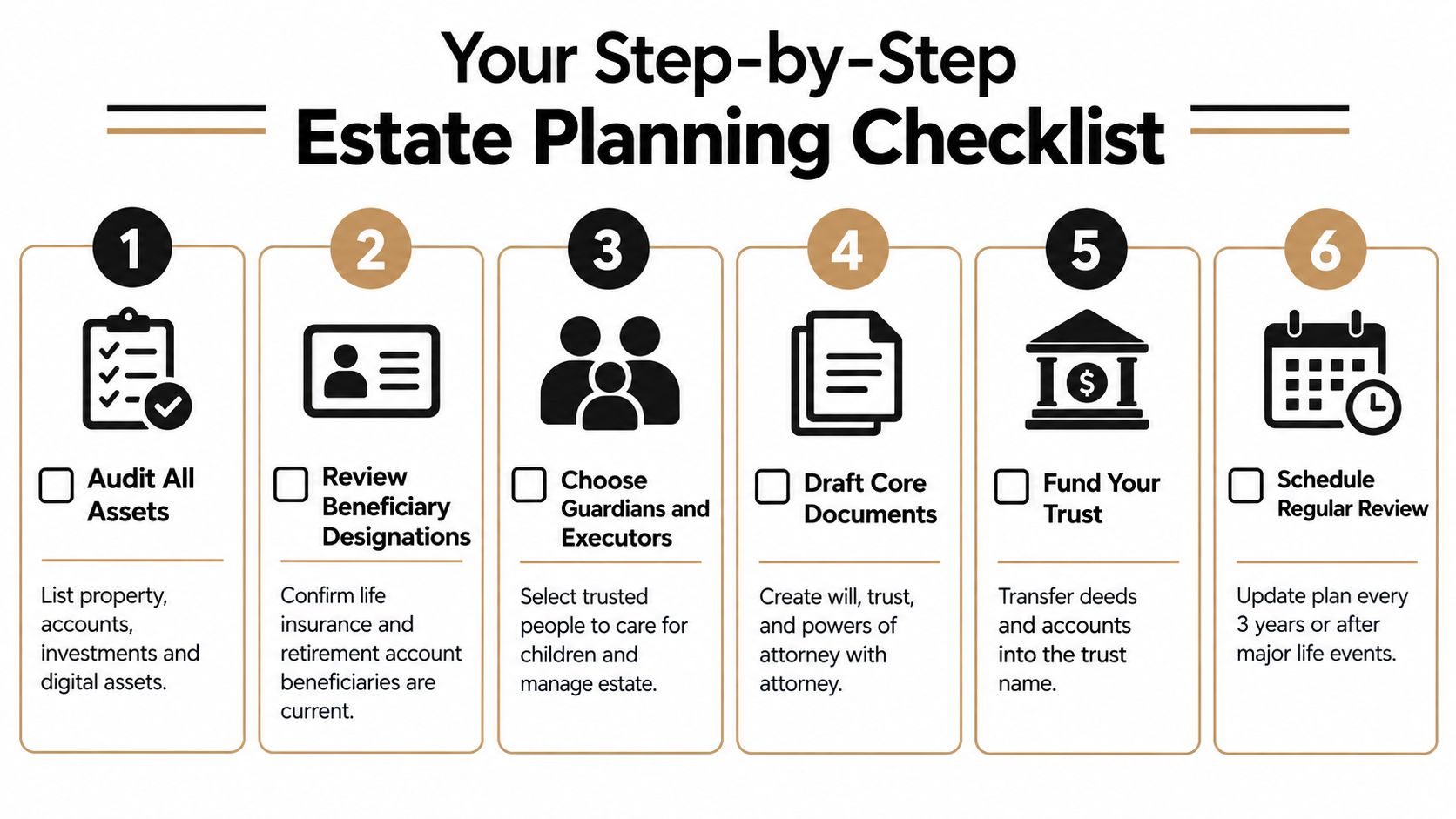
- List property and accounts. Identify homes, land, vehicles, bank accounts, investments, insurance, retirement-style accounts, business interests, personal property, and digital assets. Record ownership, approximate value, account location, and current beneficiary information.
- Review transfer instructions. Beneficiary designations and joint ownership may control assets outside the will. Compare those instructions with the people named in your proposed estate plan.
- Document digital access safely. Create a secure record of email addresses, cloud storage, cryptocurrency, online financial accounts, devices, and authentication methods. Don't place sensitive passwords in a will that may be filed publicly.
Choose people before drafting documents
Select a personal representative who can manage filings, notices, records, and distributions. Choose a successor trustee if a trust is used, a financial agent for incapacity, and a health care agent who understands your medical preferences.
Parents should identify preferred guardians for minor children and discuss whether those people are willing and able to serve. The best choice isn't always the oldest relative. Reliability, geography, communication skills, financial judgment, and family dynamics all matter.
Review, sign, and implement
Your attorney should draft documents based on the asset inventory and family goals, then explain the practical consequences before signing. Ask how North Carolina execution and notarization requirements apply to each document and whether witnesses or other formalities are needed.
Signing is not the final step. If the plan uses a trust, assets may need to be retitled. Deeds, financial accounts, and beneficiary forms should be checked so the ownership structure matches the intended result.
Store originals securely and tell the right people where they can be found. Give agents enough information to act, but protect private credentials. Set a recurring review process and revisit the plan after major life changes, relocation, divorce, remarriage, a child's birth, a death, a major asset purchase, or a serious health event.
Common Questions and Securing Your Family's Future
Is an out-of-state will valid in North Carolina?
An out-of-state will may be recognized if it was properly executed under the law that applied when and where it was signed. Recognition doesn't guarantee that the document coordinates with North Carolina property rules, elective-share rights, digital assets, or local probate procedure. A North Carolina review can identify conflicts before the family needs to use the will.
How often should I update an estate plan?
Review the plan after major life events and whenever your assets, beneficiaries, fiduciaries, or goals change. Beneficiary forms deserve separate attention because they may control transfers outside the will. A document can remain formally valid while no longer reflecting your family.
What happens if I die without a will?
You die intestate, meaning North Carolina's default inheritance rules determine who receives probate property. Those rules may not match your wishes, particularly in blended families, unmarried relationships, families with minor children, or situations involving a dependent adult. The clerk's process still requires proper estate administration, and the absence of a will removes your ability to nominate a personal representative and guardian through that document.
Do I need an attorney if my estate is modest?
Not every modest estate needs the same level of planning. Small-estate procedures, beneficiary designations, joint ownership, and properly prepared powers of attorney may simplify matters, but they must be evaluated together. A short consultation can reveal whether a simple plan is sufficient or whether one overlooked account could create a larger problem.
Estate planning is an act of care, especially when family members may be grieving or making urgent decisions. A focused North Carolina consultation can clarify which assets pass through probate, which transfer directly, who can act during incapacity, and where your current documents leave gaps.
The Law Office of Bryan Fagan offers North Carolina-focused assistance with wills, trusts, powers of attorney, and probate guidance, with attention to the documents and asset transfers that shape your family's outcome. Visit Law Office of Bryan Fagan to schedule a consultation and discuss a practical estate plan for your North Carolina circumstances.