Facing a child custody case in North Carolina can be one of the most challenging experiences a parent will ever face. The uncertainty and emotional stress can feel overwhelming, but you don’t have to go through it alone. A knowledgeable custody attorney in North Carolina is your advocate, helping you protect your parental rights and build a stable future for your child. We created this guide to provide clarity and empower you with a plan from the very start.

Starting Your North Carolina Custody Journey
Navigating a custody dispute isn't just about knowing the law; it's about having a clear strategy and an empathetic legal partner. The process can feel isolating, filled with confusing legal jargon and anxiety about what happens next. Our goal is to give you a roadmap that turns complex legal rules into a clear, actionable plan.
This guide will walk you through the entire process, empowering you to make informed, confident decisions for your family. We'll begin with the single most important concept in any North Carolina family court: the "best interest of the child" standard.
The Guiding Principle: The "Best Interest of the Child" Standard
In North Carolina, every single decision a judge makes in a custody case is guided by one core principle: what is in the best interest of the child. This standard, established in North Carolina General Statute § 50-13.2, acts as the court's compass. It is not about fairness to the parents; it is about the child's well-being, happiness, and safety.
To determine what is in a child's best interest, a judge looks at the whole picture. They will consider many factors, including:
- Each parent's ability to provide a safe, stable, and loving home.
- The child’s age, developmental needs, and relationship with each parent.
- Any history of domestic violence, substance abuse, or other conduct that could impact the child's welfare.
- The willingness of each parent to support and encourage the child's relationship with the other parent.
It’s not about finding the "better" parent. It's about determining which parent’s circumstances and abilities are the best fit for the child’s specific needs. A skilled custody attorney in North Carolina knows how to build your case around these critical factors.
Practical Example: Imagine a case where one parent works from home and can be present after school, while the other parent travels frequently for work. An attorney would highlight the first parent's availability to provide daily stability and homework help, arguing this aligns with the child's best interest for consistent care, without attacking the other parent's career.
Your attorney’s main job is to tell a clear, compelling story—backed by solid evidence—that shows how your custody goals align with what is truly best for your child. This is the foundation of every strong custody case in North Carolina.
If you'd like to learn more about our specific approach, you can read more on our main North Carolina child custody cases page.
How to Understand North Carolina Custody Laws

To build a strong custody case, you first need to understand the language the court speaks. A common misconception is that "custody" is a single concept. In North Carolina, it's split into two distinct parts: legal custody and physical custody. The court makes separate decisions for each, and they are not interchangeable.
Think of it like this: legal custody is about making the big-picture decisions for your child's life, while physical custody determines where your child lives. An experienced North Carolina custody attorney can help you advocate for an arrangement that protects your child's best interests in both areas.
You’re not alone in this process. A 2021 North Carolina Legal Needs Assessment showed that family law matters, including custody and visitation, accounted for nearly 5% of all civil cases handled by legal aid providers in 2019, highlighting just how many families across the state navigate these same challenges.
The Two Pillars of NC Custody: Legal vs. Physical
Let's break down exactly what legal and physical custody mean for your family.
What Is Legal Custody?
Legal Custody is the right and responsibility to make major decisions that shape your child's future. It’s not about the daily schedule but rather the long-term parental authority. Think of it as being a co-chair on your child's "board of directors."
Key decisions covered by legal custody include:
- Education: Choosing a school, approving tutoring, or consenting to special education services.
- Healthcare: Deciding on doctors, dentists, and significant non-emergency medical treatments.
- Religious Upbringing: Guiding your child’s spiritual or religious life.
- General Welfare: Agreeing on other major issues, like getting a driver's license or traveling internationally.
What Is Physical Custody?
Physical Custody is what most people picture when they hear "custody." It refers to where the child physically lives and who is responsible for their day-to-day care. This is what forms the basis of the parenting schedule or visitation plan.
The following table breaks down these core concepts to clarify their distinct roles in a North Carolina custody order.
Legal Custody vs. Physical Custody in North Carolina
| Aspect of Custody | Legal Custody | Physical Custody |
|---|---|---|
| Primary Focus | Parental rights to make major life decisions for the child. | Where the child lives and the day-to-day parenting schedule. |
| Examples | Choosing a school, consenting to surgery, religious instruction. | School-week residence, weekend/holiday schedules, summer vacation. |
| Decision-Making | Relates to long-term welfare, education, and health. | Pertains to daily care, supervision, and routine. |
| Common Arrangement | Often shared jointly, even if physical custody is not 50/50. | Can be sole, primary/secondary, or a true joint/50-50 split. |
Understanding this distinction is the first step in developing a clear legal strategy that protects both your decision-making rights and your time with your child.
Sole vs. Joint Custody Arrangements
Once the court addresses legal and physical custody, it then decides how to award them. North Carolina law allows for sole custody (one parent) or joint custody (both parents). It's crucial to know that these can be applied differently to legal and physical custody.
For instance, it is very common for parents to share joint legal custody even when one parent has primary physical custody.
Important Distinction: A common misconception is that "joint physical custody" automatically means a perfect 50/50 split. In North Carolina, it simply means both parents have periods of physical custody. The division could be 60/40, 70/30, or any other schedule the judge believes is in the child's best interest.
Let's look at a common, real-world scenario.
Real-World Scenario: Primary Physical Custody with Joint Legal Custody
- The Situation: Sarah and Tom are divorcing and have an 8-year-old son, Leo. Sarah's job has regular hours, while Tom's requires frequent, unpredictable travel.
- Physical Custody Arrangement: The court awards Sarah primary physical custody, meaning Leo lives with her during the school week to ensure consistency. Tom has secondary physical custody (visitation) every other weekend and for several weeks during the summer.
- Legal Custody Arrangement: They are awarded joint legal custody. This means Sarah and Tom must consult and agree on major decisions, like if Leo needs braces or which middle school he will attend. Neither parent has the authority to make these choices alone.
This is a very typical arrangement we see structured by custody attorneys in North Carolina. It gives the child a stable home base while making sure both parents stay fully involved in the big decisions. Your attorney's job is to present evidence showing why your proposed plan best meets the "best interest of the child" standard, which is the guiding principle for all custody decisions under N.C.G.S. § 50-13.2.
The Role of a Custody Attorney in Your NC Case
Many people assume a custody lawyer’s job is just arguing in a courtroom. In reality, a trial is often the last resort. Think of your attorney as the architect of your legal strategy and the project manager for your entire case—they design the plan, gather the materials (your evidence), and guide the process from start to finish.
A skilled custody attorney in North Carolina is your strategist, negotiator, and advisor all in one. We guide you through one of life's most difficult chapters with a single focus: building a case that proves your goals align with the “best interest of the child” standard that guides every decision a North Carolina judge makes.
With over 600 child custody lawyers in North Carolina available to assist families, finding the right advocate is critical. An experienced attorney does more than just file paperwork; they translate your day-to-day life as a parent into a compelling legal narrative the court will understand.
How We Build Your Case for the Best Interest of the Child
One of your attorney's most important jobs is to help you gather and present evidence that matters. This isn't about digging up "dirt" on the other parent. It's about constructively proving your fitness, your stability, and your deep commitment to your child's well-being.
Your lawyer will give you practical, specific guidance on what to document and how. This work on the front end can make all the difference.
- Documenting Daily Involvement: We'll advise you to keep a detailed journal of your parenting activities—from helping with homework and attending doctor's appointments to coaching their soccer team or preparing their meals.
- Organizing Communications: Your attorney will help you manage communication with the other parent, advising you to keep conversations focused on the child and avoid emotional arguments that can be used against you later.
- Identifying Key Witnesses: We can identify which teachers, neighbors, or family friends can provide credible, third-party testimony about your positive parenting and stable home life.
This evidence becomes the foundation of your case. It gives the judge concrete examples of why the custody arrangement you're asking for serves your child's best interests.
Negotiating and Drafting Your Parenting Agreement
While every good attorney prepares for trial, the primary goal is often to secure a strong settlement outside of court. A negotiated agreement gives you and the other parent control over your family's future, rather than leaving that power in a judge's hands.
A custody attorney acts as your advocate and buffer during negotiations, focusing on legal strategy and long-term goals. They help you detach from the emotional turmoil of the dispute, preventing you from making rash decisions that could harm your case.
Once an agreement is reached, the work isn't over. Your lawyer will then draft an airtight parenting agreement, often called a Consent Order. This legally binding document must be detailed and crystal-clear to prevent confusion and future conflict. A well-drafted agreement plainly outlines:
- The specific physical custody schedule for the school year, holidays, and summer break.
- How parents will handle joint legal custody decisions on major issues like education and healthcare.
- Rules for things like travel, communication protocols, and introducing new romantic partners.
This detailed document becomes your family's new rulebook. A skilled custody attorney ensures it is built to last, protecting your child's stability and your peace of mind for years to come.
Navigating The North Carolina Custody Process: A Step-by-Step Guide
The North Carolina custody process can feel like a tangled web, but knowing the path forward makes all the difference. Understanding the typical timeline of a custody case—from the first paperwork to a potential trial—empowers you and helps you regain a sense of control. We’ll walk you through each step in plain English so you know what’s coming next.
To give you a clearer picture, the visual below breaks down how an attorney’s role shifts throughout your case, moving from big-picture strategy to the crucial details of drafting legal documents.
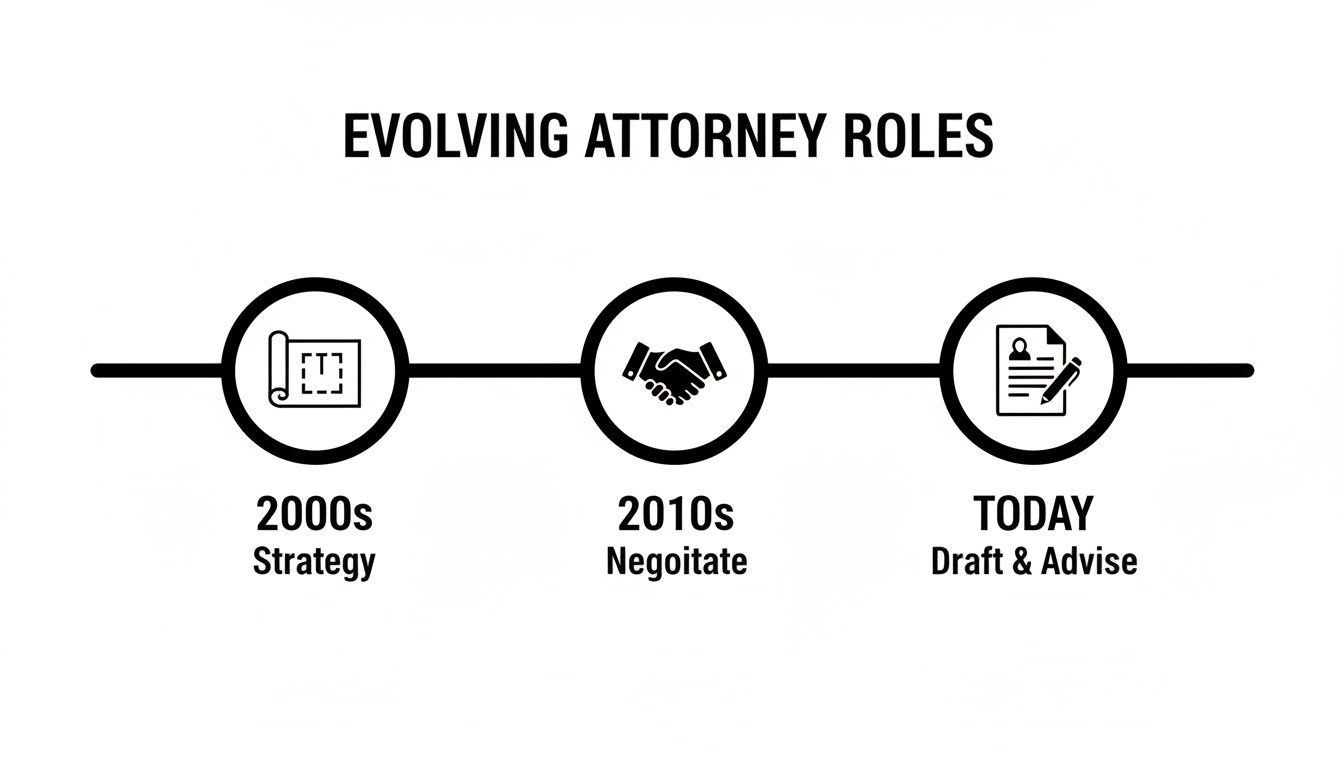
As you can see, a custody attorney wears many hats, blending strategic planning, tough negotiation, and meticulous legal work to protect what matters most.
Step 1: The Initial Filing and Service
Every custody case officially starts when one parent, known as the Plaintiff, files a “Complaint for Child Custody” with the court. This is the legal document that formally asks a judge to either create or change a custody arrangement. It lays out exactly what the plaintiff is asking for and why they believe it’s in the child's best interest.
Once filed, the Complaint and a “Summons” must be properly delivered—or "served"—to the other parent, the Defendant. This serves as official notice of the lawsuit and gives them a deadline, usually 30 days, to file a formal response, called an “Answer.”
Step 2: Mandatory Mediation and Temporary Hearings
In most North Carolina counties, the court requires parents to attend mandatory custody mediation soon after a case is filed. This isn’t a courtroom battle. It’s a confidential meeting where a neutral mediator helps you and the other parent try to work out your own custody agreement.
Mediation puts the power back in your hands. A successful mediation is almost always faster, cheaper, and less stressful than trial. It allows you to create a personalized solution that truly fits your family’s needs.
Of course, life doesn’t stop just because a case is pending. If you have an urgent need for a parenting schedule or decisions about the child's immediate care, your custody attorney in North Carolina can file a motion for a temporary custody hearing. A judge will hear limited evidence and issue a temporary order that stays in effect until the case is finalized. You can learn more in our detailed guide on how to get temporary custody in North Carolina.
Step 3: The Discovery Phase: Gathering Evidence
If mediation doesn’t resolve everything, the case moves into the “discovery” phase. This is the formal, structured process where both sides gather the facts and evidence needed to build their case. It’s a critical stage where an attorney's experience really shines.
Discovery involves several key legal tools:
- Interrogatories: These are written questions that the other parent must answer in writing, under oath.
- Requests for Production of Documents: This is a formal demand for things like financial records, emails, text messages, or school and medical records.
- Depositions: This involves your attorney questioning the other parent or other important witnesses under oath, with a court reporter transcribing everything they say.
This entire phase is about uncovering the facts that prove your requested custody arrangement is what’s best for your child.
Step 4: Trial: The Final Step (If Necessary)
If you and the other parent cannot reach a settlement after discovery, the final step is a trial in front of a District Court judge. At trial, both attorneys will present evidence, call witnesses to testify, and make their final arguments.
After hearing everything, the judge will make a final decision and issue a permanent custody order. This order is legally binding and can only be changed down the road if a parent can prove there has been a "substantial change in circumstances." Knowing this path from start to finish helps you work with your attorney to make smart, strategic decisions every step of the way, always keeping your child’s future at the forefront.
Understanding the Cost of a Custody Attorney in NC
Let's talk frankly about the financial side of protecting your family. For most parents, the cost of hiring a custody attorney in North Carolina is a major concern, and rightly so. Understanding how legal fees work is the first step in setting a realistic budget and making an informed decision for your case.
There's no single price tag for a custody case because every family's situation is different. The total cost will depend entirely on your unique circumstances, but most family lawyers in North Carolina follow a similar fee structure.
Common Fee Structures Explained
The most common arrangement you'll encounter is an initial retainer followed by hourly billing.
- Retainer Fee: Think of this as a down payment for your legal team's services. You pay a lump sum upfront, which your attorney holds in a dedicated trust account. As work is done on your case—from drafting documents and making phone calls to preparing for court—the time is billed against this fund.
- Hourly Rate: Your attorney and their staff, like paralegals, have set hourly rates. You will receive regular invoices detailing exactly how time was spent on your case. When the retainer runs low, you'll typically need to replenish it to keep your case moving forward.
This structure allows the cost to scale directly with the complexity and amount of conflict in your case.
Key Factors That Influence Your Total Cost
The single biggest factor that drives up legal fees is conflict. A case where parents can cooperate and find common ground will always be less expensive than one filled with constant disagreements that require court intervention.
Other significant factors include:
- The Complexity of Your Issues: A straightforward local parenting plan will require far fewer hours than a case involving complex issues like parental relocation, allegations of substance abuse, or a child with special needs.
- The Discovery Process: If your case requires extensive discovery—such as depositions, subpoenas for records, or hiring expert witnesses—the costs will naturally increase.
- Going to Trial: Reaching a negotiated settlement is significantly less expensive than a full-blown trial, which demands days of intense preparation and time in the courtroom.
An important perspective: While it may seem counterintuitive, investing in an experienced custody attorney upfront can often prevent costly disputes down the road. A poorly drafted or vague custody agreement is a recipe for future conflict, which can land you right back in court years later, costing you more time, money, and stress.
Can the Other Parent Be Ordered to Pay Your Attorney Fees?
Yes, in certain situations. North Carolina law, specifically N.C.G.S. § 50-13.6, gives a judge the authority to order one party to pay for the other's legal fees in a custody case. For a judge to award fees, they must find that the parent asking for them:
- Is acting in good faith (meaning, they are not filing motions just to harass the other parent).
- Does not have sufficient financial means to cover the legal costs on their own.
- The other parent does have the financial ability to pay.
This is never automatic and is decided by the judge on a case-by-case basis. You can find more details about attorney fees in NC custody cases to better understand how courts approach these matters.
How to Choose the Right NC Custody Attorney for Your Family
Picking the right lawyer is easily one of the most important decisions you’ll make in your entire custody case. This isn't just about hiring someone to handle paperwork; it's about finding a strategic partner who will guide you through one of life's most stressful and emotional processes.
The right custody attorney in North Carolina will do more than just protect your legal rights. They’ll bring clarity to the chaos, giving you the support you need to make smart, level-headed decisions for your child’s future. You're not just hiring a law firm; you're choosing an advocate. You should feel completely confident in that choice.
Look for Specialization and Local Experience
When it comes to child custody, not all lawyers have the same playbook. An attorney who dabbles in everything from DUIs to real estate simply won’t have the deep, specific knowledge needed to navigate a complex custody battle. It’s absolutely vital to find a lawyer who dedicates their practice to North Carolina family law.
Even better, find an attorney who is in your local county courthouse every week—whether it’s in a busy district like Mecklenburg or Wake or a smaller rural one.
Practical Advantage: Local knowledge is a powerful and often underestimated asset. An attorney who knows the local judges—their pet peeves, their expectations, and how they run their courtroom—can build a strategy that’s far more effective. They know the unwritten rules and local procedures that can make or break a case.
This on-the-ground experience means your attorney can give you realistic advice about what to expect, helping you avoid unnecessary stress and expense.
Essential Questions to Ask During a Consultation
Think of your first meeting with a potential attorney as a two-way interview. While they are evaluating your case, you should be evaluating them. Come prepared with a list of questions to determine if they're the right fit for you.
Here are a few practical questions to get you started:
- Strategy and Approach: "Based on what I’ve shared, what is your initial assessment? What kind of strategy would you recommend for a case like mine?"
- Experience: "What percentage of your practice is focused on family law, and specifically, how often are you handling custody cases right here in this county?"
- Communication: "How will you or your team keep me updated? What is your policy for returning calls and emails, and what is a reasonable timeframe to expect a response?"
- Team Structure: "Who exactly will be handling the day-to-day work on my case? Will I be working directly with you, or primarily with a paralegal or associate attorney?"
- Fees and Billing: "Can you walk me through your fee structure in detail? I need to understand your retainer, your hourly rates, and what other costs I should anticipate."
The answers you get should be direct, clear, and reassuring. If you leave a consultation feeling more confused or intimidated, that’s a red flag. A good attorney demystifies the legal process, they don't make it more complicated. This is especially true when facing interconnected issues, such as those handled by a North Carolina divorce lawyer's team.
Trust Your Gut Feeling
At the end of the day, legal qualifications and courtroom experience are critical, but they aren’t everything. Your personal comfort level is just as important. You are about to share some of the most personal details of your life with this person. You have to trust them.
Do they actually listen, or do they just talk over you? Do you feel respected and understood, or do you feel like just another case file? The relationship you have with your attorney is a partnership, and that partnership must be built on trust and mutual respect. Choose the custody attorney in North Carolina who not only has a great track record but also gives you the unshakable confidence that you have a dedicated, empathetic advocate fighting in your corner.
FAQ: Common Questions About North Carolina Custody
Going through a custody case brings up countless questions, and a lot of misinformation online only adds to the anxiety. As custody attorneys in North Carolina, we believe in providing clear, accurate answers based on state law to help you feel more in control. Here are the facts about some of the most common concerns we hear from parents.
1. Can my child decide who to live with in NC?
No, a child under 18 cannot legally make the final decision. However, under North Carolina law, a judge is allowed to consider the preference of a child who is of "sufficient age and maturity" to express a reasoned choice.
What this means in practice: There is no "magic age" when a child’s opinion becomes binding. A judge will naturally give more weight to the thoughts of a mature 16-year-old than to a 9-year-old. The child's preference is just one of many factors the judge must consider under the "best interest of the child" standard laid out in N.C.G.S. § 50-13.2(a). The court will always assess whether the child's wishes are genuine and not the result of manipulation.
2. Do NC courts favor mothers over fathers?
Absolutely not. North Carolina law is explicit: judges are legally forbidden from showing a preference for one parent based on gender. The outdated idea that mothers are automatically better suited to care for young children—sometimes called the "tender years doctrine"—has no place in a modern North Carolina courtroom.
Key Takeaway: The "best interest of the child" is the only standard that matters. A father has the exact same right to be the primary caregiver as a mother does, and the court is required to evaluate each parent based on their individual merits, parenting skills, and ability to provide a stable home.
3. What happens if my ex and I agree on a custody plan?
Reaching an agreement is the best-case scenario. It saves money, reduces stress, and keeps you and the other parent in control of your family's future. However, a simple verbal or written agreement between you is not legally enforceable.
To make your agreement official, it must be formalized into a "Consent Order." This is a legal document drafted by an attorney that details every aspect of your custody arrangement. Once both parents sign it, it is filed with the court and signed by a judge, giving it the full power of a court order. Without this step, if the other parent violates your informal deal, you have no legal recourse.
4. Can I move out of state with my child?
No, you cannot unilaterally decide to move out of North Carolina with your child if a custody order is in place or if your move would interfere with the other parent's rights. Taking a child across state lines without either the other parent's notarized, written consent or a court order is a serious violation that can have severe legal consequences.
If you wish to relocate, you must file a formal "Motion to Relocate" with the court. You will have the burden of proving to a judge that the move is for a legitimate reason and, most importantly, that it is in your child’s best interest. Relocation cases are often complex and highly contested.
Take the Next Step: Schedule a Consultation with a North Carolina Custody Attorney
Navigating a child custody case is a journey you should not have to take alone. The decisions made today will shape your child's future and your relationship with them for years to come. Having an experienced and compassionate legal advocate on your side can make all the difference.
At the Law Office of Bryan Fagan, we are dedicated to helping North Carolina families find clear, strategic, and effective solutions. We understand the laws, we know the local courts, and we are committed to protecting what matters most to you. We will listen to your story, answer your questions, and provide an honest assessment of your case.
Don't wait to get the guidance you need. Contact us to schedule a confidential consultation and take the first step toward securing your family's future.