
A lot of people in North Carolina start with the wrong budget number. They hear that divorce costs a few hundred dollars to file, then get blindsided when the actual expense comes from everything attached to the divorce.
That confusion makes sense. In this state, there are really two cost tracks. One track is the absolute divorce itself, which ends the marriage. The other track covers the claims that usually matter more financially, such as property division, postseparation support, alimony, child support, and custody. Those claims can be settled, negotiated, mediated, or litigated on a very different timeline and at a very different price.
That distinction is where many budgets fail.
A simple absolute divorce may stay relatively affordable if the paperwork is handled correctly and no one is fighting over anything else. The cost changes fast when someone needs a court to decide who keeps the house, how retirement accounts will be divided, whether support will be paid, or what custody schedule will apply. In practice, that is why two people can both say they are “getting divorced” while facing completely different legal bills.
Clients usually ask me a more practical question than “What does divorce cost?” They ask how to avoid spending money in the wrong places. That is the better question. In North Carolina, cost control often comes from knowing which claims must be preserved before the absolute divorce is entered, which disputes are worth negotiating early, and which issues can wait without creating legal risk.
The goal is not just to spend less. The goal is to spend carefully, protect the claims that matter, and avoid turning a manageable case into an expensive one by mistake.
Understanding the Financial Reality of a North Carolina Divorce
A spouse walks into my office with what seems like a simple question: “How much does a divorce cost in North Carolina?” What they usually need is a more precise answer. The price to end the marriage is one cost. The price to deal with the money, the house, support, and the children can be an entirely different cost track.
That is the financial reality in North Carolina.
An absolute divorce is the court process that legally ends the marriage after the required one-year separation. It is often the least expensive part of the case. The larger legal bill usually comes from separate claims such as equitable distribution, postseparation support, alimony, child support, and custody. Those issues do not resolve themselves just because the divorce judgment is entered.
Trouble often begins. They budget for filing fees and assume the rest will stay in that range. Then they learn that one disagreement over the home, a retirement account, temporary support, or a parenting schedule can change the cost of the case far more than the divorce filing itself.
The practical question is not only “What will my divorce cost?” It is “Which track am I paying for?”
If your case is limited to an uncontested absolute divorce, the expense may stay relatively controlled. If you also need court orders or negotiated agreements on property or support, your budget needs to reflect that early. Waiting too long to identify those issues can be expensive, especially if a claim should have been addressed before the absolute divorce was finalized.
That timing piece matters. In North Carolina, certain rights can be lost if they are not properly preserved before the marriage is officially dissolved. Cost control often starts there. It is not just about being cooperative. It is about knowing what must be filed, what can be negotiated, and what should not be left to chance.
Clients also ask whether they should hold off on talking with a lawyer until the separation year is almost over. Usually, no. Early advice can help you avoid paying later to fix preventable mistakes, and it can help you decide whether you need only the divorce itself or a broader plan for property and support. If you are also trying to estimate attorney fees, this guide on how much a divorce lawyer costs in NC can help you frame that part of the budget.
A North Carolina divorce becomes more affordable when you separate the legal tasks at the beginning, protect the claims that matter, and avoid spending money on the wrong fight. That is a different strategy from just hoping both spouses stay agreeable.
The Three Tiers of Divorce Costs in North Carolina
A spouse may call my office expecting to budget for one filing, then learn there are really two cost tracks in play in North Carolina. One track is the absolute divorce itself. The other is everything tied to money and rights after the marriage ends, such as equitable distribution, postseparation support, or alimony. If you separate those tracks early, the budget usually makes more sense.

A side by side view of the typical paths
| Divorce Type | Court & Filing Fees | Estimated Attorney/Mediator Fees | Estimated Total Cost |
|---|---|---|---|
| Uncontested absolute divorce filed without major disputes | Public court costs are usually limited to the filing fee, service costs, and any optional name-restoration fee | Attorney fees often stay at the lower end when the lawyer is handling only the divorce filing and basic paperwork | Usually the lowest-cost path, if no separate property or support claims need to be filed |
| Negotiated or mediated divorce with limited disputes | The absolute divorce filing costs still apply, but settlement work adds document drafting, financial review, and negotiation time | Fees vary based on how organized the parties are, how much financial information must be exchanged, and whether mediation resolves the main disputes | Often moderate in cost, especially when parties narrow the issues before involving the court |
| Contested divorce with multiple issues going to trial | Filing costs are still a small part of the overall expense | Attorney fees rise quickly when the case requires discovery, motions, expert input, repeated hearings, and trial preparation | Usually the highest-cost path |
Tier one stays affordable only if the case is truly limited
The lowest tier is a plain absolute divorce with no active fight over property division or support, and no need for extensive court involvement. In that setting, court costs matter because they make up a meaningful share of the total bill.
What raises the cost is scope. A case stops being a simple filing once one spouse needs protection for financial claims or wants a formal agreement drafted carefully enough to avoid later disputes. That is the practical line many people miss.
The middle tier is usually where smart cost control happens
This tier often gives people the best chance to control spending without giving up important rights. The goal is not to agree on everything immediately. The goal is to identify which issues need lawyer time and which ones can be resolved through targeted negotiation, mediation, or a written separation agreement.
That approach can save real money.
For example, if both spouses already agree to sell the house and split the net proceeds, there is no reason to spend hours fighting over a point that is already resolved. If they disagree about whether one retirement account is marital, that is where the legal work should go. Careful issue selection matters more than general promises to stay amicable. If you are also pricing representation, this guide on how much a divorce lawyer costs in NC helps frame the attorney-fee side of the budget.
For some people, working with a North Carolina Divorce Lawyer means getting representation for the filing itself and for the separate claims that determine who keeps what and who pays what.
Tier three gets expensive because every unresolved issue creates more work
The highest tier is not just "a contested divorce." It is a case where the absolute divorce is accompanied by active disputes over equitable distribution, spousal support, custody, child support, or all of them at once. Each disputed claim adds documents, deadlines, strategy decisions, and hearing preparation. The filing fee becomes almost irrelevant compared with the cost of the legal work.
This is also where timing mistakes become expensive. If a spouse rushes to finalize the absolute divorce without preserving the right claims first, the short-term savings can lead to a much larger loss later. In practice, the cheapest path is often the one that keeps the divorce filing narrow, preserves the financial claims that matter, and resolves the rest in the most efficient forum available.
What Actually Makes a Divorce Expensive? Key Cost Drivers
People often say conflict makes divorce expensive. That's true, but it's incomplete. What matters is where the conflict lands. A disagreement over furniture usually doesn't drive a bill the same way a dispute over custody or a closely held business does.
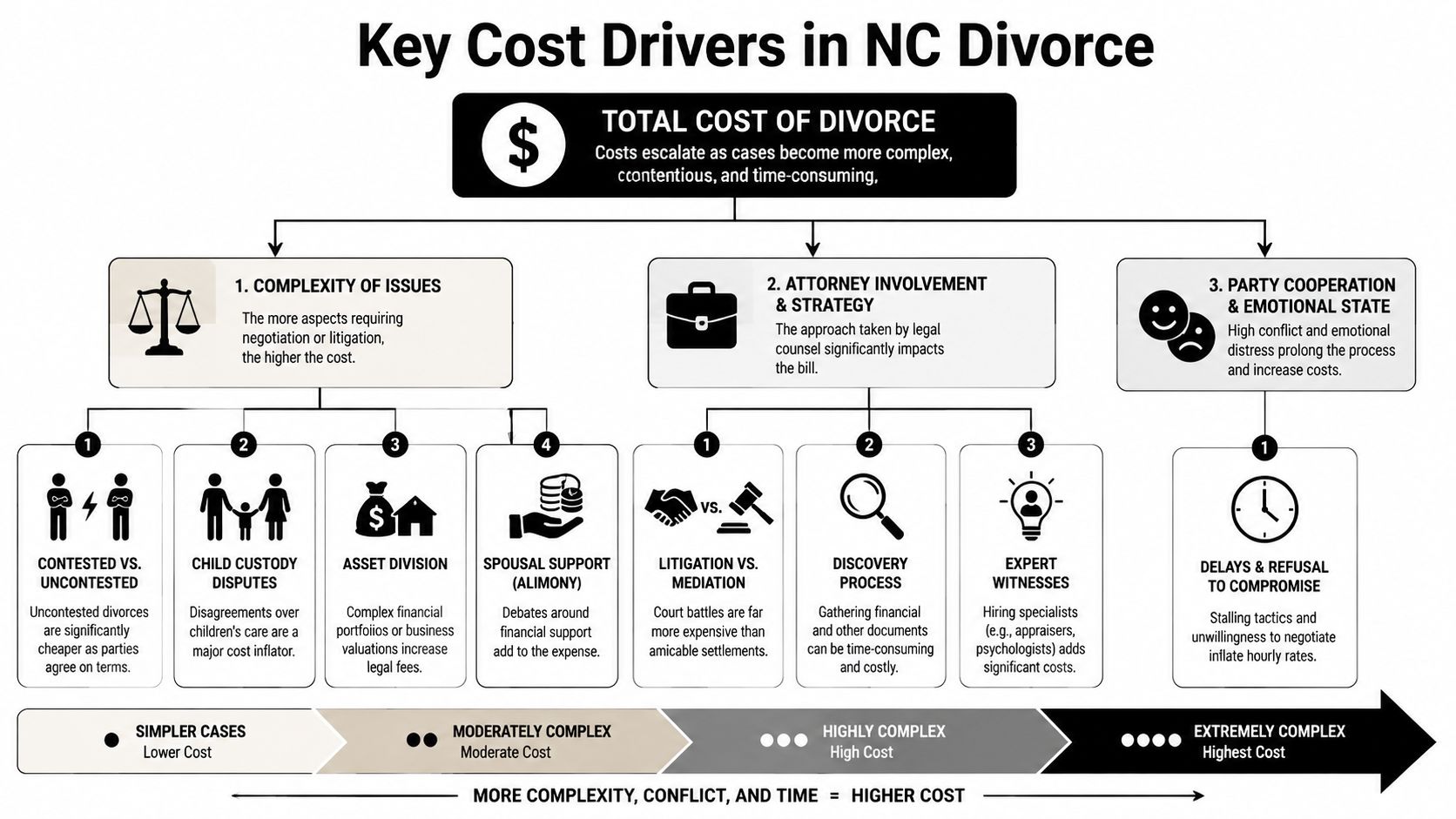
More issues means more legal work
Think of divorce costs like building a house. A basic structure is manageable. Custom features drive the final price. In a divorce, the "custom features" are disputed legal issues.
The most common cost drivers include:
- Child-related disputes about custody or support. These tend to generate repeated negotiations, detailed scheduling disputes, and urgent motions.
- Property division problems when spouses disagree about what is marital, what is separate, or how assets should be valued.
- Spousal support disputes when one party seeks support and the other contests need, amount, or duration.
- Procedural battles such as motions, discovery fights, and hearing preparation.
Complexity is different from hostility
A respectful couple can still have an expensive divorce if they own complicated assets. A hostile couple with few assets can also generate large fees by fighting over every exchange.
Here is a common real-world pattern. One spouse owns a business interest, the other doesn't trust the reported income, and both want a larger share of the marital estate. Even if the parties are otherwise cooperative, that one issue can require document requests, financial review, settlement conferences, and sustained attorney analysis. The case becomes expensive because the issue is complex, not because someone raised their voice.
Cost warning: When one unresolved issue controls the outcome of property division or support, it tends to pull the entire case into a more expensive process.
Strategy choices matter too
Not every dollar of divorce cost comes from the facts. Some comes from the approach. A narrowly targeted strategy can reduce expense. A reactive strategy often increases it.
What usually drives fees up:
- Using your lawyer as your primary emotional outlet instead of using therapy, trusted family, or other support
- Sending documents in fragments over weeks instead of organized batches
- Arguing over low-value issues while ignoring the major financial questions
- Waiting too long to define goals for parenting, housing, and property
What usually helps:
- Clear priorities
- Prompt financial disclosure
- Willingness to narrow the dispute
- Careful use of court, rather than treating court as the first answer
How the North Carolina Divorce Timeline Impacts Your Budget
A spouse moves out in January. By March, one side wants temporary support, the other wants a custody schedule, and both are worried about who will keep the house. Clients are often surprised to learn that the legal spending can start long before anyone is eligible to file for absolute divorce.
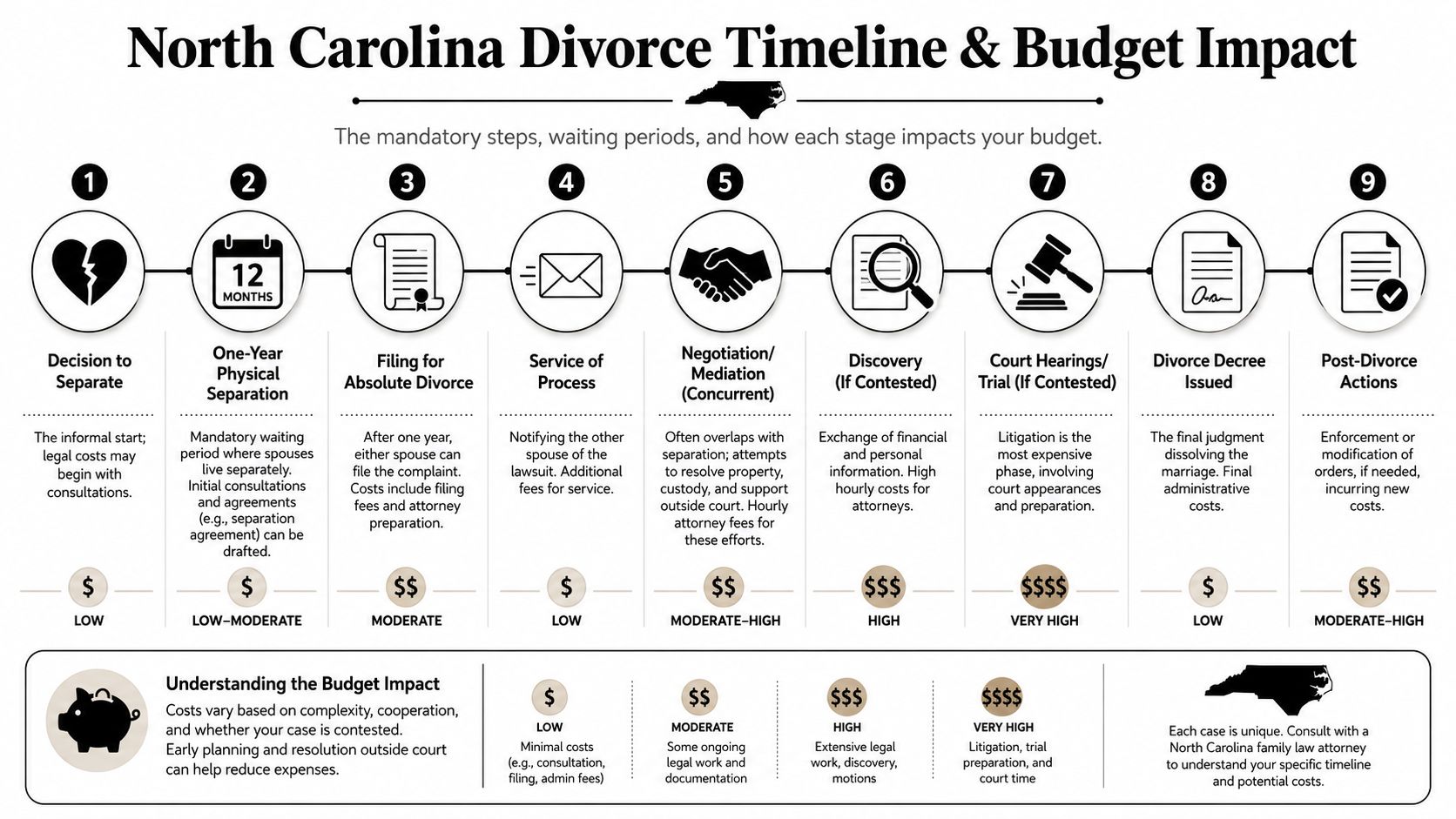
The one-year separation rule is only part of the story
North Carolina has a waiting period for absolute divorce. That rule is real, but it does not put the financial side of the case on hold. Claims involving equitable distribution, postseparation support, alimony, custody, and child support can begin during the separation period, and those claims often drive the majority of the cost.
This creates a two-track cost system in North Carolina.
- Track one: the absolute divorce that ends the marital status
- Track two: the separate claims for property, support, and parenting issues that can start earlier and usually require more attorney time
That distinction matters because many people budget for the filing fee and a short court process, then get hit with the actual expense of the case: valuing assets, reviewing income, preparing financial affidavits, negotiating temporary arrangements, or appearing in court on support or custody disputes.
Delay can be expensive, even before the divorce is filed
I regularly see the same budgeting mistake. A spouse assumes, "We have to wait a year anyway," so they postpone legal advice and do nothing structured during the separation period. Meanwhile, the other spouse files claims, controls the pace of the case, or locks in a temporary arrangement that becomes harder and more expensive to change later.
The waiting year should be treated as planning time, not idle time.
If you want a clearer sense of the sequence, this guide to the divorce timeline in North Carolina shows where costs often start before the final divorce decree.
What the timeline means for your budget in practice
The absolute divorce itself is often the simpler piece. The expensive work usually sits around it.
For example, if the only goal is ending the marriage after the separation period and there are no contested claims, costs may stay relatively controlled. If one spouse needs support during separation, or if there is a house, retirement accounts, a business interest, stock compensation, or a custody dispute, the budget changes fast because those issues require analysis, negotiation, drafting, and sometimes hearings.
A practical budget should account for both phases:
- the later cost of obtaining the absolute divorce
- the earlier and often larger cost of resolving property, support, and parenting claims
That is why timing decisions affect legal fees. Early review can help you preserve claims, avoid preventable emergency filings, and decide whether a negotiated separation agreement will cost less than litigating each issue separately.
Use the separation year strategically
The clients who usually spend more are not always the most combative. Often, they are the ones who wait too long to identify the underlying issues.
During the separation period, use the time to gather account statements, mortgage information, debt records, retirement documents, business records if applicable, and proof of income. Decide which problems need court intervention and which can be resolved by agreement. In many cases, that work reduces duplicate attorney time later because your lawyer is not rebuilding the file under deadline pressure.
One more point matters here. Absolute divorce can affect other rights if it is handled without attention to the related claims. Filing for the divorce itself may be straightforward, but the surrounding strategy is not always simple. If you need the procedural steps, How to File for Absolute Divorce in North Carolina explains that process.
Actionable Strategies for Managing Your Divorce Costs
You can't control every part of a divorce. You can control more of the bill than is commonly understood. The goal isn't to be cheap at the expense of your rights. The goal is to spend deliberately.
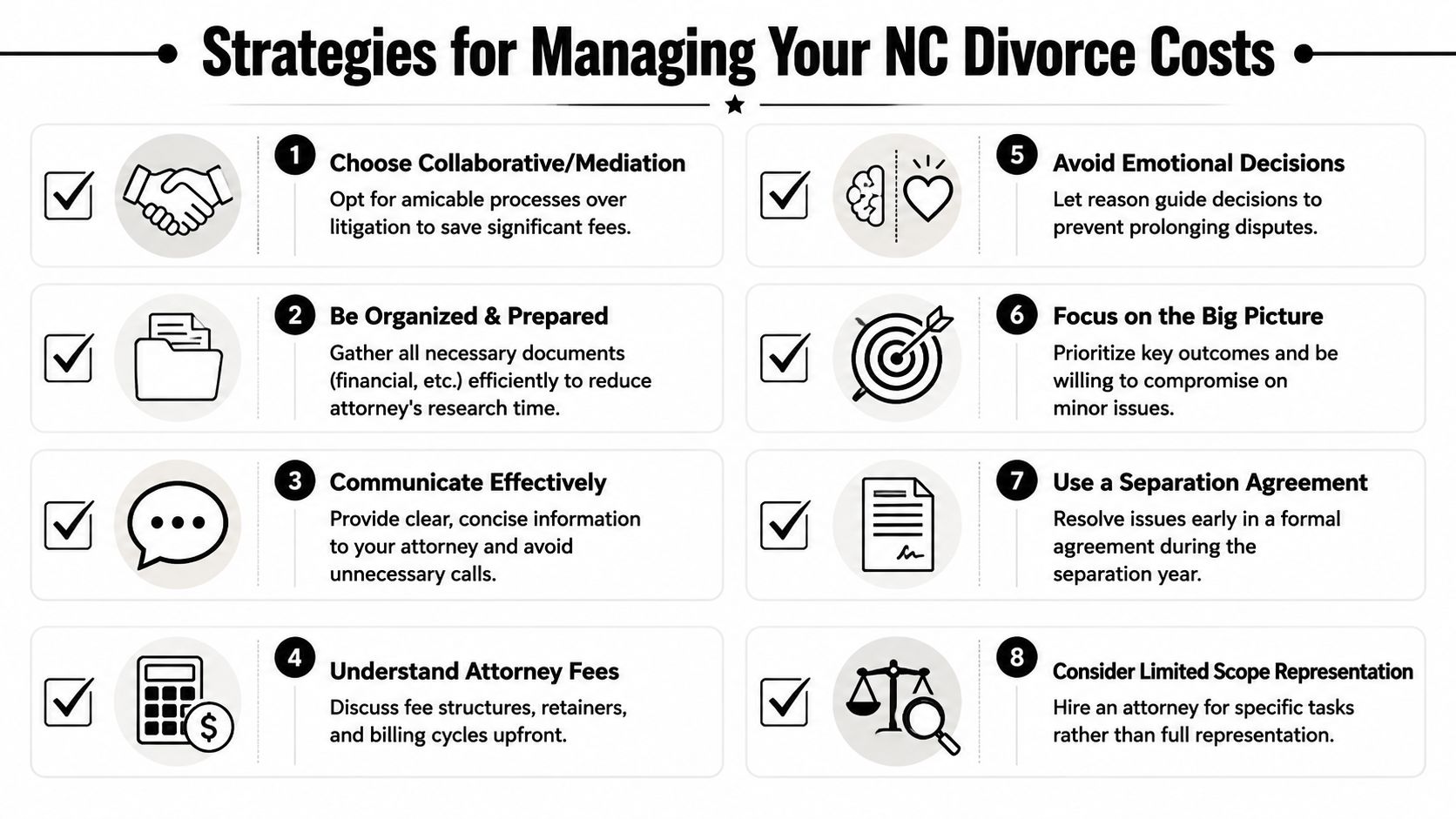
Practical ways to reduce avoidable fees
Gather documents before the first strategy meeting. Bring tax returns, pay information, bank records, debt information, real estate documents, and any existing agreements in an organized set. Lawyers spend less time reconstructing your finances when you provide a clear starting point.
Separate legal goals from emotional goals. If your objective is security, parenting time, or a fair division of assets, say that directly. If the objective is to punish the other spouse, costs usually rise fast and outcomes often disappoint.
Use your lawyer for legal judgment, not every minor frustration. Save the legal budget for legal questions, negotiations, drafting, and court preparation.
Decide what matters. Some points deserve a fight. Many don't. A focused client is cheaper to represent than a client who wants to contest every sentence in every draft.
A mediated process is often worth considering when both parties can negotiate in good faith. This overview of divorce mediation in North Carolina explains that option in more detail.
Process choices that often save money
The most effective cost-saving move is often procedural, not emotional. If a separation agreement can resolve property, support, or parenting issues during the waiting period, that can prevent later litigation. If limited-scope legal help fits the situation, that can also reduce costs while still getting important tasks done correctly.
This video offers a practical overview of divorce cost concerns many North Carolina families have:
What does not usually save money
People sometimes try to save money by delaying advice, hiding problems from counsel, or using generic forms for a case that involves children or property disputes. Those choices often create corrective work later.
Spend early on clarity if clarity prevents larger mistakes later.
Frequently Asked Questions About NC Divorce Costs
Does the person who files for divorce have to pay all the fees
The person who files usually pays the filing-related costs to start the case. That doesn't mean that person automatically pays every cost connected to the overall dispute. Attorney's fees and related expenses often depend on the claims involved, the court's orders, and how the case proceeds.
Can I get divorced in North Carolina for just the filing fee
Sometimes, but only in a very narrow case. If you're asking only for an absolute divorce and handling the matter without significant attorney work or related claims, the baseline public cost can stay relatively low. Once disputes over custody, support, or property enter the picture, the filing fee stops being the main expense.
Is mediation always cheaper than going to court
Not always, but it often is when both parties are prepared and willing to negotiate seriously. Mediation doesn't help much if one spouse refuses to exchange information, delays every decision, or treats the process as a preview of trial. The savings come from reducing hearings, motions, and trial preparation.
Who pays for attorney's fees in a North Carolina divorce
There's no universal rule that one spouse always pays the other's lawyer. In some matters, fee issues can be argued and decided under North Carolina law. In many cases, though, each party should assume they may need to fund their own representation unless a statute or court order changes that result.
Get a Clear Financial Path for Your North Carolina Divorce
If you're asking how much does divorce cost in North Carolina, the honest answer is that the cost depends on scope, timing, and process. A simple absolute divorce can stay close to the lower end of the spectrum. A case involving custody, support, property disputes, and trial preparation can become far more expensive.
The most useful question isn't just "What does divorce cost?" It's "What kind of divorce case do I have?" If the primary issue is a two-track case involving separation-year claims, your budget needs to reflect that from the start. If the primary issue is paperwork and filing only, the path may be much simpler.
Good planning reduces uncertainty. It helps you identify where money should be spent, where compromise makes sense, and where a short-term saving could create a long-term loss. That is especially true in North Carolina, where the waiting period and related claims can create cost pressure long before the final decree is entered.
A consultation should give you more than a vague estimate. It should give you a framework. You should leave knowing which claims matter, what process fits your situation, and what choices may increase or reduce your legal costs.
If you live in North Carolina and want a clearer picture of what your divorce may cost, schedule a consultation with the Law Office of Bryan Fagan. A focused case review can help you identify whether you're dealing with a simple absolute divorce, a two-track separation-and-support matter, or a more complex property or custody dispute, so you can make decisions with a realistic financial plan.