
Life changes, and what worked for your family last year might not be what’s best for your child today. To modify a custody agreement in North Carolina, you must first prove that a “substantial change in circumstances” has occurred since the last court order was signed. This isn't about a minor disagreement or a simple scheduling conflict. We’re talking about a significant shift in your family’s situation that directly impacts your child's well-being and makes the old arrangement unworkable.
What Qualifies as a Substantial Change in Circumstances in NC?
A custody order that was perfect for a toddler might be completely impractical for a teenager. North Carolina courts understand this. However, they place a high value on stability for children, which is why the law prevents parents from returning to court for every small issue.
Before a judge will consider your proposed new schedule, you must clear a critical legal hurdle established by North Carolina General Statute § 50-13.7. The parent requesting the change must prove two things:
- There has been a substantial change in circumstances affecting the child's welfare.
- The requested modification is in the child's best interest.
This first step is non-negotiable. If you cannot demonstrate a substantial change from the outset, the court will likely dismiss your case without ever reviewing the details of your request.

Real-World Examples of Substantial Changes
Legal definitions can feel abstract. Let’s break it down with some real-world scenarios that North Carolina courts often recognize as valid reasons to modify a custody order.
A classic example is a parent's relocation. Let's say the parent with primary custody accepts a new job three hours away in Raleigh. A move of that distance makes the current weekend visitation schedule impossible. This isn’t a minor inconvenience; it fundamentally alters the parenting plan and qualifies as a substantial change.
Another common reason centers on the child's changing needs. For instance, a child who develops a serious medical condition requiring specialized care near one parent’s home, or a teenager who needs to attend a specific school for a learning disability, presents a clear substantial change. The old schedule no longer supports the child’s new reality.
When Lifestyle Changes Become a Legal Concern in North Carolina
Sometimes, the changes involve a parent's personal life or stability, raising direct concerns for a child’s safety and well-being.
A substantial change isn't just about what has changed for the parents; it's about how that change affects the child. The court's focus will always be on the child's world and whether the current order still serves their best interests.
Consider these scenarios:
- Unstable Work Schedule: A parent who previously worked a standard 9-to-5 schedule now works unpredictable overnight shifts, leaving a young child with various babysitters. That level of instability can constitute a substantial change.
- New Living Situation: If one parent moves in with a new partner who has a criminal record for violence or a history of substance abuse, this directly threatens the child’s safety and unequivocally creates a substantial change.
- Deteriorating Mental or Physical Health: A parent’s struggle with unmanaged substance abuse or a severe mental health crisis that prevents them from properly caring for the child is a textbook example.
The key is to draw a direct line from the change to its effect on your child. Simply disliking the other parent’s new partner is not enough. You must show how that person's presence or actions negatively impact your child. Understanding these complexities and how they affect the definition of primary physical custody can be challenging. Proving your case means gathering clear, compelling evidence that the situation is genuinely and significantly different than it was when the judge signed the last order.
Two Paths to Modification: Agreement or Court Action
After establishing a substantial change in circumstances, you have a choice. How you proceed will shape the cost, stress, and timeline of your custody modification. In North Carolina, you have two primary options: work with the other parent to reach an agreement or ask a judge to decide for you.
Making the right strategic choice here is critical. The path you take can mean the difference between an efficient, amicable update and a long, costly court battle.

Modification by Agreement: The Collaborative Path
By far, the best way to modify a custody order is to agree on the changes with the other parent. This approach keeps you and your co-parent in control of the outcome, rather than handing that power to a judge who doesn’t know your family or your children.
Working collaboratively allows you to create a customized solution that truly fits your child's evolving needs. This process is almost always faster, far less expensive, and helps preserve the co-parenting relationship—which is one of the most important things you can do for your child.
The strongest parenting plans are often the ones parents create themselves. When you agree on a modification, you're not just changing a schedule; you're reaffirming your commitment to cooperative co-parenting.
To make your new agreement official and legally enforceable, it must be formalized in a Consent Order. This is a legal document you both sign that details the new terms. An attorney then submits it to a judge for approval, and once signed, it replaces your old custody order with the full force of law.
Contested Modification: Taking Your Case to Court
Sometimes, agreement isn't possible. If you and the other parent are at an impasse about what's best for your child, or if communication has broken down, court action becomes your only option. This is known as a contested modification.
The legal process begins when one parent files a Motion to Modify Custody. This document formally asks a judge to change the current order and explains the specific reasons why—namely, the substantial change in circumstances that warrants the modification.
Once the motion is filed, it must be officially "served" on the other parent, putting them on legal notice. From there, your case moves through the court system, which can be a long road involving several steps:
- Discovery: A formal process where both sides exchange financial information, documents, and other evidence relevant to the case.
- Mediation: Before you can have a final trial, North Carolina requires parents in most custody cases to attend mediation to try and resolve the dispute.
- Hearings: You may have temporary hearings to resolve urgent issues while awaiting a final trial date.
- Trial: If mediation fails, a judge will hear testimony and review evidence from both sides before making a final ruling based on the child's best interests.
This path is inherently adversarial. It almost always involves higher legal fees, more time, and significant emotional stress for everyone—including your children.
Understanding the fundamental differences between these two approaches is key to making a sound decision. This table breaks down what you can expect from each path.
Comparing Consent Orders vs. Contested Modifications in NC
| Factor | Modification by Consent Order | Contested Modification (Court Action) |
|---|---|---|
| Control | Parents retain full control over the final outcome. | A judge makes the final decision for you. |
| Cost | Significantly lower. Usually limited to attorney's fees for drafting and filing. | Much higher. Involves fees for discovery, mediation, hearings, and trial. |
| Timeline | Fast. Can be finalized in a matter of weeks once an agreement is reached. | Slow. Can take many months, or even over a year, to resolve. |
| Stress Level | Low. Collaborative process focused on a common goal. | High. Adversarial process that can damage co-parenting relationships. |
| Process | Informal negotiation between parents (and their attorneys). | Formal court process with strict rules and procedures. |
| Outcome | A customized solution designed by the people who know the child best. | A resolution imposed by the court based on limited evidence presented at trial. |
Ultimately, the choice between cooperation and litigation depends entirely on your family’s unique circumstances.
Making the Right Choice for Your Family
Deciding whether to negotiate or litigate is a major strategic decision. Even if you feel a court fight is unavoidable, it is almost always worth trying to negotiate first. A simple conversation might reveal that you and the other parent are closer to an agreement than you realize.
For instance, a parent who needs to move for a great job opportunity could proactively offer a very generous summer and holiday schedule to the other parent. Addressing the other parent's concern about losing time before filing anything with the court can save thousands of dollars and months of anxiety.
Of course, in situations that threaten a child's safety—like domestic violence, substance abuse, or a parent's complete refusal to co-parent—filing a Motion to Modify immediately may be the only way to protect your child’s best interests. Knowing how both paths work allows you to prepare for what lies ahead and make the most informed decision possible.
Building a Compelling Case for Custody Modification
When you ask a North Carolina court to modify a custody order, your story matters—but your proof is what wins the case. A judge needs to see clear, organized evidence showing two things: that there has been a substantial change in circumstances and that your proposed new arrangement is truly in your child’s best interest.
Simply telling the judge that things are different won’t be enough. You have to show them. This means your case isn't built in the courtroom on the day of your hearing; it's built in the weeks and months leading up to it through strategic evidence gathering.
The Paper Trail: Gathering Your Documentary Evidence
The foundation of any strong modification case is documentation. These records give the judge a factual, unbiased look into your child’s life and the circumstances that have changed. Think of it as painting a picture for the court, where each document is a critical brushstroke.
Your focus should be on collecting records that directly support your claims. Key documents often include:
- School and Academic Records: Report cards, attendance logs, and emails from teachers can be powerful. They can clearly show if a child is thriving or struggling in their current situation. A sudden drop in grades after the other parent’s relocation, for example, is hard to ignore.
- Medical and Therapeutic Records: Notes and reports from doctors, counselors, or therapists are essential, especially if the request is tied to a child’s physical or mental health needs.
- Communication Logs: Keep a detailed, organized record of emails, texts, and co-parenting app messages. These logs can reveal a parent's unwillingness to cooperate, document concerning statements, or show a pattern of missed visitations.
The Human Element: The Power of Witness Testimony
While documents provide the "what," credible witnesses explain the "why." Testimony from neutral, third parties who have seen the situation firsthand can be incredibly persuasive. Judges give significant weight to observations from people who are focused on the child's well-being, not on taking sides.
Think about the people who interact with your child regularly and can speak to their behavior, their well-being, and any changes they’ve observed.
A teacher who can testify that a child has become withdrawn and anxious since the other parent’s new partner moved in provides a powerful, impartial perspective that a judge will take very seriously.
Potential witnesses aren't just about vouching for you; they're about providing context. They could be:
- Teachers or school counselors
- Therapists or pediatricians
- Coaches or daycare providers
- Trusted family members or neighbors who have witnessed specific, relevant events
It's not about how many witnesses you have, but the quality and relevance of what they have to say.
It's All About the Child's Best Interest
Every single piece of evidence you gather must connect directly back to the “best interest” of the child. This is the single guiding principle in every North Carolina custody decision.
Real-World Scenario: Let’s say a parent needs to relocate from Charlotte to the Research Triangle for a fantastic career opportunity. The current custody order is a 50/50 schedule. To build a winning case, that parent can’t just talk about their new job. They have to show how the move benefits the child.
Powerful evidence in this situation would include:
- School Comparisons: Detailed information on the highly-rated school the child would attend near the new home, contrasted with their current school.
- Community and Support: Brochures for extracurricular activities, information on local parks, and details about the community in the new neighborhood.
- Family Support System: Testimony from family members who live near the new location and can provide a strong, stable support network for the child.
This shift in focus—from the parent's needs to the child's benefit—is what convinces a judge. Over the past few decades, courts across the country have increasingly favored shared parenting. In North Carolina, this trend means that while modifications are common, the bar for proving they are necessary remains high. Success hinges on presenting strong, child-focused evidence. You can explore more about these evolving custody trends and their statistical backing.
Building a persuasive case is a methodical process. Every document, email, and witness statement must serve a clear purpose: to prove the substantial change and show, without a doubt, that your proposed modification is what’s best for your child.
Navigating the North Carolina Court Modification Process
Going to court can feel like a maze, especially when your kids are involved. But when you and the other parent can't see eye to eye on a custody change, the court system provides a clear, structured path to a solution. Knowing the roadmap for a contested custody modification in North Carolina makes the whole journey much less intimidating.
The process is built to be thorough, making sure any final decision is grounded in what's truly best for your child. Let’s walk through what to expect, from filing the first piece of paper to standing before a judge.
Kicking Off the Legal Process
Your journey starts the moment you or your attorney file a Motion to Modify with the clerk of court. This has to be done in the same county where your original custody order was issued. This legal document is your official request to the court, and it has to do two things very clearly: explain the substantial change in circumstances that has happened and detail why your proposed changes are in your child’s best interest.
Once filed, the Motion has to be legally "served" on the other parent. This isn't optional—you can’t just text them a picture of it. Service is typically handled by the local sheriff's department or a certified process server. This creates an official record that they received the documents, puts them on notice, and starts the clock for them to file a formal response.
What to Expect from Mandatory Mediation
Before you ever see the inside of a courtroom for a final hearing, North Carolina law requires you to try mediation. This is one of the most important—and often most productive—steps in the entire process.
Mediation is simply a confidential meeting run by a neutral professional whose only job is to help you and the other parent find some common ground. It's not about winning an argument. It’s a chance to have a real conversation about your child's needs without the pressure of a judge listening in.
- Who will be there? Just you, the other parent, and the mediator. In North Carolina, attorneys typically don't sit in on the session itself, which often helps parents communicate more directly.
- What if you reach an agreement? If you work things out, the mediator will write up a Parenting Agreement. Your lawyers will review it, and once everyone signs, it’s sent to a judge to become a legally binding Consent Order.
- What if you can’t agree? No problem. If you can't resolve everything, the mediator declares an impasse, and your case moves forward to the court calendar for a judge to hear.
Building a strong case, whether for mediation or court, requires solid evidence that tells the whole story.
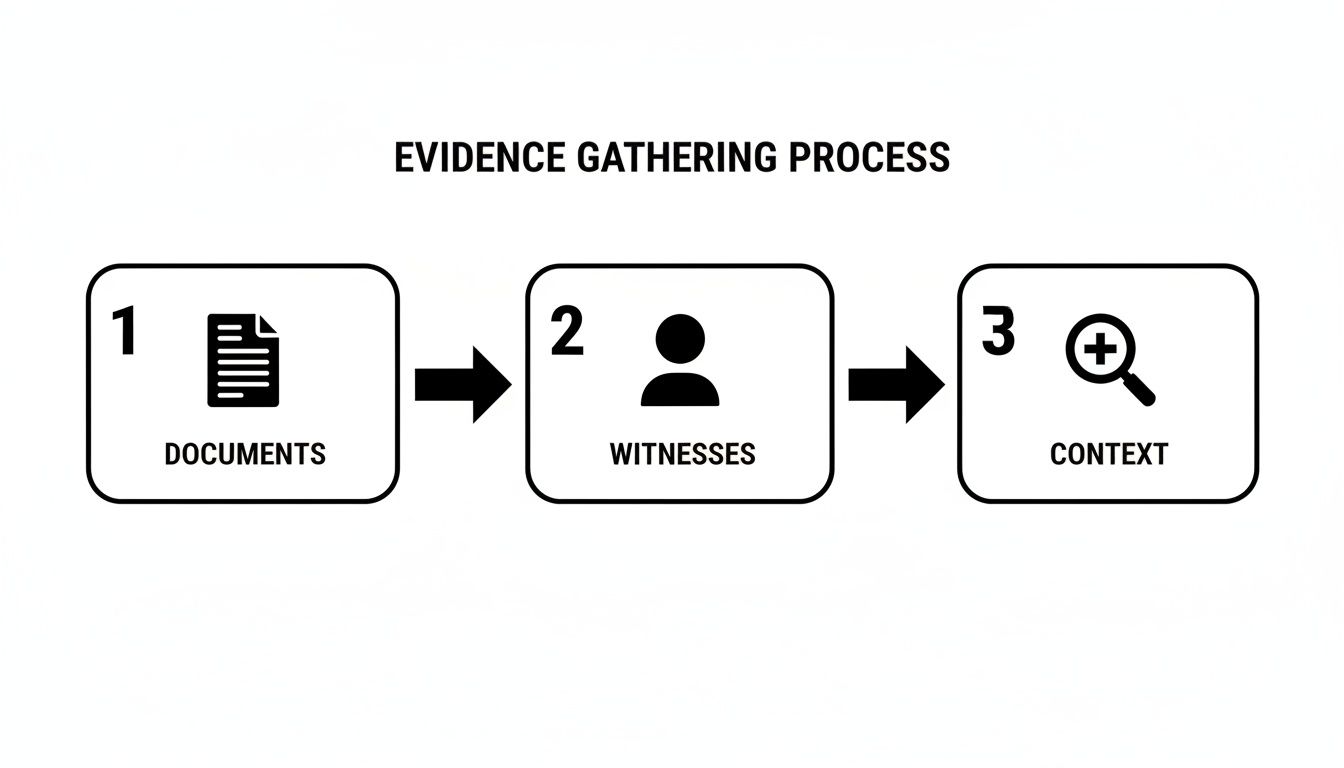
This is how you provide the context a mediator or judge needs. Strong documentation and witness testimony are the foundation of a successful modification request.
In the Courtroom: Temporary vs. Final Hearings
If mediation doesn't result in a full agreement, your case will head to court. You'll likely encounter two different types of hearings: a temporary hearing and a final trial.
A temporary custody hearing is a shorter, preliminary event. Its goal is to put a workable custody order in place while you wait for your final trial date, which can sometimes be months away. A judge will hear limited arguments and review key evidence to decide on a temporary schedule that serves the child’s immediate best interests.
The final trial is the main event. This is a full-blown evidentiary hearing where both you and the other parent present all your evidence, call witnesses to testify, and make your complete legal arguments. After hearing everything, the judge issues a permanent order that officially modifies your custody agreement for the foreseeable future.
In court, how you act is just as important as what you say. Always address the judge as "Your Honor." Speak calmly, stick to the facts, and avoid emotional outbursts or bad-mouthing the other parent. That kind of behavior only undermines your credibility.
Demonstrating that substantial change is the core of any modification case. In North Carolina, firms like the Law Office of Bryan Fagan are experienced in guiding families through the entire process, ensuring every argument is backed by facts. This parent-friendly approach aligns with evolving norms, and you can even see how shared custody trends are growing in Europe.
In particularly complex or high-conflict situations, the court might appoint a Guardian ad Litem (GAL). A GAL is an attorney appointed specifically to represent the child’s best interests. They act as the court’s investigator, interviewing everyone involved—you, the other parent, the child, teachers, therapists—and then make a formal recommendation to the judge. While the judge has the final say, a GAL’s recommendation carries a lot of weight.
How to Request an Emergency Custody Modification in North Carolina
When your child's immediate safety is on the line, you simply can't afford to wait for the standard court process to play out. North Carolina law provides a critical safety valve for these terrifying situations: an emergency custody modification.
This isn't a tool for minor disagreements or co-parenting frustrations. It is reserved for true crises where a child is in imminent danger.
The legal bar for an emergency order is extremely high. You must come prepared with credible evidence showing your child faces a substantial risk of bodily injury, sexual abuse, or being abducted or removed from North Carolina to evade the court's authority.
What Qualifies as a True Emergency?
A judge will only grant an emergency order under the most severe circumstances. Vague worries or disputes over parenting styles won't come close to meeting this strict legal standard.
Here are some real-world examples of situations that could warrant an emergency order:
- Credible Evidence of Substance Abuse: A parent is actively abusing drugs or alcohol in a way that directly endangers the child, like driving under the influence with the child in the car or leaving dangerous substances within reach.
- Severe Neglect: The child is being left without proper supervision, food, or necessary medical care, putting their health and safety at immediate risk.
- Threats or Acts of Violence: A parent has made credible threats of violence against the child or has a recent history of domestic violence that puts the child in the crossfire.
This is a serious legal action that demands strong, specific proof.
Filing for an Ex Parte Emergency Order
To get immediate protection, you will file a motion for an Ex Parte Emergency Custody Order. "Ex parte" is a legal term meaning the judge can hear from you—and grant the order—without the other parent being present or even knowing about the hearing yet.
Because this is such a powerful, one-sided action, the law places very tight restrictions on it. If a judge grants your ex parte motion, you will be given temporary custody on the spot.
However, an ex parte order is not the final word. The court is required by law to schedule a full hearing, typically within 10 days, where the other parent has the right to appear and present their side of the story.
This follow-up hearing is where the judge will decide whether to keep the emergency order in place, change it, or return to the previous custody arrangement. The burden of proof is on you to show why the emergency measures are still necessary. You can learn more about how temporary custody orders work in our detailed guide.
Successfully obtaining and keeping an emergency order requires a compelling and well-documented case that clearly demonstrates an immediate and substantial risk to your child.
Frequently Asked Questions About Modifying North Carolina Custody Orders
Can I stop paying child support if I file to modify custody in NC?
No. This is a critical point. Your child support order is a separate legal obligation from your custody order. You must continue to make all court-ordered payments until a judge signs a new order modifying your support obligation. Stopping payments can result in serious legal consequences, including being held in contempt of court. While custody and support are often related, they require separate legal actions to modify. Learn more about how a child support modification in NC works.
At what age can a child decide who to live with in North Carolina?
This is a common misconception. In North Carolina, a child cannot legally decide which parent they live with until they are 18. The final decision always rests with a judge, who is guided by the "best interest of the child" standard. However, the judge does have the discretion to consider the wishes of a child who is mature enough to express a reasonable opinion. There is no "magic age" where a child's preference becomes the deciding factor; the court evaluates each child’s maturity on an individual basis.
How much does it cost to modify a custody agreement in NC?
The cost varies dramatically based on one key factor: the level of conflict between you and the other parent. If you both agree on the changes (an uncontested modification), the cost is minimal—typically just court filing fees and an attorney's fee to draft and file a Consent Order. If you cannot agree (a contested modification), the costs will be substantially higher. A contested case involves attorney's fees for discovery, mediation, court hearings, and potentially a full trial.
Get Experienced Legal Help with Your North Carolina Custody Case
Trying to modify a custody order is more than a legal challenge—it’s about protecting your child's well-being and your relationship with them. The stakes are incredibly high, and you don’t have to navigate this complex and emotional process alone.
An experienced North Carolina family law attorney provides more than just legal knowledge. We bring strategic insight into how local courts interpret a substantial change in circumstances and what evidence is needed to build a compelling case. Our goal is to protect your parental rights and advocate effectively for your child’s best interests every step of the way.
If you are a North Carolina resident and believe your custody order no longer serves your child’s best interests, it's time to get clear, personalized advice on your legal options.
Schedule a consultation with the Law Office of Bryan Fagan to get the dedicated, strategic guidance you and your family deserve. Contact us today at https://bryanfaganlaw-nc.com.