When parents separate, the first urgent question usually isn't legal theory. It's simple and immediate. Where will the child stay tonight, next week, and until the court makes a final decision?
That's where a temporary custody order NC often becomes the most important first step. It gives the court a way to create short-term structure while the larger custody case moves forward. For many parents, that structure brings needed calm to a situation that feels anything but calm.
North Carolina families face this issue every day. According to the North Carolina Administrative Office of the Courts profile, custody cases occur at a rate of 18.4 per 10,000 residents annually, with over 18,500 new cases filed each year. That same statewide data also shows thousands of urgent matters involving temporary custody-related protective measures. If you're dealing with this now, you're not alone.
Navigating the First Steps in a North Carolina Custody Case
The first days of a custody dispute are usually messy. One parent may have moved out. School schedules may suddenly feel uncertain. Childcare, pickups, medical appointments, and overnight plans can turn into daily conflict when there isn't a clear court order in place.

A temporary custody order gives the court a way to stabilize that situation. It doesn't end the case. It creates rules that both parents must follow while the case is pending.
What most parents need right away
In practical terms, parents usually need answers to a handful of immediate questions:
- Housing stability: Which parent will the child primarily live with for now?
- Parenting schedule: When will the other parent have time?
- Decision-making authority: Who handles school, medical care, and urgent day-to-day decisions?
- Conflict reduction: What happens if one parent stops cooperating?
A temporary order isn't just paperwork. It's often the difference between a manageable routine and constant arguments.
The strongest early move is usually the one that creates order without overreaching. North Carolina judges tend to respond better to parents who focus on the child's routine, safety, and continuity than to parents who use custody filings to punish the other side.
Why timing matters early
Temporary orders often shape the path of the case more than people expect. If one parent waits too long to ask the court for structure, the other parent may settle into a status quo that becomes harder to undo. That's one reason fast, organized action matters.
At this stage, the court isn't looking for the parent with the best speech. The court is looking for the parent who can show a workable, child-focused plan.
What a Temporary Custody Order Does in North Carolina
A temporary custody order is an interim order entered while the custody case is still pending. In North Carolina, district courts have authority under N.C.G.S. § 50-13.5(c)(2) and (d)(2) to set temporary physical and legal custody arrangements until the case is finally resolved.
What the order can cover
A temporary order can address both major parts of custody:
- Physical custody means where the child lives and the parenting schedule, including overnights.
- Legal custody means who has authority to make major decisions about education, medical care, and religion.
That means a judge can set far more than a simple exchange schedule. A temporary order can decide who gets the child on school nights, how holidays are handled, and how parents share responsibility for important decisions.
The standard the court applies
The governing principle is the best interest of the child. That phrase sounds broad because it is broad. In practice, judges usually focus on stability, safety, routine, and each parent's ability to meet the child's daily needs.
A court will often look closely at issues like:
| Issue | Why it matters |
|---|---|
| Home environment | Judges want to know whether the child has a stable and appropriate place to live |
| Daily routine | Reliable school attendance, meals, sleep, and transportation carry weight |
| Parent involvement | Courts notice who handles homework, doctor visits, and ordinary care |
| Communication | A parent who can support reasonable co-parenting is often in a stronger position |
What parents often misunderstand
Many people assume a temporary order is informal or easy to undo. That's not a safe assumption. Temporary doesn't mean casual. It is a court order, and violating it can create serious problems.
Parents also sometimes think the temporary hearing is too early for the court to care about documents, witnesses, or preparation. That's a mistake. Even at the interim stage, judges are forming impressions about credibility, judgment, and whose plan seems more stable.
Practical rule: If you ask the court for temporary custody, treat that hearing like it matters, because it does.
Another common misunderstanding is that parents can create a private arrangement and skip court entirely. Sometimes parents can cooperate for a while, but if the agreement isn't formalized, enforcement becomes difficult. In contested cases, short-term certainty usually comes from a signed court order, not a text-message understanding.
Emergency Orders vs Standard Temporary Custody Orders
Not every urgent custody problem is an emergency in the legal sense. That's one of the biggest points of confusion in North Carolina family court.
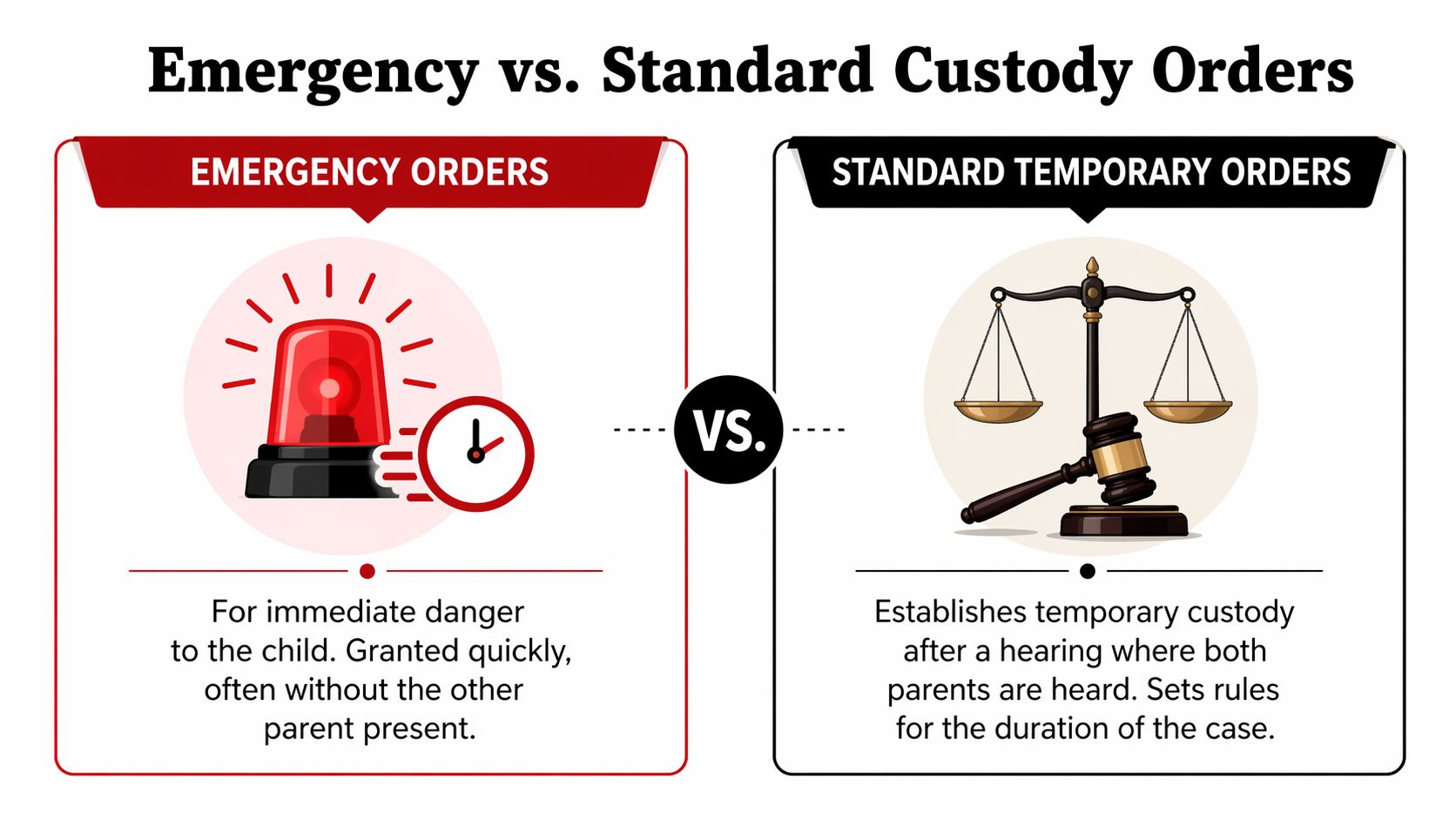
A parent may feel panicked, and that feeling may be completely understandable. But the court separates true emergency relief from a standard temporary custody request. The proof required is very different.
What counts as an emergency order
An ex parte emergency custody order is the rare form of relief. "Ex parte" means the judge may hear from one side first without the other parent present. North Carolina allows that only in narrow circumstances.
A child must face a substantial risk of bodily injury, sexual abuse, or abduction from the state for ex parte emergency relief to be available under North Carolina law, as described in this discussion of temporary child custody orders in NC.
These orders are short-lived. They often last no more than 10 days, and the court must then hold a follow-up hearing where both parents can present evidence. That limited duration is part of the due process balance. The law allows immediate protection, but not indefinite one-sided custody orders.
If your facts fit that standard, focused legal help matters quickly. A parent facing that situation may need guidance from an emergency custody lawyer in NC.
What a standard temporary order looks like
Most parents aren't dealing with ex parte facts. They're dealing with a serious dispute that still requires notice to the other side and a hearing. That's the standard temporary custody path.
A standard temporary order is usually appropriate when parents disagree over matters such as:
- Primary residence: Both parents want the child living with them most of the time.
- School stability: One parent's plan would disrupt attendance or routine.
- Safety concerns that need proof: There may be troubling behavior, but not the level of immediate danger required for ex parte relief.
- Decision-making conflict: Parents can't agree on medical care, school issues, or daily logistics.
The trade-off between the two paths
Emergency relief is faster, but much harder to get. Standard temporary relief is slower, but it's the route that fits most cases and gives both parties a chance to be heard.
A parent hurts their case by filing for emergency relief when the facts don't support it. Judges notice exaggeration. If the issue is serious but not legally immediate, a well-prepared standard temporary motion is usually the smarter strategy.
Courts reserve emergency custody for danger, not for ordinary parenting disputes wrapped in urgent language.
That distinction matters. Parents who understand it often make better choices from the start.
The Process for Obtaining a Temporary Custody Order
The process is usually less mysterious once you break it into steps. Most North Carolina custody cases follow a familiar path, even though local practice can vary by county.
Filing the case
A parent typically starts by filing a Complaint for Child Custody and, when immediate interim relief is needed, a motion requesting temporary custody. You may also see North Carolina court forms such as AOC-CV-609 used in the custody process.
The key point is that you are not merely telling the court you want custody. You are opening a formal civil case and asking a judge to enter enforceable orders.
For a broader overview of the filing side of this issue, this guide on how to get temporary custody is a useful starting point.
Service and notice
After filing, the other parent must be properly served. This step matters more than many people expect. If service is defective, your hearing can be delayed or challenged.
Don't rely on informal notice. A text saying "you know about court" isn't a substitute for proper service.
Mediation in North Carolina custody cases
North Carolina generally requires custody mediation in custody actions unless waived. That surprises many parents who expect to go straight into a courtroom fight.
Mediation can be frustrating if the relationship is tense, but it serves a purpose. It gives parents a chance to resolve at least some parenting issues before a judge has to decide everything. Even partial agreements can narrow the conflict.
Here is the practical sequence most parents encounter:
- File the custody complaint and temporary motion. The pleadings frame the issues and ask for relief.
- Complete service on the other parent. Without this, the case may stall.
- Attend court-ordered mediation if required. Some cases settle in whole or in part here.
- Prepare for the temporary hearing. This includes exhibits, witnesses, affidavits, and a clear parenting proposal.
A short explanation of the hearing process can help before court:
The hearing itself
Temporary custody hearings are often shorter and more focused than people expect. In many counties, hearings are scheduled relatively quickly, and the court may rely on affidavits and testimony to assess the child's immediate best interests.
That makes preparation critical. You need a concise theory of the case. Who has been handling the child's routine? What arrangement protects continuity? What documents support your position? What weaknesses will the other side try to exploit?
What works and what doesn't
What works is specific, organized evidence tied to the child's day-to-day life. What doesn't work is general character attack.
- Helpful approach: Bring school records, calendars, medical information, and a realistic parenting schedule.
- Unhelpful approach: Spend the hearing arguing that the other parent is selfish, rude, or difficult.
- Helpful approach: Show the court how your proposed order solves concrete problems.
- Unhelpful approach: Ask for extreme restrictions that the evidence doesn't support.
Judges hear a lot of anger in family court. They pay closer attention to structure than outrage.
Presenting Your Case Evidence and Legal Standards
A temporary hearing turns on proof, not assumption. The judge has to decide what arrangement serves the child's best interests based on the evidence available at that stage.
What judges want to see
North Carolina judges usually want practical evidence of stability, safety, and parental judgment. That means the strongest evidence often isn't dramatic. It's consistent.
Examples include:
- Affidavits: Sworn written statements can give the court a focused summary of important facts.
- Your testimony: You should be able to explain the child's routine clearly and calmly.
- Documents: School records, medical records, calendars, messages, and photographs can support your account.
- Witnesses: Teachers, relatives, counselors, or other adults with direct knowledge may help when their testimony is specific and relevant.
A judge is often asking a simple question beneath the legal language: which parent is more prepared to keep this child's life steady right now?
Why evidence succeeds or fails
Evidence helps when it connects directly to parenting ability. A clean, age-appropriate bedroom matters because it shows readiness to care for the child. Attendance records matter because they reflect consistency. Messages between parents matter when they show cooperation, refusal to co-parent, or threats to disrupt the child's routine.
For context on the broader legal framework, this overview of child custody laws in North Carolina provides a helpful summary.
Real examples of persuasive proof
Consider three common examples:
| Evidence | What it can show |
|---|---|
| School attendance records | Which parent has maintained daily consistency |
| Medical appointment history | Who handles healthcare and follow-through |
| Text messages about exchanges | Whether a parent is cooperative, evasive, or disruptive |
Bring evidence that answers the judge's question before the judge has to ask it.
Common mistakes at temporary hearings
Parents often damage good cases by overloading the court with irrelevant grievances. If the dispute is about who can provide a stable school-week routine, long arguments about old relationship problems usually don't help.
Another mistake is showing up with facts but no organization. A pile of screenshots is not a case theory. The stronger presentation groups documents by issue, explains why each item matters, and ties everything back to the child's needs.
Parents also underestimate demeanor. A judge notices who answers directly, who interrupts, and who appears more focused on the child than on revenge.
When a Temporary Order Becomes Permanent The Senner Test
This is the part many parents don't see coming. A temporary order can stop functioning like a short-term measure if the case sits too long without meaningful action.

What the Senner test asks
North Carolina case law uses what many lawyers call the Senner test to decide whether an order is temporary. As explained in this discussion of the court's test for temporary versus permanent child custody orders, an order is more likely to remain temporary if it does at least one of the following:
- States it is without prejudice
- Sets a clear future hearing date
- Leaves custody or visitation issues unresolved
If those features are missing, or if the parties let the order sit for an extended period without moving toward final resolution, the court may later treat it as permanent in substance.
Why that changes everything
That shift matters because the legal standard changes. If an order is treated as permanent, modifying it generally requires proof of a substantial change of circumstances affecting the child's welfare. That's a much harder burden than arguing over temporary arrangements in an open case.
In this context, strategy matters more than labels. An order can say "temporary" on the first page, but if nobody pushes the case forward, the practical risk grows.
A temporary order is safest when the record shows everyone understood it was interim and acted like it was interim.
The danger of inaction
Parents often make one of two mistakes.
The first is complacency. They accept a temporary arrangement because it's workable enough, then months pass and the order starts to look like the established status quo. The second is avoidance. They don't want another hearing, so they delay until changing the arrangement becomes harder.
The issue isn't only time on a calendar. It's also conduct. Did someone request a final hearing? Did the order reserve issues for later? Did the court clearly intend to revisit custody soon?
Practical steps to protect your position
If you don't want a temporary order to harden into a permanent one by default, take active steps:
- Read the language carefully: Look for "without prejudice" and any future review setting.
- Track the case: Don't assume the court will automatically move it for you.
- Request further hearing dates when needed: Silence can work against you.
- Keep building evidence: The case doesn't stop just because an interim order is entered.
This is one of the most overlooked parts of a temporary custody order NC case. Parents focus on winning the first hearing, then lose sight of the long game. That's risky.
Common Scenarios Involving Temporary Custody Orders
Custody law makes more sense when you look at how it plays out in real family situations. These examples are simplified, but they reflect issues North Carolina parents commonly face.
Domestic violence and immediate protection
A mother leaves the home after an assault allegation and takes the child with her. She is afraid the other parent will appear at school or demand the child back. In that setting, custody may intersect with a domestic violence protective order under Chapter 50B.
If the facts show immediate danger to the child, emergency relief may be appropriate. If the danger is serious but the legal standard for ex parte custody isn't met, a fast temporary hearing may still be the right route. The key is evidence. Police involvement, sworn statements, photos, and recent communications can matter.
A threatened relocation
A father learns the other parent plans to move the child out of North Carolina before the custody case is resolved. Not every move justifies emergency relief, but relocation can create serious urgency when it would disrupt school, daycare, medical care, and regular contact with the other parent.
In that situation, a temporary order can preserve stability while the court evaluates the longer-term custody issue. Judges often want to know whether the move is definite, how it affects the child, and whether the proposed plan protects the child's routine and relationships.
Parents often focus on whether a move feels unfair. Judges focus on how the move affects the child.
Grandparent or third-party intervention
Sometimes neither parent is functioning well. A grandparent may step in because one parent is struggling with substance abuse and the other is absent or unstable. Third-party custody cases have their own legal complications, but temporary relief can still matter if the child's daily care is in immediate question.
In those cases, the court usually wants detailed facts, not family conclusions. "The parents are irresponsible" won't carry much weight by itself. Specific examples of missed care, unsafe conditions, or abandonment are far more useful.
Mental health or substance-related instability
A parent may not be violent, but may be creating chaos through untreated mental health issues, active addiction, or repeated behavior that disrupts the child's routine. That may support a temporary order with structure, supervised conditions, or limited decision-making, depending on the evidence.
The strongest approach is usually measured. Ask for protections the evidence supports. Overreaching can distract from legitimate concerns.
Frequently Asked Questions About NC Temporary Custody
| Question | Answer |
|---|---|
| Can I get a temporary custody order without the other parent knowing first? | Only in narrow emergency situations. Ex parte relief is limited to cases involving substantial risk of bodily injury, sexual abuse, or abduction. Most temporary custody requests require notice and a hearing. |
| Do parents have to go to mediation in North Carolina custody cases? | In many custody actions, yes. Mediation is generally mandatory unless waived. Even when parents are far apart, mediation may narrow issues before the hearing. |
| Can a temporary custody order be enforced? | Yes. A temporary order is still a court order. If a parent violates it, the other parent may seek enforcement through the court. The exact remedy depends on the facts and the violation. |
| Can we just make our own temporary agreement? | Parents can agree informally, but informal agreements can be hard to enforce. If the conflict is serious, a signed court order usually provides much better protection and clarity. |
| How long does a temporary order last? | It lasts until the court replaces it, the parties resolve the case through an enforceable order, or the court treats the matter as moving toward final resolution. Delay can create strategic problems, especially under the Senner analysis discussed above. |
Secure Your Child's Stability with an Experienced NC Attorney
A temporary custody case moves fast, but its effects can last much longer than parents expect. The first hearing can shape the routine your child lives under for months. In some cases, inaction after that hearing creates even bigger problems, especially when a supposedly temporary order starts looking permanent.
Good custody strategy isn't about making the loudest accusation. It's about presenting a stable plan, supporting it with credible evidence, and keeping the case moving in the right direction. That includes understanding when emergency relief is appropriate, how to prepare for a temporary hearing, and how to avoid getting trapped by the Senner issue later.
If you're dealing with a temporary custody order NC matter, don't guess your way through it. North Carolina law is fact-specific, local court practices matter, and mistakes early in the case can be difficult to fix later.
Working with an experienced North Carolina family law attorney can help you protect your parental rights, present the right evidence, and seek an order that supports your child's safety and stability.
North Carolina parents don't have to manage a custody crisis alone. If you need guidance on a temporary custody order NC case, schedule a consultation with the Law Office of Bryan Fagan to discuss your options, your timeline, and the steps needed to protect your child's well-being.